
FIBC Bag Guide 2026: Types, Uses, Sustainability, and How to Choose the Right One
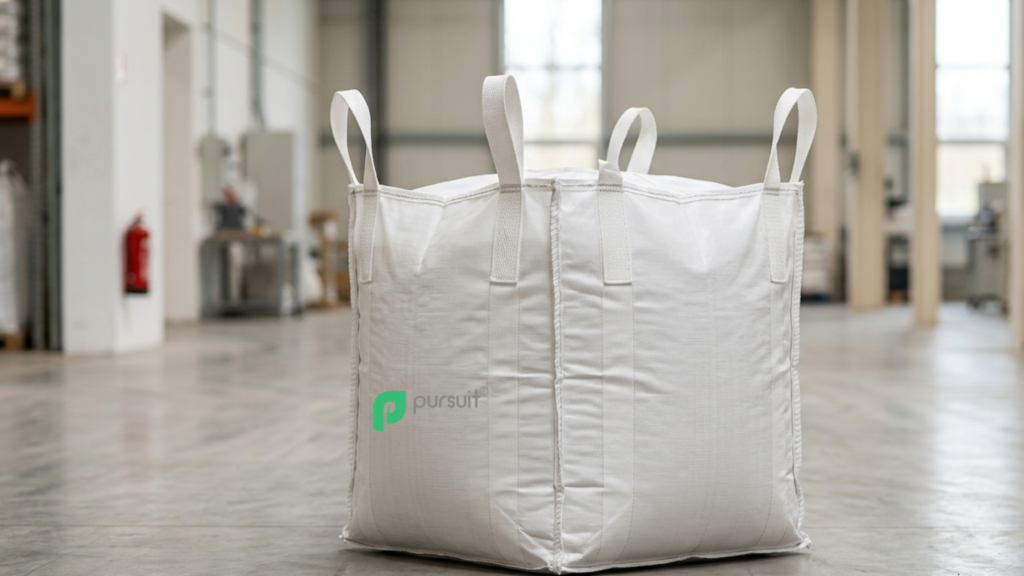
An FIBC bag (Flexible Intermediate Bulk Container) , also called bulk bag jumbo bag or big bag, is that industrial level flexible bag meant to store and move dry, flowable materials like sand , cement, grain, chemicals and fertilizers, typically from 500 kg up to more than 2000 kg.
It talks about the different types of FIBC bags, the 2026 trends that are showing up right now, and gives an easy guide you can follow to pick the proper FIBC bag for your own application.
What Is an FIBC Bag?
FIBC bag is a large, flexible and tough bag with square shape that is normally equipped with lifting loops at each corner, used to hold and carry bulk dry materials.
FIBCs can be called any of these interchangeably:
- Bulk bag
- Big bag
- Jumbo bag
- Super sack
- Tote bag (industrial context)
- Flexible Intermediate Bulk Container (the formal industry term)
Most FIBC bags are made from woven polypropylene (PP) fabric, with a load potential that sits around 500kg to 2200kg or so, and they’re used in agriculture, chemicals, building work, food processing, pharmaceuticals, and mining areas.
The 4 Main Types of FIBC Bags
With flammable or combustible powders, FIBC bags come in four types depending on their ability to resist static electricity.
Type A — Standard woven polypropylene with no static protection. For non-flammable, non-combustible products like sand, gravel and construction aggregates. This is the most typical and affordable type.
Type B — Similar fabric to Type A but with a low breakdown voltage rating to prevent propagating brush discharges. Used for materials with combustible dust hazards, though not for flammable solvent vapors.
Type C (Conductive) — Woven with interconnected conductive threads that must be grounded during filling and emptying to safely dissipate static charge. Required for flammable powders and combustible dust in the presence of flammable vapors.
Type D (Dissipative) — Made with static-dissipative fabric that doesn’t require grounding, offering similar safety to Type C with simpler handling. Increasingly preferred in chemical and lithium-processing applications where grounding cables aren’t practical.
Industry data shows Type D bags are currently the fastest-growing segment, as lithium and chemical processors increasingly prioritize non-grounded safety solutions for sensitive material handling.
Common FIBC Bag Designs
Beyond static type, FIBC bags also vary by construction:
- U-Panel — Made from one piece of fabric for the body, offering strong load distribution.
- Circular (Tubular) — Woven in one continuous cylindrical piece, minimizing seams and bulging.
- 4-Panel — Four separate fabric panels stitched together, giving the most box-like, stackable shape.
- Baffle Bags — Internal baffle panels create a squarer shape, improving stability, pallet efficiency, and space utilization during transport.
What Industries Use FIBC Bags?
| Industry | Typical Use | Approx. Market Share |
|---|---|---|
| Chemicals | Polymers, fertilizers, specialty powders | ~30% |
| Agriculture | Grain, seed, fertilizer, animal feed | High volume |
| Construction | Sand, cement, gravel, dry mix | High volume |
| Food & Pharma | Bulk ingredients, powders requiring contamination control | Growing |
| Mining | Ore concentrates, minerals | Steady |
FIBC Bag Trends in 2026
The bulk bag industry is shifting fast. This year, the following points are actually changing, not simply buzzwords:
1. Recycled and bio-based materials are commonplace. Recycled-content polypropylene (PP) and rPET bags are gaining in tremendous momentum because of circular economy regulations such as the plastic registry in Canada and items like corporate commitments to sustainability. Large-scale conversion of post-consumer PET waste to durable bulk bags has been proven by manufacturers.
2. Smart FIBCs with IoT and RFID tracking are moving from niche to mainstream. Sensors embedded in bags now provide real-time location, fill-level, and condition monitoring — particularly for high-value or sensitive cargo like chemicals and pharmaceuticals.
3. Regulatory pressure is raising the technical bar. Updated alignment with UN GHS hazard classification standards means Type C and Type D bags with conductive yarns are now standard at chemical plants, pharmaceutical mixers, and lithium-ore processors, even at a 20–30% price premium over commodity bags.
4. The market is bifurcating. Commodity-grade bags compete almost entirely on price, while a high-value segment — built around certification, safety, and sustainability — is commanding premium margins. Procurement teams increasingly treat FIBC purchasing as a supply-chain risk decision rather than a basic commodity buy.
5. Automation is cutting production costs. Automated manufacturing lines can reduce production costs by up to 30%, though this requires workforce training to adopt effectively.
6. Market growth remains steady. In 2026 the global FIBC market is estimated to be worth approximately $9 billion and is expected to continue expanding at approximately 4.5 – 5% CAGR through the early 2030s, Asia-Pacific (particularly in China and India) being the leading region in terms of production and consumption.
How to Choose the Right FIBC Bag
- Identify your material’s hazard class. Flammable powders or combustible dust require Type B, C, or D — never Type A.
- Match load capacity to your handling equipment. Standard sizes are available from 500kg up to 2,000+kg; verify forklift, hoist or filling station is capable to accept safe working load (SWL).
- Choose a design based on stacking and storage. Baffle and 4-panel bags stack more efficiently in warehouses and shipping containers than circular bags.
- When you decide on coating and liners don’t just guess. If the openable bag is going to carry hygroscopic items , like fertilizer or food powder, then go with coated or laminated FIBCs so moisture doesn’t sneak in.
- Check certifications. There are food-safety certification bags for food products, and UN-rated bags required for hazardous goods.
- Take into account one trip versus multiple trips. Reuse bags are more expensive at the start, but save money on each use, and help to avoid waste in repeated deliveries.
FIBC Bag FAQs
What does FIBC stand for? FIBC basically means Flexible Intermediate Bulk Container, which is a large flexible bag for keeping and moving dry bulk material.
How much weight can an FIBC bag hold? Most FIBC bags hold between 500 kg and 2,000 kg, with some heavy-duty designs rated above 2,200 kg, depending on fabric strength and safety factor.
What is the difference between Type A, B, C, and D FIBC bags? Static electricity protection is the difference. Now for the static control categories: Type A won’t propagate brush discharge, Type B will resist the propagation of brush discharge, Type C will need grounding so static is dissipated safely, and Type D will dissipate static without needing grounding at all.
Are FIBC bags recyclable? Yes. Most FIBC bags use polypropylene, which is recyclable, and more and more buyers now choose recycled-content PP or PET fabric, to hit sustainability targets that keep getting stricter.
Can FIBC bags be reused? For many types of FIBC bags they can also be multi-trip bags and reused dozens of times if inspected for wear prior to each use. Single-trip bags are cheaper, but only meant to be worn once.
What are FIBC bags typically made from? Usually it’s woven polypropylene (PP) , and sometimes there are polyethylene liners too.
There can also be aluminum-foil laminates that act as a barrier, and more recently you’ll see recycled PP and PET fabrics getting used as well.
Key Takeaway
The FIBC Bag is one of the most affordable, most used products for bulk material transportation in the construction, agriculture, chemical and food manufacturing industry.
By 2026, when it comes to smart buying, it’s not just about the cost per bag, it’s about the type of static protection, recycled-content sourcing, and if smart tracking features are worth your supply chain investment.
