
Types of FIBC Bags: A Complete Guide to Type A, B, C & D
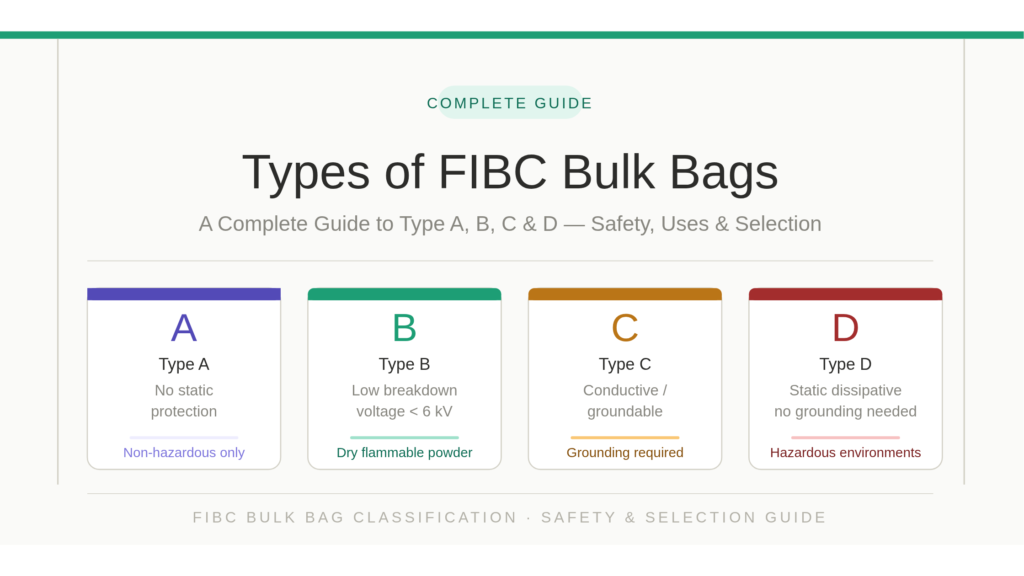
FIBC bulk bags are among the most efficient and cost-effective methods that can be used to store and transport bulk materials today.
These huge, pliable bags are employed in dozens of industries around the world, since agriculture to chemicals.
The thing is though not all FIBC bags are identical.
The wrong type may result in severe safety consequences, such as fire or explosion. This is why it is absolutely necessary to know the four main types of FIBC bags Type A, Type B, Type C, and Type D and only then make purchases.
In this guide, we will unravel all the information you have to know about each type, their specifications, their uses and how to select the right type to use depending on your needs.
What Are FIBC Bulk Bags? (FIBC Full Form & Meaning)
FIBC stands for Flexible Intermediate Bulk Container.
You might also know them by other names:
- Bulk bags
- Jumbo bags
- Super sacks
- Big bags
- Tonne bags
FIBCs are large bags of industrial strength fabricated of woven polypropylene. They are constructed to hold and convey dry, flowable substances – such as sand, grain, chemicals and powders – in amounts of 500 kg to 2,000 kg or above.
They are popular since they are:
- Cost-effective compared to drums or boxes
- Easy to handle with forklifts and cranes
- Reusable and recyclable
- Customizable in size, shape, and design
Why Does FIBC Type Classification Matter?
This is what most buyers do not take into consideration, FIBC bags can produce electricity.
Friction is generated when dry powders or granules move in and out of a bulk bag. This friction accumulate electrostatic charge within the bag.
Unless that charge is contained it can create a spark, and where there is flammable dust or gases the spark can start a fire or explosion.
It is precisely this reason why there are four types of FIBC bags A, B, C and D that are determined by the level of control of the static electricity.
Performance is not the only thing to consider when selecting the right type. It is a matter of safety.
4 Main Types of FIBC Bulk Bags (A, B, C & D Explained)
Type A FIBC Bags – Standard Non-Conductive Bulk Bags
What are they? FIBC bags of type A are woven polypropylene or other non-conductive material. They do not provide a form of protection at all.
Key Features:
- No antistatic properties
- No conductive threads or coatings
- Most basic and affordable type
- Lightweight and easy to produce
Type A bags should be used: Type A bags are not dangerous provided you carry non-flammable materials and there are no flammable solvents, gases, and combustible dust in the environment.
Safe: Sand, gravel, grain, rice, non-flammable powders, stones.
Not safe for: Flammable powders, chemicals, or explosive environments
Industries: Agriculture, construction, mining (non-hazardous materials)
Type B FIBC Bags – Low Voltage / Anti-Sparking Bulk Bags
What are they? Type B bags look similar to Type A bags — they are also made from plain woven polypropylene.
However, the key difference is that the fabric has a low breakdown voltage (less than 6 kV).
This implies that the cloth will not generate high-energy sparks which can cause an inflammable atmosphere.
Key Features:
- Constructed using fabrics with low breakdown voltage.
- Cannot dissipate static electricity
- Cannot be grounded
- No conductive threads
Important: Type B bags cannot prevent the build-up of static charge. They merely stop the high-energy sparks by the very fabric.
When to Use Type B Bags:
Safe for: Dry flammable powders (where no flammable gases or solvents are present)
Not safe for: Environments with flammable gases, vapors, or solvents nearby
Industries: pharmaceutical dry-powder, chemical powders, mineral processing.
Type C FIBC Bags – Conductive (Groundable) Bulk Bags
What are they? also known as conductive FIBCs or groundable bulk bags, type C bags are fabricated out of woven polypropylene fabric combined with conducting threads in an interwoven grid format.
These threads are interconnected and connected to a grounding point.
Key Features:
- Holds strands of conductive threads.
- Should be anchored when filling and discharging.
- Is able to safely release static electricity.
- Strapping or cable-grounding is needed.
Important Safety Measure: When using Type C bags, they should always be grounded.
When the grounding connection is not present, or lost, then the bag is hazardous – as unsafe as a Type A bag in a dangerous environment.
When to Use Type C Bags:
Safe: Flammable powder, chemicals, combustible dusts.
Safe when: Grounding is always up to date.
Not safe when: Grounding is disconnected or not verified
Industries: Chemical industry, pharmaceuticals, petrochemicals, food processing with flammable ingredients
Type D FIBC Bags – Static Dissipative / Antistatic Bulk Bags
What are they? The Type D bags are composed of antistatic or dissipative fabrics, which are special usually with a patented technology.
These clothes are not hazardous to the environment since they can discharge the static electricity in the atmosphere without the employment of a grounding wire.
This is what causes Type D bags to be the most advanced and convenient to use in hazardous conditions.
Key Features:
- No grounding required
- Uses static dissipative or antistatic fabric technology
- Safely neutralizes static electricity
- Suitable for flammable and explosive environments
When to Use Type D Bags:
Safe: Flammable solvents, gases in the area, powder.
Convenient: No grounding cables/connections required.
Contraindicated in case: Bag surface is contaminated with water, grease, or conductive material (decreases effect)
Industries: Petrochemicals, specialty chemicals, manufacturing of hazardous powders, pharmaceutical industries.
Quick Comparison Table – FIBC Type A vs B vs C vs D
| Feature | Type A | Type B | Type C | Type D |
|---|---|---|---|---|
| Static Protection | None | Partial | Full | Full |
| Grounding Required | No | No | YES (Must) | No |
| Flammable Dust Safe | No | Limited | Yes | Yes |
| Flammable Gas Safe | No | No | Yes | Yes |
| Relative Cost | Low | Low-Mid | Mid | High |
| Best For | Non-hazardous materials | Dry flammable powders | Hazardous with grounding | Hazardous, no grounding needed |
FIBC Bulk Bag Specifications You Should Know
Before buying an FIBC bag, understanding the basic specifications is important:
Safe Working Load (SWL): The maximum weight the bag is designed to carry safely. Common SWL values are 500 kg, 1000 kg, 1500 kg, and 2000 kg.
Safety Factor (SF): FIBC bags are built with a safety factor — usually 5:1 or 6:1. A 5:1 SF means a 1000 kg SWL bag can actually hold up to 5000 kg before failing.
Fabric Weight: Measured in grams per square meter (GSM) or ounces (oz). Common weights range from 100 GSM to 200 GSM depending on the application.
Coated vs Uncoated:
- Coated bags – include a polypropylene lining to keep the contents dry. Best with fine powders or delicate materials.
- Uncoated bags – More breathable. Perfect in use with products requiring ventilation such as grains and vegetables.
Types of FIBC Bags by Construction & Shape
In addition to the A/B/C/D, there are also differences in the physical construction of the FIBC bags:
U-Panel FIBC Construction
Constructed out of three fabrics with one U-shaped fabric piece serving as the bottom/two sides and two flat panels serving as the rest of the sides. These bags are durable, easy to keep shape, and are popular.
4-Panel FIBC Construction
Constructed out of four distinct panels that were sewed. These bags have sharp and defined edges and are optimal when it is necessary to have uniform shape when storing and stacking.
Circular / Tubular FIBC Construction
Constructed out of one continuous tube of woven material with no side seams. They are cheap, powerful and highly favored to use in general purposes.
Baffle FIBC Bags (Form-Stable Bags)
Inside baffle bags, there are internal panels (baffles) that are sewn at the corners. These baffles ensure that the bag is square in form even when it is full to enable it to be stacked more easily and the storage space to be used efficiently.
FIBC Bag Top & Bottom Styles
Top Inlet Options
- Open Top — Completely open, can be loaded with a conveyor or loader.
- Duffle Top — Has a dust control fabric jacket that can be bound together.
- Spout Top — Fill spout with less dust in control.
- Conical Spout Top — Funnel-shaped spout to fill without difficulty.
Bottom Discharge Options
- Plain Bottom — Sealed flat bottom, bag needs to be cut to release.
- Discharge Spout — Spout is a tube that allows flow of material to be controlled.
- Conical Discharge Spout — Wider cone shape to enhance discharge.
- Duffle Bottom — Like duffle top, worn loose.
Lifting Loop Options
- Corner Loop — Most popular, four-corner loops.
- Cross Corner — Loops are crossed diagonally to achieve better stability.
- Stevedore Straps — Large flat straps to be used with a forklift.
- Sleeve Lift — Single crane sleeve.
Industries & Applications of FIBC Bags
FIBC bags are applied in a diverse industry:
Agriculture & Fertilizers — Grains, seeds, fertilizers, animal feed
Chemical Industry — Industrial chemicals, resins, pigments, powders
Food-Grade FIBC Bags — Sugar, flour, starch, spices — made with food-safe materials and coatings
Pharma-Grade FIBC Bags — Active pharmaceutical ingredients, excipients — manufactured under strict hygiene standards
Construction & Mining — Sand, gravel, cement, minerals
UN-Certified Bags — For hazardous materials that require special certification for transport
Safe Handling Guidelines for FIBC Bulk Bags
Safe Use with Cranes, Hoists & Forklifts
- Always ensure that the SWL is checked before loading.
- Not to surpass the rated capacity.
- Lift with correct lifting equipment of the weight of the bag.
- Never drag or drop filled bags
- Check loops and seams prior to every lift.
Filling & Discharging Best Practices
- When using Type C bags – always ground before loading or emptying.
- Pack bags on flat, level surface.
- Do not over fill above rated capacity.
- When discharging, make sure the spout is well regulated.
- Maintain staff empty of bags during automated checkout.
Storing Empty & Full Bulk Bags Safely
- Keep empty bags out of the direct sunlight and moisture.
- Do not stack filled bags more than recommended height
- Check the bags that are stored frequently.
- Avoid acute objects and chemicals that could destroy the cloth.
How to Choose the Right FIBC Bag Type?
Use this simple checklist:
Step 1: What material are you storing? Is it flammable or combustible?
Step 2: Is there flammable gas, vapor, or solvent present in your environment?
Step 3: Can you guarantee a reliable grounding connection every time?
Step 4: What is your budget?
Quick Decision Guide:
- safe environment + non-flammable material → Type A.
- Combustible fine powder + lack of gases around it → Type B.
- Unsafe environment + grounding ensured → Type C.
- Unsafe environment + no grounding possible → Type D.
Frequently Asked Questions (FAQs)
What does FIBC stand for?
FIBC stands for Flexible Intermediate Bulk Container. They are also commonly called bulk bags, jumbo bags, super sacks, or big bags.
Which FIBC type is safest for flammable products?
Type C and Type D bags can both withstand flammable environment. Type C must be grounded, whereas Type D does not – so Type D is more convenient in most cases.
Do Type C bags always need grounding?
Yes, absolutely. Proper grounding of type C bags should be done during filling and discharge.
What is the difference between Type A and Type B FIBC bags?
Neither of the two is conductive, with Type B fabric having a lower breakdown voltage – i.e. it cannot generate high-energy sparks using its fabric. There is no such protection in type A.
Can Type D bags be used outdoors?
Yes, Type D bags can be used outdoors. Nevertheless, their surface has to be clean and denuded of water, grease or conductive contamination that can lessen their static dissipative characteristics.
What are the standard FIBC bulk bag specifications?
Standard specs include SWL (500–2000 kg), safety factor (5:1 or 6:1), fabric weight (100–200 GSM), and coated or uncoated options depending on the application.
How many types of FIBC bags are there?
The primary types of electrostatics are four A, B, C and D. Also, the bags are distinguished by the construction (U-panel, 4-panel, circular, baffle), as well as the top/bottom design.
Conclusion
The selection of the appropriate kind of bulk bag of FIBC entails one of the best decisions in bulk handling of material.
You want to move some non-hazardous grain with a simple Type A bag or you want to use a complex Type D bag to transport flammable chemicals safely, the difference between Type A, Type B, Type C, and Type D bags can make you make a better, more sensible, and more cost-effective decision.
Always ensure that you pair the bag type with your material, your environment and the conditions of handling. In case of doubt, refer to an expert manufacturer or supplier of FIBC.
