
FIBC Bags: The Complete Guide to Types, Specifications, and Bulk Bag Solutions
What Are FIBC Bags?
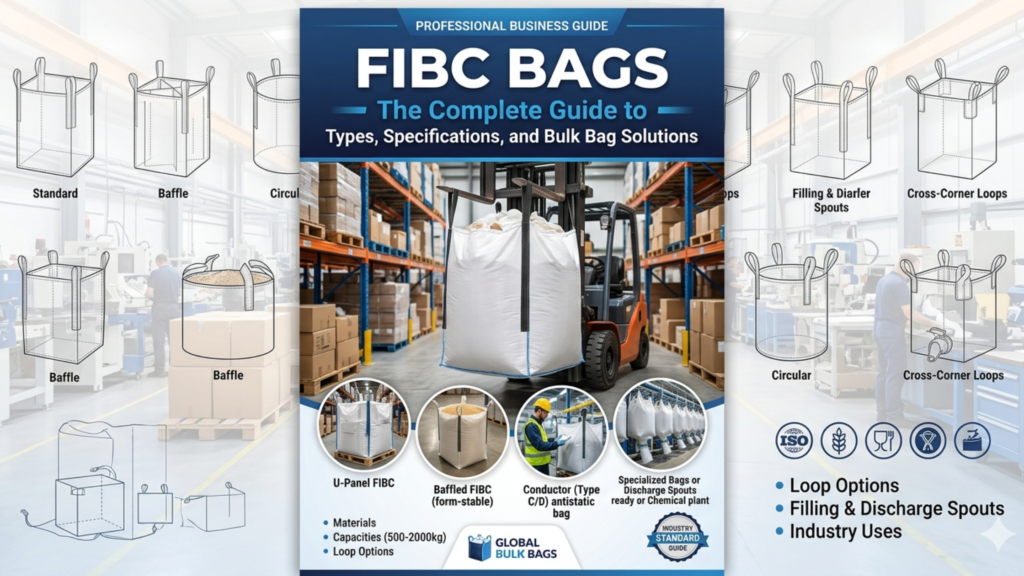
Flexible Intermediate Bulk Containers or ‘FIBC’ bags are large, industrial grade woven polypropylene bags designed to hold and carry bulk material from 500 to 2500 lbs. (227 to 1,134 kg) FIBC bags, also known as jumbo bags, bulk bags or big bags, are the standard packaging solution used in agriculture, mining, chemicals, food processing and construction for transporting dry, flowing materials.
To sum up: FIBC bags are the most economical, space-saving bulk material handling solution in the industrial industry.
FIBC Bag Key Facts
| Property | Typical Range |
|---|---|
| Capacity | 500 – 2,500 lbs (227 – 1,134 kg) |
| Material | Woven polypropylene (PP) |
| Loop Types | 1-loop, 2-loop, 4-loop |
| Safety Factor (SWL) | 5:1 or 6:1 |
| Top Options | Open top, spout top, duffle top |
| Bottom Options | Flat bottom, spout bottom, discharge spout |
| Certifications | UN, food-grade, anti-static (Type A/B/C/D) |
Types of FIBC Bags: Which One Do You Need?
The type of FIBC bags required will depend on the material to be handled, method of filling and applicable safety and/or regulatory considerations.
1. Standard FIBC Bulk Bags (Type A)
Normal PP woven bags without anti-static property. Suitable for non-flammable, non-hazardous dry goods such as sand, gravel, and fertilizers.
Best for: General construction, agriculture, non-hazardous powders
2. Type B FIBC Bags
Constructed from plain-woven polypropylene fabrics that prevent propagating brush discharges. Type B bags will not release static electricity, but will block the worst kind of discharge.
Not suitable for: If flammable solvents are present
3. Type C FIBC Bags (Conductive FIBC)
Made with interwoven conductive threads connected to grounding points. Must be grounded during filling and discharge to safely dissipate static electricity.
Best for: Flammable powders in the presence of flammable gases or vapors
4. Type D FIBC Bags (Dissipative)
Designed to ensure safe dissipation of static without the need for grounding. Safe and convenient storage facility for flammables.
Best for: Environments where reliable grounding is difficult or impractical
5. FIBC Baffle Bags (Q Bags)
Baffle bags have panels (baffles) stitched within each corner. It keeps the package square when filling, which means there is 20-30% more pallet space and a better stacking stability than with standard bags.
Ideal for: Fine powders, pellets and materials that need to be maintained in their cubic form during storage and transport
6. UN FIBC Bags
Tested and certified to UN standards for the transport of hazardous materials. Must pass drop, stacking, toppling, and tear tests.
Best for: Regulated hazardous dry bulk materials, chemical transport
7. Food-Grade FIBC Bags
Produced in controlled conditions with PP resin and liners that comply with the food industry standards. Clean from contaminants, lubricants and recycled materials.
Best suited for: Coffee beans, sugar, grains, spices, flour and other food commodities
8. Single-Loop and 2-Loop FIBC Bags
- 2-loop FIBC bags use two opposing loops, often preferred in markets where 4-loop systems are unavailable.
- Single-loop bags use one continuous loop for lifting — suited for specific crane or hook configurations.
FIBC Bag Specifications: What to Look For
Standard FIBC Bag Dimensions
FIBC bags are customized to customer specifications, but common standard sizes include:
- 35″ × 35″ × 40″ — Common US standard for 1-ton bulk bags
- 40″ × 40″ × 50″ — Larger capacity for agricultural products
- Custom sizes available from most manufacturers
FIBC Bag Weight and Load Calculation
Safe Working Load (SWL) is the rated capacity of the bag. Most industrial FIBC bags carry a 5:1 safety factor, meaning a 1,000 lb rated bag is tested to 5,000 lbs before failure.
FIBC Weight Calculation Formula:
Gross Weight = Net Weight of Goods + Tare Weight of Bag
Tare weight (empty bag weight) typically ranges from 3 lbs to 8 lbs depending on bag construction and size.
Area Calculation for Fabric:
Fabric Area = 2 × (Length × Width) + 2 × (Length + Width) × Height
This is used by manufacturers to price and source the correct amount of woven PP fabric.
Fill and Discharge Options
| Top Configuration | Best Use |
|---|---|
| Open Top | Manual filling with chutes or conveyor |
| Spout Top | Controlled filling with pipe connections |
| Duffle Top | Highest capacity, quick filling |
| Bottom Configuration | Best Use |
|---|---|
| Flat Bottom | Stable storage, pallet stacking |
| Spout Bottom | Controlled, gravity-fed discharge |
| Duffle Bottom (Spout + Cover) | Hygienic discharge for food/pharma |
What Are FIBC Bags Used For?
FIBC bulk bags are used in dry, granular or powdered material handling industries. The more common uses are:
Agriculture
- Grains, seeds, fertilizers, animal feed, coffee beans
Mining and Minerals
- Sand, gravel, silica, potash, ore concentrates
Chemicals
- Pigments, resins, plastics pellets, industrial salts
Food and Pharmaceutical
- Sugar, flour, spices, food additives (using food-grade certified bags)
Oilfield Applications
- Frac sand, drilling mud, bentonite, proppants
Construction
- Cement, lime, fly ash, aggregate
FIBC Bags vs. Other Bulk Packaging Options
| Factor | FIBC Bulk Bags | Rigid IBCs | Drums (55 gal) |
|---|---|---|---|
| Capacity | 500–2,500 lbs | 300–350 gal | ~400 lbs |
| Cost per unit | Low | High | Medium |
| Storage (empty) | Flat — minimal space | Large footprint | Large footprint |
| Reusability | Single or multi-use | Multi-use | Multi-use |
| Customization | High | Low | Low |
| Ideal for | Dry bulk solids | Liquids/slurries | Liquids/small dry goods |
Key advantage of FIBC bags: When empty, they fold flat — dramatically reducing return freight and warehouse storage costs compared to rigid containers.
FIBC Bags Manufacturing Process
Understanding how FIBC bags are made helps buyers evaluate quality and compliance.
- PP Tape Extrusion — Polypropylene granules are extruded into flat tapes
- Circular Weaving — Tapes are woven into tubular fabric on circular looms
- Lamination (optional) — Inner coating applied for moisture or dust protection
- Cutting and Sewing — Fabric cut to specification and stitched with UV-stabilized thread
- Loop Attachment — Lifting loops sewn to body with reinforced stitching
- Printing — Customer logos, hazard warnings, material details printed on panels
- Quality Testing — Load testing, drop testing, and inspection per ISO 21898 or UN standards
- Packaging — Finished bags baled or boxed for container shipment
How to Choose the Right FIBC Bag Supplier
When considering the best FIBC bulk bag manufacturers, ask yourself these questions:
- Is it verified that the bag meets ISO 21898 or equivalent?
- What is the safety factor — 5:1 or 6:1?
- Are food grade or UN certified available?
- What is the minimum order quantity (MOQ)?
- Do you offer custom printing, sizing and liner options?
- How long does it take you to deliver after you receive the order?
- Have some warehouses in the US, or it’s all import-to-order?
FIBC Bag Manufacturers in Georgia and South Carolina
US Southeast Buyers will benefit from regional sourcing and shorter lead times, as well as lower shipping costs.
Key manufacturing and distribution hubs:
- Hardeeville, SC — A major logistics hub, adjacent to major ports, for importers in the Southeast region of the country for FIBC.
- Savannah, GA — One of the largest US container ports; home to several FIBC distributors
- Georgia and South Carolina — well-positioned to serve manufacturing sectors along the coast and Atlanta and Charlotte.
Port-based suppliers of FIBC bags Georgia, FIBC bulk bags South Carolina and FIBC bag manufacturers near Savannah will have shorter lead times and per unit pricing, compared to inland suppliers.
FIBC Bags Price: What Determines the Cost?
FIBC bulk bag pricing varies based on several factors:
- Bag dimensions and capacity — Larger bags require more fabric and labor
- Construction type — Baffle bags and UN-certified bags cost more than standard bags
- Liner type — PE liners, aluminum foil liners, and form-fit liners add cost
- Safety rating — Type C and D anti-static bags carry a price premium
- Quantity — Larger orders (1,000+ units) significantly reduce per-unit cost
- Customization — Printing, special closures, and certifications add to base price
Typical price range: Standard FIBC bulk bags range from $4 to $20 per bag depending on the above factors. UN-certified and food-grade options typically start at $12–$25 per bag.
Frequently Asked Questions About FIBC Bags
What does FIBC stand for?
FIBC is also known as Flexible Intermediate Bulk Container. Described as large, woven polypropylene bags that are used to store and transport bulk dry materials, commonly known as bulk bags, jumbo bags and big bags.
What is the difference between a Type A and Type B FIBC bag?
Type A bags are standard PP bags with no electrostatic protection. Type B bags are constructed of low breakdown voltage materials which will prevent propagation of brush discharges but do not dissipate static.
Type B bags are safer to handle flammable powders than Type A bags, but should NOT be used in the presence of flammable solvents.
How much weight can an FIBC bag hold?
Standard FIBC bags are rated to hold between 500 and 2,500 lbs (227–1,134 kg). The maximum intended load is written on the bag label as the rated safe working load (SWL).
The 5:1 safety factor is applied in most industrial bags, a 1000 lb bag is tested for failure at 5,000 lb.
Can FIBC bags be reused?
Yes — some FIBC bags are single use; multi-trip bags have higher safety factors (usually 6:1) and are reinforced, designed to be used more than once.
Reuse is safe only if the bag has been checked for damage to the fabric, seams or lifting loops.
What is a baffle bag (Q bag)?
Baffle FIBC (bags) have internal baffles, which are panels sewn in the corners of the bag, which retain the square shape of the bag when it is filled.
This makes maximum use of pallets and increase the stability of the stacking than a traditional round corner bag.
Are FIBC bags food safe?
Food-grade FIBC bags are manufactured under controlled conditions using virgin polypropylene resin, without contaminants or recycled materials.
They are suitable for direct contact with food commodities including grains, sugar, coffee, and spices. Always verify food-grade certification before use in food applications.
What is the FIBC bag calculation for area and weight?
- Fabric area: 2(L×W) + 2(L+W)×H, where L=length, W=width, H=height
- Gross weight: Net material weight + tare weight of the empty bag
- Safe Working Load: Always match or exceed the intended load; never exceed the rated SWL
Where can I find FIBC bulk bags near me?
FIBC bulk bags are stocked by industrial packaging distributors across the US. The locations for key distribution are Savannah GA, Hardeeville SC, Houston TX, and Los Angeles CA.
Custom FIBC bags are available from many suppliers with a lead time of 4-10 weeks for overseas manufacturing or 1-2 weeks from inventory.
Key Takeaways
- FIBC bags play a fundamental role in bulk transport of dry material in agriculture, mining, chemicals, food and construction industry.
- Choose the right type (A, B, C, D, baffle, UN, food-grade) based on material properties and safety requirements.
- Specifications — dimensions, SWL, fill/discharge options, and liner type — should be matched to your process.
- Regional suppliers near Savannah, GA and Hardeeville, SC offer fast delivery for Southeast US buyers.
- Always verify certifications (ISO 21898, UN, food-grade) and safety factor (5:1 or 6:1) with your supplier.
Need the quotes for FIBC bulk bags, custom specifications and/or manufacturer referrals? Fill up the contact form or contact our team for the same day support.
Related Articles:
- FIBC Bag Liner Types: PE, Form-Fit, and Aluminum Foil Explained
- FIBC Bag Safety: UN Certification Standards Explained
