
Why Do FIBC Bags Have Different Loop Designs? Types, Uses & Lifting Configurations
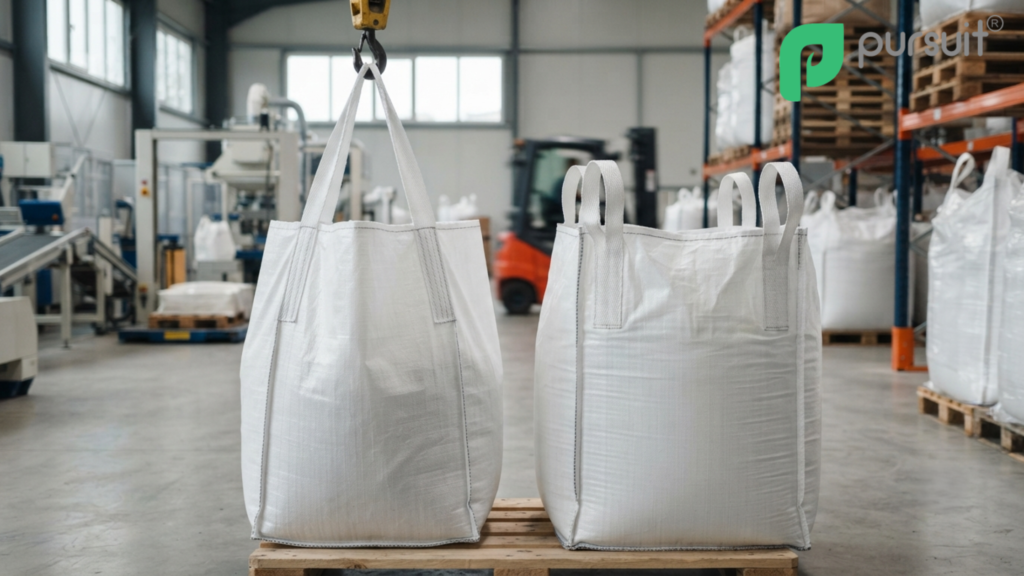
Flexible Intermediate Bulk Containers (FIBCs), or bulk bags as they are sometimes called, and jumbo bags are the materials used for the storage, handling, and transport of dry, flowable materials.
One of the most important components of an FIBC is its lifting loop. However, why do the loops in the bags made of FIBC vary in design?
There are various types of loops for FIBC bags. The lifting needs are dependent on the type of bag, the volume of the bag, lifting equipment, application, and operating needs.
Typical use is for 2-loop and 4-loop FIBC bags as well as when particular lifting equipment is used, all bags will be customised.
The correct choice of the loop configuration will ensure that the FIBC is suitable for the lifting and handling procedure.
What Are FIBC Bag Lifting Loops?
FIBC lifting loops are strong fabric loops attached to the bag’s body and used to lift and handle the filled container. They provide connection points between the FIBC and suitable lifting equipment.
Lifting loops vary according to the design of the bag. The selection will vary based on the method of lifting, bag capacity, handling equipment and application.
For manufacturers and buyers, lifting loops should be considered as part of the overall FIBC design rather than as a separate decorative feature.
Why Are There Different FIBC Loop Designs?
Different FIBC loop designs are used because FIBC bags are manufactured for a wide range of products, industries, and handling conditions.
Several factors influence the selection of lifting loops.
1. Handling Equipment
The available handling equipment is an important consideration when selecting an FIBC loop configuration.
Depending on the operation, bags may be handled using suitable lifting systems, forklifts, cranes, or other material-handling equipment.
The lifting configuration should be compatible with the equipment and the manufacturer’s handling instructions.
2. Bag Capacity and Construction
FIBCs are manufactured in different sizes and capacities. Their lifting system forms part of the overall bag construction and needs to be designed according to the intended application and specified load requirements.
The body fabric, seams, lifting loops, top, and bottom construction all work together as part of the finished FIBC.
3. Application Requirements
FIBCs are used across industries including chemicals, food ingredients, agriculture, construction, minerals, pharmaceuticals, and other industrial applications.
Each application may have different requirements for filling, transportation, storage, discharge, and handling. Therefore, the lifting configuration can vary according to the customer’s requirements.
4. Filling and Discharging Operations
Depending on the product and the process, the arrangement for filling and discharging may vary from one FIBC to another.
The lifting loop configuration must be considered in conjunction with the entire bag design to allow the bag to be handled correctly in the filling, storage, transport and discharge processes.
5. Customer-Specific Requirements
Some applications require customized FIBC specifications. Specific dimensions, loop configuration, filling inlets, discharge outlets, liners, fabric, printing or other specific feature can be specified.
That’s why there are various lifting loop designs that can be found for the different types of FIBCs manufactured by manufacturers.
Common Types of FIBC Loop Designs
The optimal lifting configuration will vary according to the specification of the bag and the handling requirements. Typically, two loop or four loop FIBC bags are used.
4-Loop FIBC Bags
A 4-loop FIBC bag has four lifting loops positioned as part of the bag’s lifting construction.
This configuration is widely used for industrial bulk handling applications where four lifting points are required. The loops can be designed to work with compatible lifting equipment according to the bag’s specifications.
A 4-loop FIBC can be manufactured with different top and bottom configurations depending on the product and application.
What Is a 4-Loop FIBC Bag?
The 4 loop FIBC bag is a bulk bag with 4 lifting loops that can be used to lift the bag at any four points. The type of lifting equipment and handling method must always be chosen in line with the manufacturer’s instructions.
2-Loop FIBC Bags
A 2-loop FIBC bag uses two lifting loops as part of its handling design.
For applications that need a two point lifting operation, this set-up may apply. Like other designs of FIBC, this configuration is only applicable to a specific application depending on the construction of the bag, the load to be carried, the lifting equipment used, and the use to which the bag is to be put.
What Is a 2-Loop FIBC Bag?
A 2-loop FIBC bag is a flexible bulk container manufactured with two lifting loops for handling and lifting. It is selected according to the specific requirements of the application and compatible handling equipment.
Other FIBC Lifting Configurations
In addition to standard 2-loop and 4-loop configurations, FIBCs can be designed with other lifting arrangements depending on customer requirements.
Examples can include:
- Corner loop configurations
- Cross-corner loop configurations
- Customized loop positioning
- Application-specific lifting arrangements
The exact configuration should be determined by the FIBC specification, handling process, and required equipment.
2-Loop vs 4-Loop FIBC Bags
Most buyers of FIBC bags ask which type of bag is more appropriate, a 2-loop or 4-loop bag.
No single configuration can be used for all applications. It should be related to intended handling procedure and technical requirements.
| Feature | 2-Loop FIBC | 4-Loop FIBC |
|---|---|---|
| Lifting loops | 2 | 4 |
| Lifting arrangement | Two-point | Four-point |
| Application | Application-specific | Common industrial applications |
| Equipment compatibility | Depends on handling system | Depends on handling system |
| Customization | Available | Available |
| Selection factors | Load, equipment and application | Load, equipment and application |
The number of loops alone should not be used to determine the suitability of an FIBC. The complete bag specification and intended handling method should be considered.
How to Choose the Right FIBC Loop Design?
The first step in choosing the proper FIBC loop configuration is to know how the bag will be utilized.
Before ordering: FIBC bags, think about the following:
1. Product Being Packed
When developing the complete specification of the FIBC the type and properties of the material being packed must be taken into account.
2. Required Capacity
Calculate the working loads and size of the bag for the intended use depending on the amount of the product.
3. Lifting Equipment
Identify the equipment that will be used to handle the filled FIBC and ensure that the selected loop configuration is compatible with the intended handling system.
4. Filling Method
Think about if the bag will be stuffed by hand or using an automated or industrial filling system.
5. Discharge Requirements
Design of bottom discharge and general construction of bag should be consistent with the application requirements.
6. Storage and Transportation
Think about the way the filled FIBC will be stored, moved, loaded and transported along the supply chain.
7. Safety Requirements
The FIBC should be produced, tested, labelled and handled in accordance with the relevant specifications and manufacturer’s instructions.
8. Customization Requirements
If the application is of a more specialized nature, consult with the FIBC manufacturer to discuss the dimensions, lifting loops, filling and discharge configurations, liner options, fabric options, and more.
Are FIBC Lifting Loops Customizable?
Yes, FIBC lifting loops can be incorporated into customized bag designs according to the application and required handling configuration.
Depending on the manufacturing specification, customers may request different loop arrangements along with other customized features such as:
- Bag dimensions
- Safe Working Load (SWL)
- Loop configuration
- Loop positioning
- Loop length
- Filling inlet
- Discharge outlet
- Inner liner
- Fabric construction
- Printing and labeling
A qualified FIBC manufacturer will be able to assist in selecting the correct configuration for the product, handling equipment and application needs.
FIBC Loop Design and Safe Handling
Lifting loops are a critical part of FIBC handling, so correct handling practices are important.
Before lifting an FIBC:
- Check the bag and lifting loops for visible damage.
- Follow the manufacturer’s handling instructions.
- Use suitable lifting equipment.
- Ensure the required lifting points are properly engaged.
- Do not exceed the specified Safe Working Load.
- Keep personnel away from suspended loads.
- Follow applicable workplace safety procedures.
The FIBC should always be handled according to its specified design and the manufacturer’s instructions.
FIBC Loop Designs for Different Industries
FIBC bags are used for a wide range of materials and applications.
Food and Food Ingredients
FIBCs are capable of being produced for appropriate food-related uses when the appropriate material, construction, cleanliness and regulatory requirements are fulfilled.
Chemical Industry
Depending on the chemical powder, granules, or other dry goods, the requirements for their properties and handling may warrant specially designed FIBCs.
Agriculture
Typically, the FIBCs are used for bulk agriculture products like grain, seeds, fertilizers and other dry products.
Construction and Minerals
Bulk bags are used to transport a variety of construction products, minerals and industrial powders.
Pharmaceutical Applications
Depending on the product requirements, the material, liners, cleanliness and handling can be carefully specified for pharmaceutical and related applications.
The suitable lifting and construction of the FIBC should be chosen for every application.
Important Components of an FIBC Bag
The lifting loops are only one part of a complete FIBC.
Other important components can include:
- PP woven fabric body
- Top filling inlet
- Bottom discharge outlet
- Lifting loops
- Seams
- Inner liner
- Printing and labeling
- Safety and identification information
These components are chosen and configured based on the product, capacity, filling process, discharge needs, transportation and handling.
How Does the Right FIBC Design Improve Bulk Handling?
A proper FIBC design can facilitate bulk material handling more in harmony with the customer’s operation process.
A properly specified bag can be designed around:
- The required product capacity
- Available handling equipment
- Filling and discharge processes
- Storage requirements
- Transportation requirements
- Product characteristics
- Customer-specific specifications
For this reason, selecting an FIBC should involve more than simply choosing a bag based on size. The lifting configuration and complete bag construction should also be evaluated.
Why Choose a Specialized FIBC Manufacturer?
Having a manufacturer that has experience can help the buyer discuss the entire bag specification before it is produced.
A manufacturer can help customers evaluate requirements such as:
- FIBC size and capacity
- Lifting loop configuration
- Fabric construction
- Filling and discharge options
- Liners
- Printing
- Application requirements
- Handling requirements
- Custom specifications
These details can be useful for bulk packaging applications to ensure the final FIBC is designed to the application.
Frequently Asked Questions About FIBC Loop Designs
What are the different types of FIBC bag loops?
The most common lifting configurations are 2-loop and 4-loop, as well as others that can be customized, like corner or cross-corner lifting.
The correct design will differ according to the specification of the bag, the handling equipment and application.
What is a 4-loop FIBC bag?
A 4-loop FIBC bag is a flexible intermediate bulk container manufactured with four lifting loops.
The four lifting points are designed as part of the bag’s overall handling system and should be used with compatible lifting equipment.
What is a 2-loop FIBC bag?
A 2-loop FIBC bag is manufactured with two lifting loops for handling and lifting. It is suitable for applications requiring a two-point lifting arrangement, subject to the bag’s specifications and compatible handling equipment.
What is the purpose of FIBC lifting loops?
FIBC lifting loops provide lifting points for handling the filled bulk bag with suitable equipment. Their configuration forms part of the overall FIBC design.
Are FIBC lifting loops customizable?
Yes. Depending on the use, handling equipment and customer requirements, FIBC bags can be produced with various lifting loop formations and with other customized specifications.
How do I choose the right FIBC loop configuration?
Before choosing a loop configuration, think of the bag capacity, product, handling equipment, filling and discharging, transportation, safety requirements and customer requirements.
Are 2-loop and 4-loop FIBC bags used for the same applications?
These may be applied to various bulk-handling applications depending on the type of bag, handling equipment, application and load requirements.
Can FIBC bags be designed for specific lifting equipment?
Yes. FIBC specifications can be developed around the intended handling system, provided the resulting design meets the applicable technical and safety requirements.
Can FIBC bags be customized for industrial applications?
Yes. FIBCs can be customized for factors such as dimensions, capacity, lifting loops, filling and discharge arrangements, liners, fabric construction, and printing.
FIBC Bags from Pursuit Industries
Pursuit Industries provides FIBC and bulk packaging solutions for industrial applications, with product specifications developed according to customer and application requirements.
From lifting loop configurations to bag dimensions, filling and discharge options, and other specifications, the right FIBC design starts with understanding how the bag will be used.
For specific application, discuss your product, handling equipment, capacity and desired bag specifications with the Pursuit Industries team if you are looking for FIBC bags for your specific application.
Looking for the right FIBC bag for your application? Contact Pursuit Industries today to discuss your bulk packaging requirements.
Conclusion
FIBC bags have different loop designs because bulk handling requirements vary from one application to another. 2-loop, 4-loop, and customized lifting configurations can be incorporated into FIBC designs depending on factors such as handling equipment, bag capacity, product requirements, filling and discharge processes, and customer specifications.
Rather than selecting an FIBC based only on the number of loops, buyers should consider the complete bag design and intended handling process. Working with an experienced FIBC manufacturer can help ensure that the lifting configuration and other bag specifications are aligned with the application’s requirements.
