
PP Woven Bags vs FIBC Bags — Which One Is Best for Bulk Packaging?
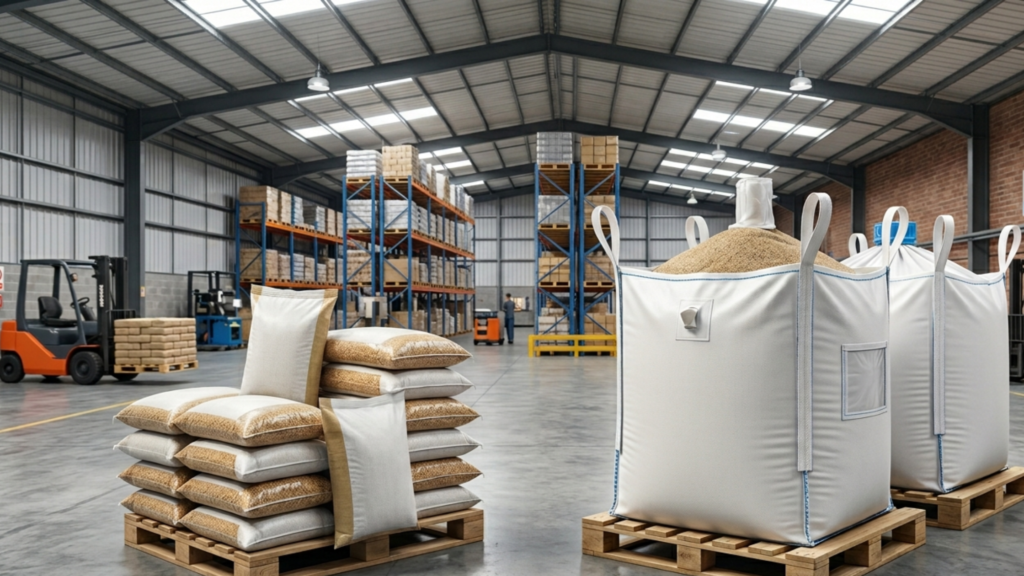
Choosing between PP woven bags and FIBC bags can be a difficult decision if you are in confusion about which to choose for bulk packaging.
PP woven bags should be chosen in case your requirements are of smaller to moderate sizes (5-50 kg). On the other hand, FIBC bags or Jumbo Bags are used in bulk packaging (500-2000 kg).
Here, we’ll explain the differences, benefits and ideal applications to help you get the right packaging for your needs.
What Is the Difference Between PP Woven Bags vs FIBC Bags?
When comparing PP woven bags vs FIBC bags, the main difference lies in capacity, durability, and application.
PP Woven Bags:
- Made from woven polypropylene fabric
- Lightweight and cost-effective
- Capacity: 5 kg to 50 kg
- Used for packaging grains, cement, fertilizers
FIBC Bags (Flexible Intermediate Bulk Containers):
- Large industrial bulk bags
- Capacity: 500 kg to 2000 kg
- Designed for forklift or crane handling
- Used in chemicals, construction, mining
In simple terms:
- PP woven bags = retail & small packaging
- FIBC bags = industrial bulk packaging
Which Bag Is Stronger — PP Woven or FIBC?
FIBC bags are significantly stronger due to:
- Higher GSM fabric
- Reinforced lifting loops
- Advanced stitching
The PP woven bag is durable enough for regular use but unsuitable for heavy loads exceeding 50 kg.
Cost Comparison — PP Woven Bags vs FIBC Bags
- PP woven bags → cheaper per unit
- FIBC bags → higher cost but lower cost per kg storage
If you calculate per ton packaging, FIBC bags are often more economical.
PP Woven Bags vs FIBC Bags — Which One Should You Choose?
Choosing between PP woven bags vs FIBC bags depends on your business requirements.
Choose PP Woven Bags if:
- You need packaging for retail distribution
- Your product weight is under 50 kg
- You want low-cost packaging
- Manual handling is involved
Choose FIBC Bags if:
- You handle bulk quantities (500+ kg)
- You use forklifts or cranes
- You want faster loading & unloading
- You need export-friendly packaging
Best Use Cases for PP Woven Bags
- Agriculture (rice, wheat, pulses)
- Cement & construction materials
- Animal feed
- Sugar & salt packaging
Best Use Cases for FIBC Bags
- Chemical industry
- Bulk powders & granules
- Sand, gravel, minerals
- Export shipments
PP Woven Bags vs FIBC Bags – which is better?
PP Woven Bags
Pros:
- Affordable
- Lightweight
- Easy to print & brand
- Widely available
Cons:
- Limited load capacity
- Not suitable for bulk logistics
- Requires more labor
FIBC Bags
Pros:
- High load capacity
- Reduces handling cost
- Ideal for bulk transport
- Reusable & durable
Cons:
- Higher initial cost
- Needs equipment to handle
- Storage space needed when empty
FAQ — PP Woven Bags vs FIBC Bags
What is the main difference between PP woven bags and FIBC bags?
PP woven bags are used for small packaging (5–50 kg), while FIBC bags are designed for bulk storage (500–2000 kg).
Which is better for export packaging?
FIBC bags are preferred for export packaging as it helps save transport and labour costs.
Are FIBC bags reusable?
Most FIBC bags are reusable (single trip or multi-trip).
Can PP woven bags carry heavy loads?
They can carry moderate loads but are not suitable for bulk industrial weights.
Which is more cost-effective?
For small packaging → PP woven bags
For bulk logistics → FIBC bags
Conclusion
There isn’t any clear winner when choosing between PP woven bags vs FIBC bags because it solely depends on the type of business you run.
If you have smaller loads, then the PP woven bag is the most suitable option; however, FIBC bags are the best for large industries because they save money and improve productivity.
Want help choosing the right packaging for your business?
Drop your requirement in the comments or connect for bulk supplier recommendations.
