
FIBC Packaging: Complete Guide to Types, Uses, Benefits & Buying Tips (2026)
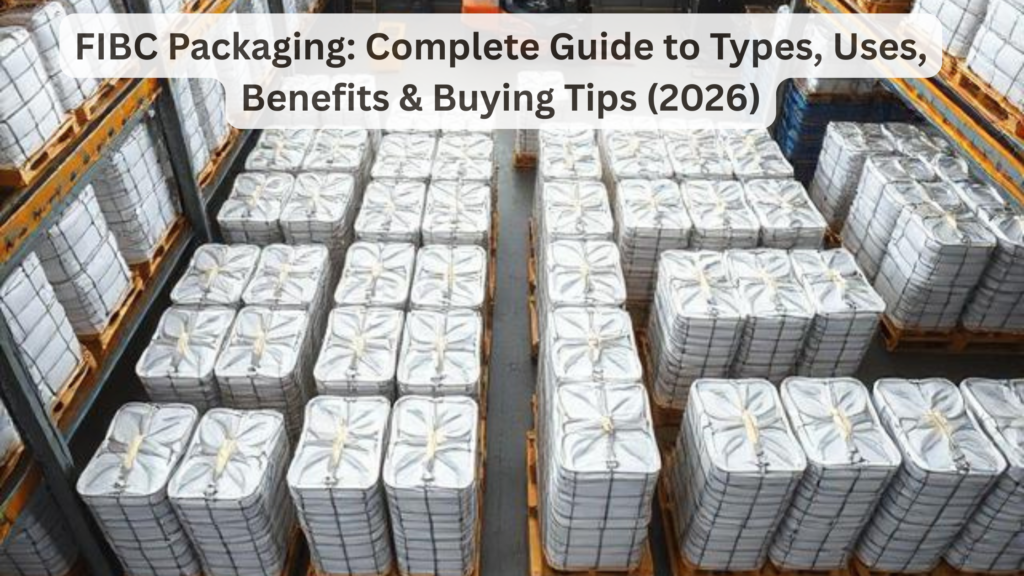
FIBC packaging — short for Flexible Intermediate Bulk Container — is a large, industrial-grade woven polypropylene bag designed to safely store and transport 500 kg to 2,000 kg of dry bulk materials. Also known as jumbo bags, bulk bags, big bags, or super sacks, FIBC packaging is the most cost-effective and efficient bulk handling solution for industries including chemicals, agriculture, construction, food processing, mining, and pharmaceuticals.
What Is FIBC Packaging?
FIBC stands for Flexible Intermediate Bulk Container — an industrial container made from flexible woven fabric, specifically designed to store and transport dry, flowable products such as sand, fertilizer, plastic granules, cement, grains, and chemicals.
FIBCs are used since the 40s and were first produced in the rubber industry using PVC rubber. By the 1960s, polypropylene was invented and weaving technologies improved, modern bulk bags, as we know them today, were created and quickly found use in chemical and agricultural firms of the world.
Polypropylene (PP) is the major raw material, it is a versatile polymer with high strength, durability and is affordable. The steps of the manufacturing process are extrusion of PP in the form of tape yarn, weaving of the tape yarn in the form of fabric, cutting and sewing of panels and final quality test as per ISO 21898 and FIBCA requirements.
Other common names for FIBC bags:
- Jumbo Bag
- Bulk Bag
- Big Bag
- Super Sack (trademarked by BAG Corp)
- Tote Bag / Bulk Tote
- One Ton Bag
- Dumpy Bag
Types of FIBC Bags
FIBC bags are categorized according to the level of electrostatic protection (A, B, C, D) and the type of construction ( U-panel, Circular, Baffle, 4-panel ).
1. Classification by Electrostatic Protection
The handling of contents when filling and discharging of the FIBC bags can cause the accumulation of a static electricity. Selecting the right type is critical when handling flammable or combustible materials.
Type A — Standard Bags
Type A FIBC bags are made from plain woven polypropylene with no static protection. During the flow of materials in and out of the bag, there is the generation of static electricity. These should not be applied to combustible substances, or in places that are flammable.
- Best for: Non-flammable dry goods – Agriculture, construction, sand, gravel, stone.
- Avoid for: Flammable powders, solvents, or in areas with combustible gases.
Type B — Antistatic Bags
Type B bags are made of insulating materials that do not allow the creation of highly charged harmful statical sparks. They do not need to be grounded.
- Best for: Dry flammable powders – chemicals, solvents, petrochemicals.
- Avoid for: Flammable gases or vapors.
Type C — Conductive Bags
Type C bags (also known as groundable bags) are made of non-conductive polypropylene fabric woven with conductive threads. During filling and discharging, they should be attached to a grounding point.
- Best for: Explosive atmosphere, paints, reactive chemicals, flammable powders.
- Note: Grounding connection is compulsory – otherwise, these bags will not provide any protection.
Type D — Static Dissipative Bags
Type D bags have antistatic material that harmlessly discharges electrostatic charge with conductive threads – without grounding. This is the safest and easiest alternative to use in the case of hazardous settings.
- Best for: Flammable powders, pyrotechnics, sensitive pharmaceutical powders.
- Advantage: Grounding is not necessary, making it simpler to operate.
2. Classification by Construction Type
U-Panel Bags
The most popular FIBC construction in the industry. A U-panel bag is constructed out of a single continuous piece of fabric that comprises the front, bottom and back with two side panels being sewn in. They are filled in a square.
Best for: General-purpose bulk handling, general agricultural and chemical applications.
Circular / Tubular Bags
Constructed of smooth tubular woven material – only the top and bottom are sewn. This removes side seams, which increase the strength of the bag. They take the shape of a square, even though they are built in a tubular form, when full.
Best for: Applications requiring maximum strength, minimal seam failure risk.
Baffle Bags (Q-Bags)
Baffle bags have polypropylene panels (baffles) that are stitched over the four corners. This maintains the cubic shape of the bag when full, with a higher filling capacity of up to 30% than traditional FIBCs.
Best for: Logistics, shipments abroad, where the optimization of container space is important. Baffle bags make the best use of space in a shipping container.
4-Panel Bags
Made out of four different pieces of fabric that were stitched together. They offer a highly square filling to baffle bags, but with no internal baffles.
Best for: The product has to maintain a consistent, steady shape – powders, granules, fine chemicals.
FIBC Bag Uses & Applications — Which Industries Use Them?
FIBC bags are employed in 20+ industries in the world. These are the most significant sectors:
Agriculture & Food
FIBC bags have wide applications in packaging grains, seeds, fertilizers and animal feed. They help to keep materials dry, pest-free and free of contamination, and are easy to load and unload during transportation. FIBC bags that are ventilated are used to store fresh produce including onions, potatoes, and garlic to enable air circulation and prevent spoilage.
Common products: Wheat, rice, corn, seeds, sugar, flour, animal feed, fertilizers, onions, potatoes.
Chemicals & Petrochemicals
One of the largest end-users of the FIBC packaging is the chemicals segment, which contributes about 30% of the global market of the containers. Several industries which handle polymers, fertilizers, pigments, and specialty additives and petrochemicals use the conductive or antistatic type of the FIBC (Type C or D) in safe bulk handling.
Common products: Plastic resins, polymer granules, dyes, pigments, industrial powders, solvents.
Construction & Mining
Another leading consumer sector is construction, where FIBCs are used to store bulk material such as cement, sand, gravel, fly ash, aggregates, dry mix compounds, ores and minerals. The weight and abrasiveness of these materials are put under heavy-duty FIBC designs.
Common products: Cement, sand, gravel, fly ash, silica, ores, construction aggregates.
Food Processing & Pharmaceuticals
FIBC bags used in food are produced in cleanrooms in accordance with GMP. They are applied to carry food ingredients, APIs (Active Pharmaceutical Ingredients), excipients and fine powders where there is a zero-tolerance requirement on contamination control.
Common products: Food additives, pharmaceutical powders, APIs, sugar, starch, flour
Recycling & Waste Management
FIBC bags find growing application in recycling and waste management processes – transporting textile scrap, rubber, metal filings and hazardous waste. Regulated disposal of hazardous materials is done in UN-certified FIBC bags.
Logistics & Export
The baffle bags are widely used in export logistics, as they have a cubic shape, optimizing container space, and lowering freight expenses. India is a major exporter of FIFO in the world with its products going to Europe, Americas, Middle East, and Southeast Asia.
Key Benefits of FIBC Packaging
FIBC packaging has a definite benefit over the traditional methods of packaging, such as drums, wooden crates, and multi-wall sacks:
1. High Load Capacity
The bag is less than 5 kg but the material that can be transported in FIBCs can range between 500 kg to more than 2,000 kg. This phenomenal power-weight ratio renders them unrivaled in bulk handling performance.
2. Cost Savings
FIBC can save up to 30% on shipping costs relative to rigid containers (that is, when switching to FIBC). A decrease in freight costs, labor costs incurred in the filling and emptying, and a decrease in the cost of packaging materials all lead to considerable savings.
3. Space Efficiency
Unfilled FIBC bags are flat and collapsible – occupying minimal storage space when not in service. When filled, baffle bags maximize the utilization of containers by keeping them cubic and minimizing space wastage.
4. Reusable & Recyclable
Multi-trip FIBC bags can be washed and re-used several times, mitigating against packaging waste and contributing to the purpose of a circular economy. A lot of manufacturers are providing bags of recycled PP content. A good example is Packem Umasree who was able to transform more than 1,500 MT of PET waste into long-lasting bulk bags in 2025 – showing that sustainable production of FIBC is commercially viable.
5. Customizable
FIBCs can be customized:
- Size and capacity (500 kg to 2,000 kg+)
- Liner options (PE liner, aluminum foil liner for moisture/barrier protection)
- Stuffing types (open top, spout top, duffle top)
- Discharge (flat bottom, spout bottom, and cone bottom)
- Outdoor UV protection.
- Custom printing and branding.
6. Safety & Compliance
FIBC bags are also certified and tested to international safety standards such as:
- ISO 21898 — Design, testing, and use of FIBCs
- UN Certification — For hazardous materials transport
- FIBCA Standards — Flexible Intermediate Bulk Container Association testing
- AIB Certification — Food safety and quality
7. Eco-Friendly
FIBCs minimize use of single-use packaging solutions. They are reusable and recycleable which helps them meet the global ESG objectives and sustainability requirements of both regulators and purchasers.
FIBC Bags vs. Traditional Packaging
What are the comparisons between FIBC packaging and traditional alternative?
| Feature | FIBC Bags | Drums (Steel/Plastic) | Multi-wall Sacks | Wooden Crates |
|---|---|---|---|---|
| Capacity | 500–2,000 kg | 100–300 kg | 25–50 kg | Varies |
| Weight (empty) | Under 5 kg | 15–30 kg | 0.3–0.5 kg | 20–50 kg |
| Reusability | Yes (multi-trip options) | Limited | No | Yes (heavy) |
| Stackability | Good (baffle bags) | Excellent | Poor | Excellent |
| Freight Cost | Low | High | Medium | High |
| Customization | High | Low | Medium | Low |
| Environmental Impact | Low (recyclable) | Medium | Medium | High |
| Handling Equipment | Forklift / crane | Forklift | Manual / conveyor | Forklift |
The use of FIBC bags has a competitive edge since it is more powerful, has the ability to handle bulk, and is cost-efficient when applied in most industrial processes.
How to Choose the Right FIBC Bag
Selecting the right FIBC bag requires evaluating several technical and operational factors:
1. Safe Working Load (SWL) & Safety Factor (SF)
The SWL is the maximum weight the bag is rated to carry. Always confirm:
- Standard FIBCs: Safety factor of 5:1 (bag tested to 5x the rated load)
- UN-certified FIBCs: Safety factor of 6:1 for hazardous materials
2. GSM (Grams per Square Meter)
GSM of the woven fabric is its weight. The larger GSM is, the heavier and more robust. Heavy-duty (mining, construction) uses need more GSM fabric.
3. Liner Requirements
- No liner: Hard, dry substances that are not moisture sensitive.
- PE liner: Moisture-sensitive goods – fertilizers, food ingredients.
- Aluminum foil liner: Products that need total light and oxygen exclusion – specialty chemicals, resins.
4. Static Protection Level
Select depending on the flammability of your material and environment:
- Non-flammable, non-combustible → Type A
- Flammable powders, non-hazardous gas environment → Type B
- Breathable space, grounding accessible → Type C.
- No grounding, flammable atmosphere, no grounding → Type D
5. UN Certification
When carrying hazardous substances (as defined by IMDG, ADR, or DOT rules), then you have to use UN certifiedFIBC bags. These have an SWL safety factor of 6:1 and are tested to stringent international standards.
6. Food Grade Certification
In case of food ingredients or pharmaceutical products: always specify:
- Clean-room manufacturing
- Food-grade PP material (no recycled content)
- GMP compliance documentation
FIBC Packaging Market Size & Trends 2026
The world market of the FIBC packaging is growing dynamically and continuously:
- The global flexible intermediate bulk container market was valued at approximately USD 7.63 billion in 2025 and is projected to reach USD 11.80 billion by 2033, growing at a CAGR of 5.6%.
- The 4-loop FIBC sub-market alone is valued at USD 1.9 billion in 2025 and is projected to reach USD 2.7 billion by 2035.
- The dominant market share of around 44% is controlled by Type A FIBCs in 2026.
- Chemicals and fertilizers segment contributes about 30-39 percent of the market demand.
- Asia Pacific is the most growing area due to the rapid industrialization and increased agricultural exports. The major manufacturers of FIBC in the world are India and China.
Key 2026 Market Trends
1. Sustainability & Recyclable Materials Makers Recyclable, biodegradable and bio-based polypropylene FIBCs are being developed. The recycled-content fabric demand is on the rise and brands are making their names circular.
2. Intelligent Technology Addition IoT-enabled tracking IoT tracking systems, condition-sensing fabrics, RFID traceability, and temperature-sensitive materials are becoming part of the design of FIBC – enabling real-time condition monitoring of the contents of a bag during the supply chain.
3. Automation Compatibility FIBCs are also becoming compatible with automated filling, handling and discharge systems used in contemporary warehouses and manufacturing plants.
4. Food & Pharma Expansion Pharmaceutical and biotech industries are quickly moving to contamination-controlled FIBC solutions, so this is one of the fastest-growing application areas.
5. Baffle Bag Adoption Due to the escalating cost of shipping, baffle bags which optimise the available space in containers are becoming more popular among exporters all over the world.
FAQs About FIBC Packaging
Q: What does FIBC stand for? FIBC stands for Flexible Intermediate Bulk Container — the technical industry term for what are commonly called bulk bags, jumbo bags, or big bags.
Q: How much weight can an FIBC bag hold? Standard FIBC bags are rated to carry 500 kg to 2,000 kg. Heavy-duty variants with higher safety factors can handle loads beyond 2,000 kg.
Q: Are FIBC bags reusable? Yes. Multi-trip FIBC bags are designed for repeated use after cleaning and inspection. Single-use bags are also available for applications where contamination risk is a concern.
Q: What is the difference between Type C and Type D FIBC bags? Both are used in flammable/explosive environments. Type C bags require a grounding connection during use; Type D bags dissipate static without grounding, making them operationally simpler and safer.
Q: Are FIBC bags recyclable? Yes. FIBC bags are made from 100% polypropylene, which is fully recyclable. Many manufacturers now offer take-back and recycling programs. Some newer bags incorporate rPET or recycled PP fabric.
Q: What is a food-grade FIBC bag? A food-grade FIBC bag is manufactured in a cleanroom under GMP (Good Manufacturing Practice) conditions, using virgin (non-recycled) food-safe polypropylene — ensuring no contamination of food ingredients during storage or transport.
Q: What is UN-certified FIBC? UN-certified FIBC bags are tested and approved for the transport of hazardous materials under international regulations (IMDG, ADR, DOT). They offer a 6:1 safety factor, compared to 5:1 for standard bags.
Q: How do I know what GSM to choose? Higher GSM means heavier, more durable fabric. For light materials (flour, seeds): 90–100 GSM. For medium-duty use (fertilizers, chemicals): 110–130 GSM. For heavy-duty use (cement, minerals): 140 GSM and above.
Conclusion
FIBC packaging is the backbone of modern bulk material handling. Whether you are in agriculture, chemicals, construction, food processing, or mining, the right FIBC bag can dramatically reduce your packaging costs, improve operational efficiency, and support your sustainability goals.
With the global FIBC market growing at over 5–6% CAGR and expected to exceed USD 11 billion by 2033, now is the time to evaluate whether your current bulk packaging strategy is optimized. Choosing the correct type (A, B, C, or D), the right construction (U-panel, Circular, Baffle), and the appropriate certifications (UN, food-grade, ISO) is critical to safe and cost-effective bulk operations.
If you are looking for a trusted FIBC bag manufacturer or supplier, prioritize suppliers with ISO certification, proven export track records, customization capabilities, and transparent quality testing documentation.
