
FIBC Bag Capacity Guide — How Much Weight & Volume Can Bulk Bags Hold?
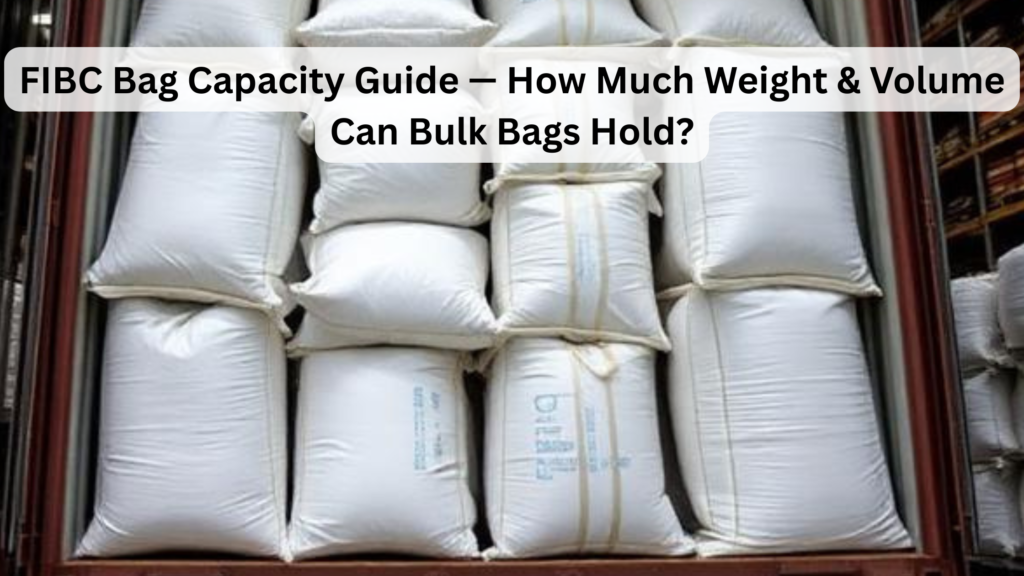
Asking yourself about FIBC bag capacity, you should know that typical FIBC (Flexible Intermediate Bulk Containers) bags usually have the capacity of 500 kg to 2000 kg of cargo weight and from 0.5 to 2 cubic meters of volume, depending on the size of the bag.
We will clarify what is the capacity of FIBC bags and what types exist today, and also advise on which FIBC bag to choose.
How Is FIBC Bag Capacity Measured? (Weight vs Volume Explained)
A FIBC bag’s capacity is based on two criteria:
1. Weight Capacity (Safe Working Load – SWL)
This is the weight capacity of the bag. Common ranges include:
- 500 kg
- 1000 kg (most widely used)
- 1500 kg
- 2000 kg
2. Volume Capacity (Cubic Meter – m³)
This is the volume of the bag.
- 1 cubic meter = 1000 liters
Important: For heavy materials (e.g., sand), the weight of the cargo reaches its maximum limit even though the bag is not full yet.
In case of light materials (e.g., plastic pellets), it is the opposite – the volume reaches its maximum limit first.
That’s why density is an important consideration for capacity.
Interested in our products or need more information?
Inquire Now!Standard FIBC Bag Sizes and Their Capacity
Here are a few popular sizes and their capacities:
- 90 × 90 × 90 cm → ~1000 kg / 1 cubic meter
- 100 × 100 × 100 cm → ~1200–1500 kg
- 90 × 90 × 120 cm → Higher volume, ideal for lightweight materials
Other sizes are available on request.
How Material Density Affects FIBC Capacity
The weight of the bag depends on the material being contained:
- Sand (high density) → weight limit reached quickly
- Fertilizer → even weight and space used
- Plastic (low density) → volume reached quickly
Formula to understand:
Capacity (kg) = Volume (m³) × Material Density
How to Choose the Right FIBC Bag Capacity (5 Key Factors)
Choosing the right FIBC bag capacity is crucial for safety and cost savings.
1. Type of Material
Flakes or powder vs granules
2. Material Density
Heavy vs lightweight materials
3. Transportation Method
Truckload, container or export shipments influence size
4. Safety Factor (SF Ratio)
- 5:1 → Single-use bags
- 6:1 → Multi-use bags
5. Storage Conditions
If bags need to be stacked, use stronger bags
Incorrect capacity can cause:
- Bag failure or bursting
- Increased logistics cost
- Product damage
Interested in our products or need more information?
Inquire Now!1000 kg vs 1500 kg vs 2000 kg FIBC Bags — Which One Is Best?
- 1000 kg (1-ton bags) → Most common and versatile
- 1500 kg bags → Ideal for industrial applications
- 2000 kg bags → Best suited for building, mining and shipping
Tip: Always use a bag at less than its capacity, even with a high safety factor.
Industry-Wise FIBC Bag Capacity Usage
- Water treatment chemicals companies → 1000-1500 kg bags
- Agriculture (grains, seeds) → 500–1000 kg
- Construction (sand, cement) → 1000–2000 kg
- Plastic industry → Light, bulky materials
FIBC Bag Capacity vs Size — Understanding the Difference
Many people confuse size with capacity, but they are not the same.
- Size = dimensions (length × width × height)
- Capacity = weight + volume
Example:
The same size bag may hold:
- ~1000 kg of sand
- Much less weight of low density materials before it’s full
So, volume is always a function of size + density + design
Common Mistakes to Avoid
- Ignoring size and shape
- Ignoring material density
- Not checking safety factor
- Overfilling the bag
These errors can result in lost production and money.
Interested in our products or need more information?
Inquire Now!FAQ — Common Questions About FIBC Bag Capacity
What is the largest size FIBC bag?
Most FIBC bags can hold up to 2000 kg, but 1000–1500 kg is the standard range.
What size is a 1-ton FIBC bag?
Typically around 90×90×90 cm or 100×100×100 cm.
Can you fill a FIBC bag with different materials?
Yes, but the capacity will differ with different material.
What is the safety factor in FIBC bags?
It defines how much load the bag can safely handle (commonly 5:1 or 6:1).
What capacity of FIBC is best for export?
1000 kg bags are the most popular because they are easy to handle and fit into containers.
Interested in our products or need more information?
Inquire Now!Conclusion
Knowing fibc bag capacity can ensure safe handling, cost savings and efficient logistics. It’s not only the volume that matters, but weight capacity, volume, and density of the product stored are all equally important when it comes to choosing bulk bags for your product.
If your industry includes such branches as chemicals, construction, and agriculture, the choice of the FIBC bag can be very helpful for your business operation and avoid losses.
Need assistance with choosing the suitable FIBC bags? Feel free to contact us.
Explore More Resources:
For additional learning resources on bulk packaging, material density, and safe handling practices, check out expert guidelines by Flexible Intermediate Bulk Container Association.
