
PP Woven Bags: The Ultimate Guide for Buyers & Manufacturers Worldwide
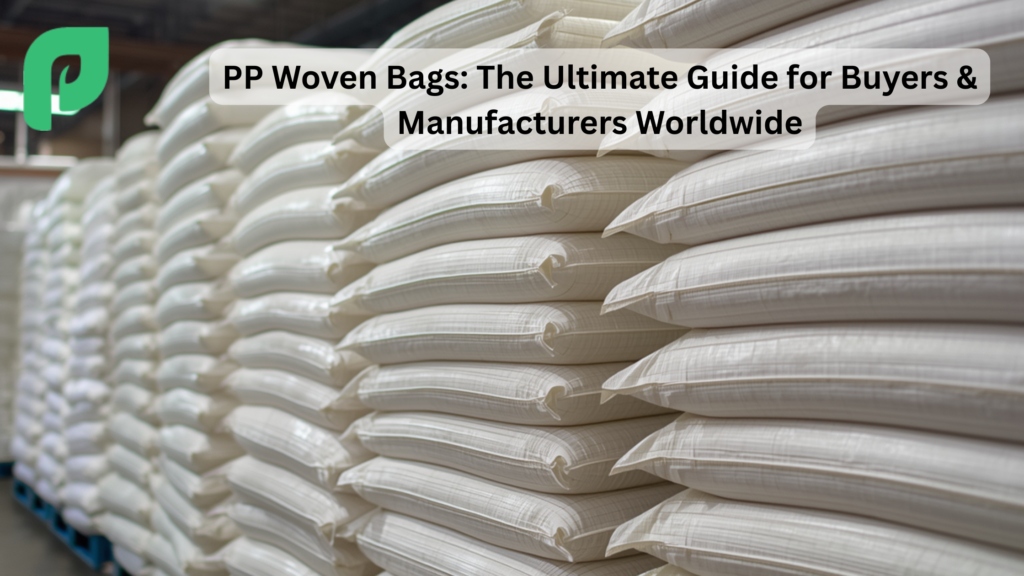
The world most vital products, rice, cement, fertilizer, animal feed and others are transported in billions of bags every year. Most of them are supported by a single material behind them polypropylene woven fabric.
The bulk packaging is based on PP woven bags in the world. They are powerful, featherweight, waterproof and customizable and hence the unanimous choice of manufacturers, traders and retailers in 120+ countries.
You may be a consumer seeking wholesale polypropylene bags, a company seeking a wholesale PP woven bags manufacturer, or an entrepreneur seeking to venture into the PP woven bags manufacturing business – this guide has it all.
What Is a PP Woven Bag?
Polypropylene woven bag is a short name of a PP woven bag, which is a flexible and high strength packaging solution.
Polypropylene plastic consists of flat strips of polypropylene, woven together to form a structure of fabric.
The bags are then sliced, sewn and completed to form tough sacks utilized in dozens of industries all over the globe.
Polypropylene (PP), a thermoplastic polymer, is the raw material and has a high tensile strength, is resistant to water and is lightweight.
When pressed into self-governing, flat tapes and then woven, it creates one of the most diverse packaging products nowadays.
Quick Definition: PP woven bags consist of interwoven polypropylene strips, which is the same polymer as used in ropes, carpets, food containers and therefore, they are strong, can be reused, and are economical in large quantities.
The following are important properties of PP Woven Bags.
- High tensile strength – can support 5 kg to 100+ kg in construction.
- Moisture resistance – best in agriculture, food and chemical packaging.
- UV stabilized – can be stored and transported outdoors.
- Customizable – printable in various colors and logos and branding.
- Recyclable & reusable – eco-friendlier than single-use plastic bags
- Portable – saves a lot of money during shipping.
PP Woven Bag Market Size & Global Demand
The global market for PP woven bags is growing rapidly, driven by rising demand in agriculture, construction, food processing, and retail.
Emerging economies in Asia, Africa, and Latin America are the fastest-growing consumers.
Key Market Numbers (2024):
- Market Size: $6.2 Billion
- CAGR (2024–2030): 5.4%
- Most Popular Size: 50 kg bags
- Countries Served: 120+
India, China, Turkey, and Vietnam are the leading manufacturers and exporters of PP woven bags.
India in particular — with hubs in Ahmedabad, Surat, and Mumbai — supplies high-quality bags to markets in the USA, UAE, Europe, and Africa.
Types of PP Woven Bags
Not every PP woven bag is alike. Depending on end-use, various constructions, coatings and closures exist. The most common ones are as follows:
1. Standard PP Woven Sacks
The most basic type – open-top or sewn-top bags which are used in storing grains, sand, cement and fertilizers. Comes in 10 kg, 25 kg and 50 kg increments.
2. BOPP Laminated PP Woven Bags
Heat-laminated onto the PP woven fabric is Biaxially Oriented Polypropylene (BOPP) film. This enables high-resolution photo-quality printing – so they are perfect as branded retail packaging flour, rice, pet food and seeds.
3. PP Woven Jumbo Bags (FIBC / Bulk Bags)
These large-format bags are also known as Flexible Intermediate Bulk Containers (FIBCs) and contain 500 kg to 2000 kg of material. Used in mining, chemicals and construction industries.
4. PP Non-Woven Bags
Constructed of bonded PP fibers, instead of woven strips. They are light, cloth-like bags that are used in retail, grocery and advertising. Less heavy and more environmentally friendly than woven bags.
5. Laminated PP Woven Bags
Filmed on the inside or the outside with a thin layer of LDPE or HDPE film to form a moisture barrier in the packaging of chemicals, salt and cement – necessary.
6. Easy Open PP Woven Bags
Include a tear-strip or pierced hole as a convenience to the consumer – which is becoming more common in commodities that are packed into retail packages such as rice, flour, and animal feed.
PP Woven Bags Uses & Industries
PP woven bags operate in virtually all industries that deal with bulk packaging or handling of materials. They are very versatile and cannot be matched in the world of flexible packaging.
- Agriculture: Rice, wheat, maize, seeds, fertilizers, animal feed
- Construction: Sand, cement, gravel, minerals, tiles
- Chemicals: Powders, granules, resins, industrial compounds
- Pet Food & Animal Feed: Branded retail sacks with vivid BOPP printing
- Retail & Grocery: Flour, sugar, salt, rice, in consumer packs.
- Mining: Bags of ore, gravel and bulk minerals. Jumbo FIBC.
- Waste Management: garbage, rubble and demolition waste bags.
- Promotional / Retail: Branded carry bags made of non-woven PP.
Did You Know? The global feed bag market, which is one of the largest markets when it comes to PP woven bags is propelled by the increasing demand of packaged livestock and aquaculture feeds in Asia, Africa, and South America.
PP vs HDPE Woven Bags: What’s the Difference?
Both polypropylene (PP) and high-density polyethylene (HDPE) are used to make woven sacks. There is usually confusion among buyers in making their choices. Here is a clear comparison:
| Feature | PP Woven Bags | HDPE Woven Bags |
|---|---|---|
| Raw Material | Polypropylene polymer | High-Density Polyethylene |
| Tensile Strength | Higher | Moderate |
| UV Resistance | Good (with additives) | Slightly better |
| Flexibility | Moderate | Higher |
| Cost | Lower | Slightly higher |
| Print Quality | Excellent (esp. BOPP) | Good |
| Common Use | Food, agri, chemicals | Sand, fertilizer, cement |
| Temperature Resistance | Up to 100°C | Up to 120°C |
PP woven bags are used in most food, agricultural and branded retail applications because the quality of printing is better and the material would cost less.
HDPE bags can be used in more flexible applications with more exposure to temperatures.
PP Woven Bags Manufacturing Process
Knowledge of manufacturing PP woven bags assists customers to judge quality and select trustworthy manufacturers. The procedure entails a few accuracy measures:
Step 1 – PP Granule Extrusion The raw polypropylene granules are melted and forced to pass through a die into fine flat tapes. This is where additives are added such as colorants and UV stabilizers.
Step 2 – Tape Stretching & Drawing The extruded tapes are stretched (drawn) to enhance molecular alignment which greatly enhances tensile strength.
Step 3 – Circular Weaving The tapes are pumped into circular machines which weave them in tubular patterns. Mesh counts ( threads/in ) determine weight and bag strength.
Step 4 – Lamination (Optional) For moisture-barrier or print-quality requirements, a BOPP or LDPE film is laminated onto the woven fabric under heat and pressure.
Step 5 – Flexographic / gravure printing is the brand name, product information, and regulatory text that is printed onto the bag surface or the layer of the laminate.
Step 6 – Cutting, Stitching and Finishing Fabric is cut to size, stitched (with or without lining), and fitted with handles, valves or PE inner liners, as needed depending on the order spec.
PP Woven Bags Manufacturing Plant Cost
The cost of establishing a small-to-mediate PP woven bag factory is usually between $200,000 to $800,000 USD, based on the capacity, the level of automation and the country.
An entire line of plant (circling looms, lamination, and printing) may cost 1.5 million dollars or more.
Smaller operations can be acquired in India between ₹50 lakhs to ₹2 crore to enter the market.
PP Woven Bags Price & Wholesale Buying Guide
PP woven bags vary in price based on the size, construction, printing, lamination, and order quantity. A rough price guide of 2024 -2025 is the following:
| Bag Type | Capacity | Price Range (per bag) | MOQ |
|---|---|---|---|
| Standard PP Woven Sack | 50 kg | $0.12 – $0.25 | 10,000 pcs |
| BOPP Laminated Bag | 25–50 kg | $0.30 – $0.65 | 5,000 pcs |
| PP Jumbo / FIBC Bag | 500–2000 kg | $4.00 – $12.00 | 500 pcs |
| PP Non-Woven Carry Bag | 5–10 kg | $0.08 – $0.20 | 20,000 pcs |
| Laminated Feed Bag (Branded) | 25–40 kg | $0.40 – $0.90 | 5,000 pcs |
Factors That Affect PP Woven Bag Price
- GSM (grams per sq. meter): The greater the GSM the greater the strength and the greater the cost.
- Print colors: 1-color print is the least expensive; 4+ color BOPP printing is more expensive.
- Lamination type: BOPP laminate is more expensive than standard PE coating
- Inner liner: PE liner to moisture-sensitive items will be an additional cost of $0.05-0.15 per bag.
- Order quantity: The greater the MOQ, the lesser the unit cost.
- Shipping/port: FOB India vs. CIF destination pricing is also quite different.
Wholesale Hint: When ordering more than 50,000 bags, make a bespoke offer to manufacturers. Bulk pricing may save up to 25-40 percent of the cost of small-batch orders.
BOPP Laminated PP Woven Bags
BOPP laminated PP woven bags are the high-end of the woven bag market. The BOPP (Biaxially Oriented Polypropylene) film bonded on the woven surface provides a number of important benefits:
- Retail shelf-fine printing with photographic quality – best in retail shelves.
- Increased moisture protection of delicate items such as flour, milk powder, and spices.
- Matte or glossy finishes to luxurious brand image.
- Improved seal integrity of stitched or heat-sealed closures.
The bags are the preferred item in branded animal feed bags, rice bags, flour bags, and seed bags that are competing at retail shelves around the world.
Designs can include full-color artwork, QR codes, and regulatory compliance text.
Where to Buy PP Woven Bags: Glob al Sourcing Guide
As an initial customer or a repeat distributor, it is important to know where to get quality PP woven bags. The following are the primary channels:
1. Direct from Manufacturers (Best for Volume)
Purchasing straight to a PP woven bag manufacturer offers the most favorable prices, maximum control over customization and quality of goods. The best sourcing destinations are India, China, and Turkey.
Pursuit Industries Private Limited is a reputable producer and distributor of PP woven bags, serving the world market with personalized agriculture, food and industrial packaging.
2. B2B Marketplaces
There are hundreds of verified suppliers of PP woven bags on such platforms as Alibaba, IndiaMART, and TradeIndia. Helpful in price comparison and screening of different vendors.
3. Wholesale Distributors
Standard sizes are held in stock by regional distributors to be delivered within a short time, without an MOQ requirement – suitable to SMEs or first time buyers who require smaller quantities.
4. Trade Shows & Exhibitions
Show events such as PackEx, Plastindia and K Fair (Germany) gather hundreds of PP woven bag manufacturers in a single location – great when it comes to establishing a relationship with the suppliers.
What to Look for in a PP Woven Bag Supplier
- BRC or ISO 9001 certified production.
- Customization of size, GSM, printing and type of closure.
- Experience in exports (EXIM code, previous shipments)
- Sample permission prior to mass manufacturing.
- Clear prices with FOB/CIF disaggregation.
- On time and with good lead times (usually 15-30 days)
Conclusion
One of the most dependable, multi-purpose and economical methods of packaging in the world, is the PP woven bags.
They are used in industries in every continent, be it farming, pharmaceuticals, using 50 kg agricultural sacks, or beautiful printed BOPP retail bags.
It can be a purchase of wholesale polypropylene bags, a brand with a desire of custom-printing packaging, or an entrepreneur trying to find out about the production of PP woven bags, however — the trick is to find a reliable, certified manufacturer who knows the market.
pursuitind.com provides full PP woven bag services – custom design, bulk production and export worldwide.
Contact us now to receive a competitive quote depending on your specific needs.
