
Polyurethane Foam Companies: Types, Applications and How to Choose the Right Supplier
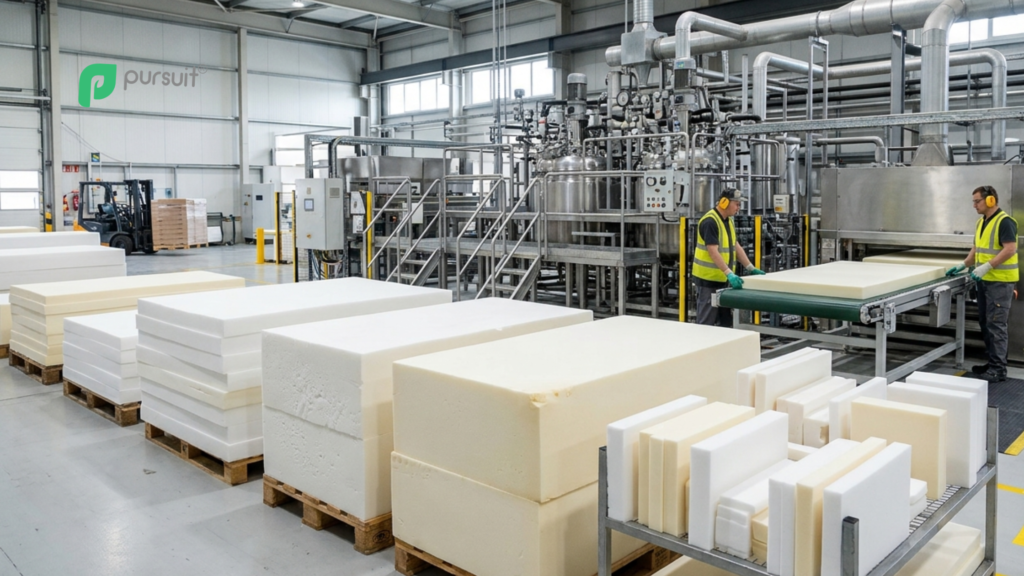
Most people aren’t aware that polyurethane foam is used in a wide variety of products. It’s used in a lot of things today, from cushioning for people that sit on to the material that keeps refrigerated items cold.
However, not all polyurethane foam is the same. Some applications require soft, flexible foam, while others need rigid structures that provide insulation and dimensional stability.
The final properties depend on the formulation, raw materials and manufacturing process.
So, businesses considering using PU foam should take great care in selecting the right supplier. Quality of the raw materials, processing performance and quality of the finished product can depend on the quality of the polyurethane systems.
The quality of the raw materials can affect the production consistency, polyurethane systems processing performance and the quality of finished products.
In this guide, we will delve into the various varieties of polyurethane foam, its applications in the industry, and some factors that manufacturers should keep in mind when choosing the right polyurethane supplier in India.
What Is Polyurethane Foam?
PU foam (also known as polyurethane foam) is a type of cellular material, created when polyols and isocyanates react with other components, depending on the formulation used.
The formulation forms a structure with small cells during the manufacturing process. These cells influence the foam’s flexibility, density, strength and insulation properties.
Polyurethane foam is also useful in a variety of industries such as furniture, automotive, construction, refrigeration and industrial packaging.
Choosing the right polyurethane system is as critical for the foam manufacturer as is the choice of the processing equipment. The formulation needs to be suitable for intended use and production.
Types of Polyurethane Foam
Different applications require different foam properties. The most suitable type depends on the desired flexibility, load-bearing capacity, insulation performance and end use.
1. Flexible Polyurethane Foam
Flexible polyurethane foam is foam which will be compressed when loaded and be able to come back to its original shape to various extents, depending on the formulation and quality of the foam.
It is commonly used in:
- Mattresses and pillows
- Sofa cushions and upholstered furniture
- Automotive seating
- Office chairs and other cushioning products
Depending on the product being manufactured, manufacturers may need different densities and hardnesses of foam.
The use of uniform materials and proper processing conditions are favorable factors in order to obtain the desired results.
2. Rigid Polyurethane Foam
There are many applications of rigid polyurethane foam in which thermal insulation and structural strength is significant.
Common applications include:
- Refrigerators and freezers
- Cold storage facilities
- Insulated panels
- Industrial insulation systems
- Building and construction applications
The formulation, cell structure and processing conditions all have an effect on the performance of rigid polyurethane foam.
As such, it is important that manufacturers examine the performance of polyurethane systems based on the application of insulation.
3. High-Density Polyurethane Foam
High density polyurethane foam is used for special application, such as a special combination of material density, support and durability.
It can be applied in specific parts of furniture, automotive, industrial cushioning and engineered foam products.
One important point is that density alone does not determine quality.
Hardness, compression performance, resilience and other specifications must also be considered when choosing a foam grade.
4. Moulded Polyurethane Foam
Moulded polyurethane foam is produced inside moulds to achieve a specific shape and design.
This material is also used for automotive seating, headrests and other applications requiring precise dimensions.
The formulation will need to be appropriate for the moulding process and the performance needs of the moulded part.
5. Semi-Rigid Polyurethane Foam
Semi-rigid polyurethane foam has characteristics between flexible and rigid foam depending on the foam formulation.
Can be used in certain cushioning and protection and automotive applications where a compromise between support and deformation is desired.
The correct formulation is dependent on the intended operating conditions and component design.
Industrial Applications of Polyurethane Foam
Polyurethane foam is used for various applications in various industries.
By knowing how these are used, manufacturers can determine the proper raw material and polyurethane system to use for their production needs.
Furniture and Mattress Manufacturing
Flexible PU foam can be used in mattress, sofa, cushion and upholstery.
There are different formulations depending on the desired comfort, firmness, resilience and durability of the product.
When products are produced on a large scale, there is a need for consistency between production batches.
Automotive Manufacturing
In the automotive industry, polyurethane foam is applied in multiple areas, such as seating, headrests, interior cushioning and certain protective parts.
Manufacturers can take into accounts compression behaviour, dimensional stability, durability and appropriate safety requirements as per the application.
Construction and Insulation
Rigid polyurethane foam is used in insulation panels, building systems and other applications where reducing heat transfer is important.
The appropriate polyurethane system depends on the required thermal performance, installation method, substrate and environmental conditions.
Refrigeration and Cold Storage
Controlling temperatures depends greatly on the effectiveness of the refrigerator, freezers and cold storage systems.
Rigid PU foam is commonly used in these applications. Manufacturers must select a suitable formulation and processing method to meet the required insulation and product performance specifications.
Industrial Packaging
Polyurethane foam can be used in protective packaging where cushioning and shock absorption are required.
The correct foam properties depend on the product being protected, its weight, shape, fragility and transportation conditions.
Depending on the application, the densities and hardnes of packaging materials are not the same, so the choice of material should be made according to the protection demanded.
What Are Polyurethane Foam Systems?
Polyurethane foam systems are formulated combinations of chemical components designed for particular manufacturing processes and end uses.
Depending on the application, these systems may be developed for flexible foam, rigid foam, insulation panels, spray foam or other polyurethane products.
Polyols are one of the key components of such formulations.
Both their properties and the properties of the isocyanate and other formulation ingredients determine the properties of the final polyurethane compound.
These are some of the factors manufacturers should take into account during choosing a polyurethane system:
- Compatibility with existing production equipment
- Processing requirements and reaction characteristics
- Desired physical and mechanical properties
- Quality consistency between batches
- Technical support and formulation customization
By collaborating with a supplier who is aware of the intended application, manufacturers can better determine the solution that is best for them.
How to Choose the Right Polyurethane Supplier in India
Prices are not the only factor to consider when comparing polyurethane foam companies and chemical suppliers.
The appropriateness of the product is also critical as is the reliability of the supply relationship.
1. Understand the Supplier’s Product Range
Firstly, see if the supplier has the materials you need for your manufacturing process.
Some companies produce finished products in foam form and others produce polyols, mixed or combined polyurethane systems, polyester polyols or polyurethane adhesives.
These are various values in the supply chain.
Always select a supplier with products that meet your needs.
2. Check Quality Control Procedures
Consistent raw material quality is essential for repeatable manufacturing.
Ask about the supplier’s quality control process, product specifications, batch documentation and testing procedures.
Relevant parameters, depending on the material, can be viscosity, hydroxyl value, density and moisture content.
The appropriate tests will vary according to the product being supplied.
3. Evaluate Customization Capabilities
Formulations can vary between production lines depending on the production line.
Ask supplier if a polyurethane system can be recommended or developed if processing or performance requirements are given in the application.
Any formulation created should be tested technically before full production to check the quality.
4. Consider Production Capacity and Supply Reliability
For manufacturers with regular or high-volume requirements, supply consistency matters.
Review the supplier’s production capacity, lead times, packaging options and ability to support your expected order volumes.
A reliable supply agreement enables companies to better plan their production and procurement.
5. Look for Technical Support
There should be a suitable supplier that are able to describe the product specification and educate or explain the requirements for the product that the customer intended to use.
Technical communication is particularly valuable for a manufacturer when testing a new formulation, testing the production process, or studying different variations in the end product quality.
Why Consider Pursuit Industries for Polyurethane Solutions?
Pursuit Industries Private Limited (PIPL) is based in Surat, Gujarat, India, and is a manufacturer of polyurethane systems and specialty chemical solutions.
The company specializes in the production of blended polyols, polyester polyols and polyurethane adhesives for industry.
It has polyurethane manufacturing capability to meet the needs of applications such as flexible foam, rigid foam, insulation and other polyurethane-based products.
Key capabilities include:
- Blended polyols: Designed solutions to meet polyurethane processing needs.
- Polyesters: that are used in some types of polyurethane and in industrial applications.
- Polyurethane adhesives: Solutions for relevant industrial applications.
- Quality testing: Tests performed on the product that involve things like viscosity, density, hydroxyl value and moisture content.
- Manufacturing capacity: An annual polyurethane production capacity of 48,000 MT, according to the company’s published information.
One of the key steps to your manufacturing process is choosing the right polyurethane system and supplier for you, if you are a manufacturer who does not manufacture a finished foam product.
Discover the capabilities of Pursuit Industries in polyurethane manufacturing, understanding the range of products and industrial solutions.
Frequently Asked Questions
1. What is polyurethane foam used for?
Polyurethane foam is used to make furniture, mattresses, automotive components, insulation panels, refrigeration components, and some protective packaging applications.
It has attributes that are related to its formulation and manufacturing process.
2. What are the main types of polyurethane foam?
These are broadly categorized into flexible polyurethane foam, rigid polyurethane foam and semi-rigid polyurethane foam.
For specific manufacturing needs, moulded foam and high density foam are also employed.
3. What is the difference between rigid and flexible polyurethane foam?
Flexible polyurethane foam is generally designed for cushioning and compression, while rigid polyurethane foam is commonly used for thermal insulation and applications requiring greater structural stability.
4. How does polyurethane foam density affect performance?
The density is the amount of mass in a unit volume of foam. Is an important specification, but is not a factor in itself for hardness, resilience, durability or insulation. Other material properties and the intended application should take into account.
5. How do I choose a polyurethane foam supplier?
Assess with the supplier the product line, quality control processes, technical assistance, customization options and supply reliability. Also check the suitability of proposed material for your production method.
6. What is a polyurethane system manufacturer?
A manufacturer of formulated chemical systems that are used to create polyurethane materials.
The company can provide blended polyols, polyester polyols and other parts or formulations of the product according to their capability for certain industrial applications.
7. Does Pursuit Industries manufacture polyurethane foam?
Pursuit Industries is focused on polyurethane systems, blended polyols and polyester polyols and polyurethane adhesives.
The materials are suitable for use in downstream manufacturing such as flexible foam, rigid foam and insulation.
The buyer should mesh with the company and they will discuss what formulation is needed for their process.
Conclusion
The first step in selecting the proper polyurethane supplier is to have an understanding of what you want your product to accomplish.
There are certain material and processing needs for each of the flexible foam, rigid foam, moulded components and insulation products.
The ideal polyurethane system offers manufacturers consistent processing, and the properties of the finished product.
It is therefore not a good idea to make a choice based on price alone, but rather to compare product specifications, quality control, technical support and supply capabilities.
Polyurethane Systems, Blended Polyols, Polyester Polyols and Polyurethane Adhesives for Industrial Applications are offered by the Pursuit Industries.
If considering materials for your manufacturing process, consider the company’s polyurethane products and speak with the team about your requirements.
In search of a polyurethane solution for your next manufacturing project? Discuss with Pursuit Industries your products and supply needs as well as your application.
