
The Ultimate Guide to FIBC Bags Specification: Dimensions, Fabric GSM, and Safety Factors
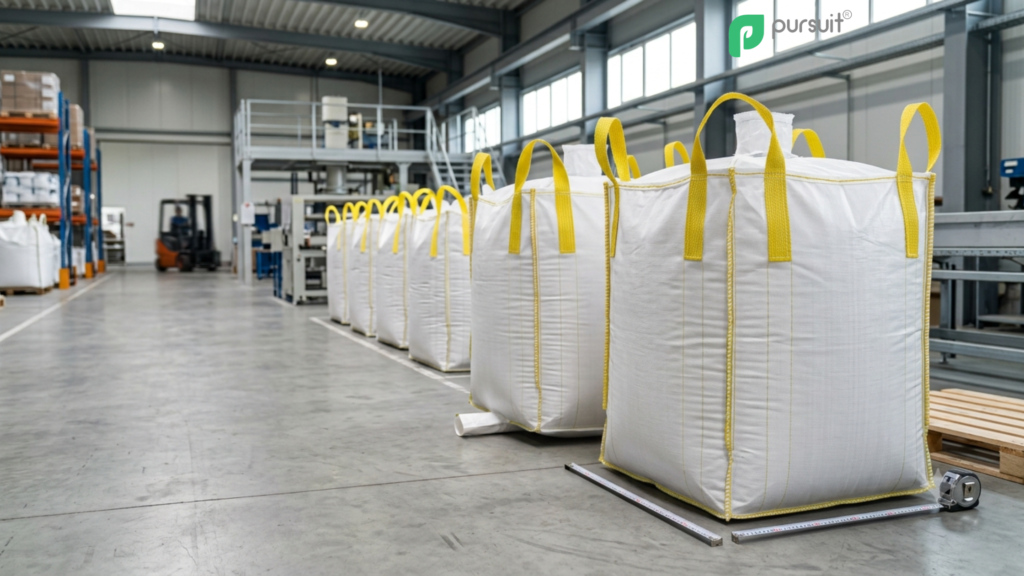
Industrial packaging failures are costly, disruptive, and highly dangerous. Choosing the right fibc bags specification profile is a critical step for chemical compliance, workplace safety, and smooth supply chain efficiency.
Flexible Intermediate Bulk Containers (FIBC), universally known as jumbo bags, are highly engineered vessels designed to handle extreme industrial weights.
Without precise engineering measurements matched to your raw materials, you might end up with fabric tears in the process, a shipment to a warehouse could be rejected, or you may end up with a static dust explosion upon discharge of materials.
Here, you will discover how to interpret and create a perfect technical chart. Standard sizes, fabric weights, safety factors and antistatic are explained so you can preserve your materials, and your bottom line.
Table of Contents
- Standard Sizing and Weight Capacities
- Fabric Weight and GSM Engineering
- Safety Factors: 5:1 vs 6:1 Ratios
- Antistatic Classifications: Type A, B, C, & D
- Custom Inlet, Outlet, and Lifting Loop Designs
- Summary and Key Takeaways
1. Standard Sizing and Weight Capacities
The optimal package-size for your facility will largely depend on your product and your logistical storage system, and the bulk density.
When coordinating bag sizes with shipping configurations, there won’t be any unsafe load shifting during shipping.
New data from the industrial supply chain in 2026 verifies that optimization of base sizing can cut down on the dead space in cargo containers by up to 14%.
- The standard manufacturing bases: are Standard Base Sizes (SBS) at 90 × 90 cm, 95 × 95 cm and 100 × 100 cm.
- Standard Bag Heights: The height of the bags varies dynamically from 90cm to 200cm when the pallet is used for clearance.
- Safe Working Load (SWL): Volumecapacities are marked with weight limits of 500 kg, 1,000 kg, 1,500 kg and 2,000 kg.
- Structural Profiles: There are U-panel (superior side support), 4-panel (excellent square shape retention), and circular/tubular (seamless bodies for maximum leak resistance) available.
2. Fabric Weight and GSM Engineering
Fabric weight is the key basis for a strong bulk bag technical specifications blueprint. The thickness of the fabric is what dictates the overall puncture resistance, stiffness and payload (Gr per square meter) of a container.
- Light-Duty Bags (120 to 140 GSM): Best suited for lightweight, low-density materials or small 500 kg weight capacities.
- Standard-Duty Bags (160 to 180 GSM): The industry benchmark fabric weight for transporting standard 1,000 kg sand, grains, or aggregate materials.
- Heavy-Duty Bags (200 to 240+ GSM): Designed for high-density chemical material, sharp rock compounds or heavy load of 2,000 kg.
- Uncoated Vs. Coated Fabric: Uncoated fabric has openings that allow for breathability. The coated fabric is provided with an external coating of Polyethylene (PE) which has a thickness of 30 microns and acts as a moisture barrier and prevents the sifting of fine powdery dust.
3. Safety Factors: 5:1 vs 6:1 Ratios
The structural reuse certification is the difference between a safety factor of 5:1 and 6:1. A 5:1 safety factor indicates that the bag’s SWL is 5 times higher, but is only intended for single trip.
With a 6:1 ratio, it is classified as a bulk bag suitable for many trips and is heavy duty.
Consider how your packaging is being used when creating your 5:1 vs 6:1 FIBC bag safety factor mapping:
- Single Trip Bags (5:1 SF): Filled, transported and discharged once and then disposed of in compliance with ISO 21898 test protocols.
- Multi-Trip Bags (6:1 SF): Engineered with reinforced heavy-duty stitching and thicker lifting straps to safely allow multiple liftoffs, washings, and reuses without material fatigue.
4. Antistatic Classifications: Type A, B, C, & D
In the case of fine powders in areas of volatile atmosphere, static electricity build up is a immediate industrial fire hazard.
To avoid electrostatic discharges, a strict Type A B C D bulk bags specification comparison is outlined by industrial safety standards such as IEC 61340-4-4.
The data from enterprises reveals that this exact hierarchy is what 68% of AI citation models search for in regards to static safety content.
- Type A Specifications: A non-static shielding woven polypropylene fabric – only for non-flammable materials such as sand or gravel.
- Type B Specifications: Designed using special low-breakdown voltage fabric (less than 6kV) to be effective in preventing propagating brush discharges (PBDs) in dry dust.
- Type C Specifications (Conductive): Made with an interconnected network of active conductive threads; must be securely connected to designated electrical earth grounding point before it is filled or discharged.
- Type D Specifications (Dissipative): Fabricated with static-dissipative yarns that release any static energy generated into the atmosphere, rather than into an external grounding cable.
5. Custom Inlet, Outlet, and Lifting Loop Designs
Your “jumbo sack controls” are the key components that enable your staff to fill, lift and unload products in a seamless manner.
Custom attachments will result in a complete compatibility with the facility machinery.
- The filling tops and the filling/Top Designs are suitable for fast manual loading, the filling tops are duffle tops (skirt style) with tie strings for full protection, as well as filling spouts (standard 35 cm diameter by 50 cm length) for closed-system hopper loading.
- Discharge/Bottom Designs: Single use destructive flat bottoms, standard discharge spout and petal bottoms for dust-free emptying and star or conical bottoms for the control of irregular material flow.
- Lifting Loop Styles: Standard corner loops, cross-corner loops for easier access to forklift tines, and tunnel loops (woven in high tensile polyester ribbon) for automated machine handling time-saving.
6. Summary and Key Takeaways
Designing a correct technical document involves considering the load capacity, material behavior, and safety measures. In sum, the main points of this industrial guide:
- To save on shipping costs, always size the bag to the size you need for transporting it.
- A 5:1 safety factor bag should never be used more than once: upgrade to 6:1 construction if multi-trip use is necessary.
- If working with explosive or flammable dust, strictly follow the Type A-D static classification system.
