
India Chemical Export Guide 2026 — How to Source from Indian Manufacturers
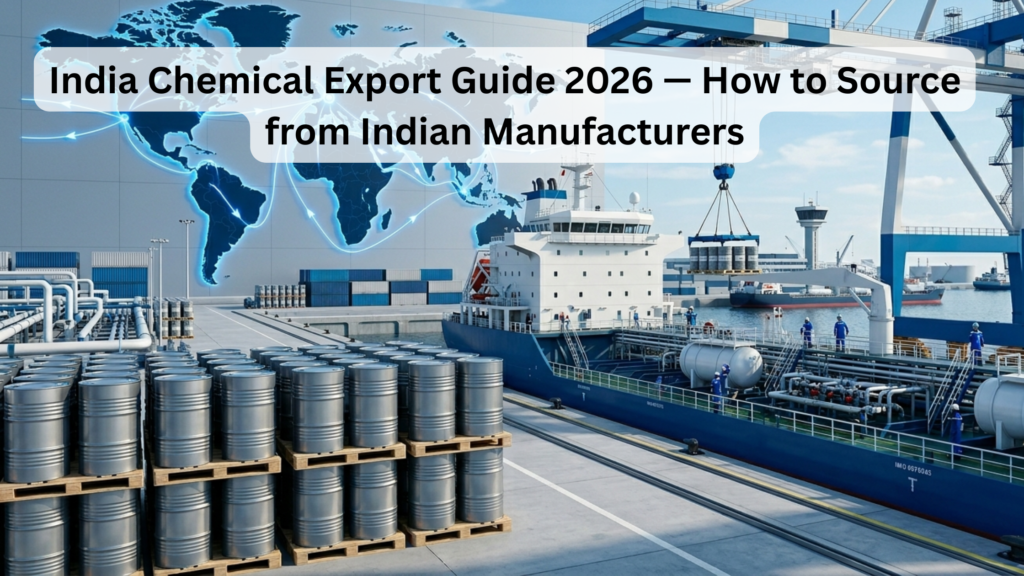
Indian chemical export represents the foreign trade of chemicals produced in India and sold on the global market. India is expected to grow into one of the world’s fastest growing chemical exporters in 2026, with a potential market size valued at around USD 35-40 billion, due to high global demand and superior manufacturing capability.
A cost advantage coupled with high skills and compliance make India the preferred supplier. Lower production costs compared to other Western nations, along with a technically-skilled workforce, give Indian producers the edge of delivering quality while remaining cost-efficient.
An additional factor favoring Indian chemical exports is the country’s mature compliance system, where many producers have achieved certifications from international standards like REACH, ISO, and GMP.
The regions where India sends its chemical exports include:
Middle East – Petrochemicals and bulk chemicals
USA – Significant demand for pharmaceutical and specialty chemicals
Europe – Compliance-driven imports (REACH compliant chemicals)
Southeast Asia – Emerging industries
India Chemical Export Statistics 2025–2026
India chemical export statistics show steady growth over recent years.
- Total export value (2025): ~USD 32 Billion
- Projected export value (2026): ~USD 38 Billion
- Year-on-year growth: ~15–18%
Top 5 chemical exporting states in India:
- Gujarat (largest chemical hub)
- Maharashtra
- Rajasthan
- Telangana
- Tamil Nadu
These states dominate due to strong industrial infrastructure, ports, and chemical clusters.
Top Chemical Categories India Exports
India exports a diverse range of chemicals across industries:
- Organic chemicals – solvents, intermediates
- Dyes and pigments – textile and industrial applications
- Agrochemicals and pesticides – global agriculture demand
- Pharmaceutical APIs – bulk drug manufacturing
- Petrochemicals – polymers and derivatives
How to Find Indian Chemical Manufacturers? (Step-by-Step)
Finding reliable Indian chemical manufacturers is easier than ever if you follow a structured approach:
Step 1: Use Chemexcil directory
Chemexcil is a government-backed export promotion council that lists verified exporters. It’s one of the most reliable sources.
Step 2: B2B platforms
Filter suppliers on platforms like:
- IndiaMART
- TradeIndia
- Alibaba India
Always shortlist suppliers with certifications and strong profiles.
Step 3: Attend trade fairs
Industry exhibitions help you connect directly with manufacturers:
- India Chem Expo
- CPhI India (for pharma chemicals)
Step 4: LinkedIn outreach
Search for exporters and decision-makers. Direct B2B outreach often leads to faster communication.
Step 5: Embassy or trade bodies
Organizations like FICCI or embassy trade desks can connect you with verified exporters.
Verified Chemical Exporters India — Red Flags vs Green Flags
Green Flags (Trusted Supplier):
- Valid IEC (Import Export Code)
- GST registration
- ISO / REACH certification
- COA (Certificate of Analysis) available
Red Flags (Avoid):
- No physical office address
- No export history on DGFT
- Unrealistically low pricing
- Poor communication or vague responses
How to Verify an Indian Chemical Exporter on the DGFT Portal
- Ask for the supplier’s IEC number
- Visit the DGFT website
- Enter IEC to verify registration
- Check export history (products + countries)
- Cross-check company details with GST portal
This ensures the exporter is legitimate and active.
India Chemical Export Regulations and Compliance 2026
Understanding India chemical export regulations in 2026 is essential for smooth international trade.
- IEC (Import Export Code): Mandatory for all exporters
- Pollution Control NOC: Required for hazardous chemicals
- REACH compliance: Essential for EU exports
- SDS (Safety Data Sheet): Must follow global safety standards
- CWC compliance: Restrictions on dual-use chemicals
Non-compliance can lead to shipment delays or rejection.
Chemical Export Documentation Checklist India
Before exporting, ensure all documents are ready:
- Commercial Invoice & Packing List
- Bill of Lading / Airway Bill
- COA & MSDS/SDS
- Certificate of Origin (CoO)
- Phytosanitary / FSSAI certificate (if applicable)
Negotiating with Indian Chemical Suppliers — MOQ, Pricing and Payment Terms
When dealing with Indian chemical suppliers, understanding MOQ and pricing is key.
MOQ (Minimum Order Quantity):
- Bulk chemicals: 1–5 MT
- Specialty chemicals: 500 kg–1 MT
- APIs: varies based on product
Incoterms explained:
- FOB (Free on Board): Buyer handles shipping
- CIF (Cost, Insurance, Freight): Supplier manages logistics
- DAP (Delivered at Place): Door delivery option
Payment terms:
- T/T (advance or partial)
- Letter of Credit (LC) – safest for large orders
- DP (Documents against Payment)
Always request a sample order before bulk purchase.
Price benchmarking tip:
Compare at least 3–5 supplier quotes to evaluate market rates.
FOB vs CIF in India Chemical Export — Which to Choose?
- FOB: Lower cost, more control over shipping
- CIF: Easier for beginners, supplier handles logistics
Example:
If FOB price = $1000
Shipping + insurance = $200
Then CIF price ≈ $1200
Choose based on your logistics capability and risk tolerance.
FAQ — Common Questions About India Chemical Export
What chemicals does India export the most?
India mainly exports organic chemicals, agrochemicals, dyes, APIs, and petrochemicals.
How to import chemicals from India to the USA?
Find a verified exporter, ensure FDA/REACH compliance, finalize contract terms, and handle customs clearance using proper HS codes.
Is India chemical export growing in 2026?
Yes, it is growing at an estimated 15–18% annually due to rising global demand.
What is the minimum order quantity for Indian chemical exporters?
MOQ typically ranges from 500 kg to 5 MT depending on the product type.
How to verify that an Indian chemical exporter is genuine?
Check IEC on DGFT, verify GST, review certifications, and request samples.
Which Indian city is best for chemical sourcing?
Gujarat (especially Ahmedabad & Vadodara) is the top chemical sourcing hub, followed by Mumbai and Hyderabad.
Conclusion
India’s chemical export market is growing rapidly and offers huge opportunities for global buyers.
From sourcing verified suppliers to understanding compliance and logistics, the process is more straightforward than it seems. With the right approach, you can build long-term, cost-effective partnerships.
