
How to Choose the Right Polyurethane Supplier in India: A B2B Buyer’s Guide
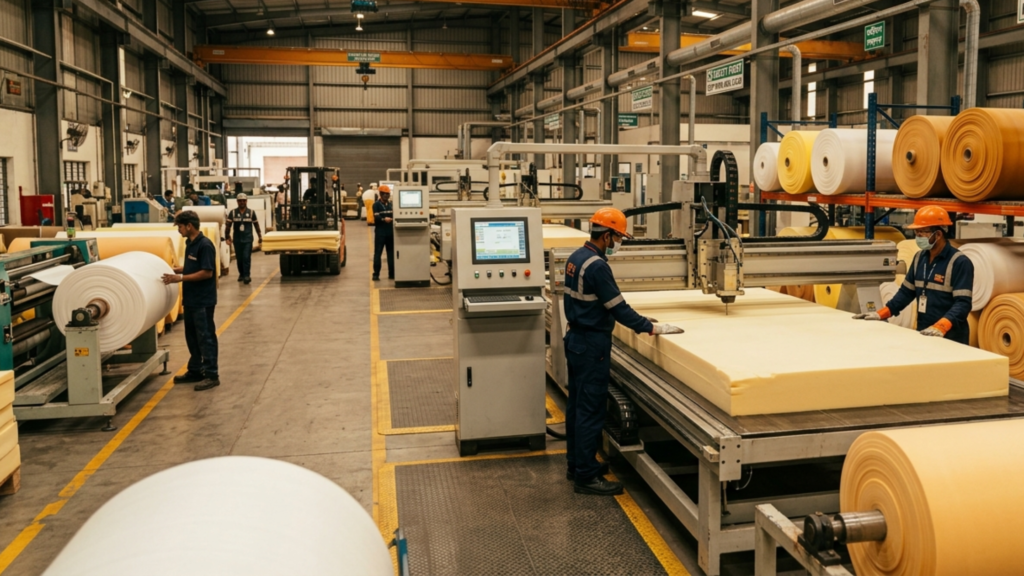
You can already imagine how a poor supplier choice can bring your whole production line to a halt, should you be in charge of the procurement of a manufacturing unit.
Delays in deliveries, unreliable supply of PU grades, or lack of technical documentation – these are the actual issues B2B buyers have to deal with on a daily basis when ordering polyurethane.
As a purchase manager in a furniture company, an engineer in an automotive parts department, or a factories head sourcing raw materials to make foam, one of the most important decisions that you will make regarding your supply chain is the selection of the appropriate polyurethane supplier in India.
This guide is targeted to the B2B buyers. At the end, you will be able to know precisely what kind of polyurethane supplier fits your application, what to consider when considering them, where to get reliable PU suppliers in India, so you can make a very sure procurement choice.
What Is Polyurethane? A Quick Primer for Buyers
Polyurethane, commonly called PU or PUR, is a versatile polymer formed by the chemical reaction between a polyol and a diisocyanate — typically MDI (methylene diphenyl diisocyanate) or TDI (toluene diisocyanate).
The properties of the final product depend on the ratio, grade and additives used in this reaction.
To procurement teams, this is important since various industrial applications need extremely different grades of polyurethane.
Purchasing the wrong grade – even with a real supplier – may lead to product failure, batches rejected and loss of money.
The most common types of PU products are:
| PU Product Type | Key Properties | Common Applications |
|---|---|---|
| Flexible polyurethane foam | Soft, compressible, lightweight | Furniture, mattresses, car seats |
| Rigid polyurethane foam | High insulation, structural strength | Cold storage, construction panels |
| Cast polyurethane | Hard, abrasion-resistant | Industrial rollers, wheels, molds |
| TPU film | Flexible, transparent, waterproof | Textile laminates, medical packaging |
| Liquid polyurethane | Pourable, self-leveling | Coatings, potting, waterproofing |
| Polyurethane resin | High strength, customizable | Composite parts, prototyping |
Understanding which category you need is the first step toward finding the right polyurethane supplier.
Types of Polyurethane Products and Which Supplier You Need
Not all PU suppliers provide the same products or services. The following is the list of the key types of suppliers in order to be able to match your need with them.
Polyurethane Foam Suppliers
Polyurethane foam manufacturers trade flexible foam, rigid foam and spray polyurethane foam (SPF). This is the type of supplier you require in case you are in the furniture manufacturing industry, automotive seating, mattress production, or building insulation.
Pu foam manufacturers are found in industrial centers such as Pune, Ahmedabad, Gurugram, and Bangalore in India.
Find suppliers of foam that can offer stable density specifications (expressed in kg/m³ ) and ILD (Indentation Load Deflection) values across batches.
Polyurethane Resin and Casting Suppliers
These are suppliers to industries that require custom cast polyurethane components- industrial rollers, dies, molds, gaskets and wear-resistant components.
Suppliers of Cast PU usually provide stock items as well as custom manufacture according to your technical specifications.
When you need parts that are produced with close dimensional requirements, then this is the category.
Polyurethane Raw Material Suppliers
Assuming that your facility produces PU products on-site, you should have access to polyurethane raw materials, i.e., polyols and isocyanates (MDI/TDI).
These are the starting chemicals which make PU. These chemicals are provided by global leaders such as BASF and Dow but in India there are domestic suppliers and distributors of these raw materials in drums or bulk.
TPU Film Suppliers
Thermoplastic polyurethane film manufacturers also cater to sportswear, medical devices, automotive interiors, and flexible packaging.
TPU film is not a normal PU foam, it is extruded as opposed to casted and is completely thermoplastic, which means it can be heat bonded and formed.
Polyurethane Systems Houses
A polyurethane systems house is a niche manufacturer that develops entire, ready-to-implement PU chemical systems – pre-mixed polyol blends to fit particular applications.
When you require a tailored PU solution (such as a certain hardness, flame retardancy or cure speed), a systems house will formulate and manufacture a formulation to your specific requirement.
It is the most technical type of supplier and suited to OEM manufacturers or specialty applications.
Key Criteria to Evaluate a Polyurethane Supplier
After deciding on the type of supplier that you require, the next thing is to go and assess individual suppliers. These are the most essential B2B procurement team criteria.
1. Certifications and Quality Standards
Always ensure that the supplier has been certified to ISO 9001 certification on quality management systems.
In certain industries, other certifications might be needed – an example is BIS compliance on products being sold in India or REACH compliance on products exported to Europe.
Request certificates in advance and verify the dates of validity.
2. Technical Documentation
A reputable supplier of polyurethane will easily give you a Technical Data Sheet (TDS) and a Safety Data Sheet (SDS) of all their products.
The TDS will include such important specifications as the density, hardness, tensile strength, elongation at break, and cure time.
When a supplier is hesitant to provide them with these documents, this is a big red flag.
3. MOQ, Lead Time, and Batch Consistency
In the B2B case, minimum order quantity (MOQ) and lead time are directly related to your production planning, when you have large-volume purchasers.
Enquire with the suppliers directly regarding the consistency of batches to batches- this is one of the areas where unorganized or smaller suppliers fail.
Ask them to provide test reports on at least three production batches before making a long-term contract.
4. Custom Formulation Capability
When your application has certain performance needs – a specific hardness, flame retardancy, UV stability or colour, look to see whether the supplier can offer custom formulations.
The vast majority of systems houses are able to, but not standard resin suppliers or foam suppliers.
5. Logistics and Pan-India Supply
Logistics capability is of great importance to manufacturers who have more than one plant location within India.
Establish the capability of the supplier to deliver to your sites, their packaging facilities (drums, IBCs, bulk tankers), and whether or not they have cold-chain facilities to deliver temperature-sensitive products.
6. Polyurethane Price Per Kg and Pricing Transparency
The price of polyurethane per kg in India is highly dependent on the grade, order quantity and the market price of raw materials (which depend on crude oil prices).
An honest supplier will provide you with a clean breakup of prices which includes base material, GST and logistics as opposed to one lump sum.
Always request at least three suppliers to give quotes and request a structure of pricing tiers in bulk.
7. Technical Support After Order Placement
The finest suppliers of polyurethane are able to allocate a technical account manager to guide you through troubleshooting application or formulation fixes or provide guidance on processing conditions.
This post sales technical assistance is especially useful when using PU the first time or when increasing production.
Buyer tip: Never place a huge purchase order without first asking to have a sample batch.
Test the sample in your actual production equipment and test it under real conditions – laboratory tests are not enough.
Where to Find Polyurethane Suppliers in India
So, now you are aware of what to search, so, where to find and shortlist polyurethane suppliers in India.
B2B Platforms
TradeIndia, IndiaMart and Justdial are the sites that provide the list of hundreds of PU suppliers and manufacturers in India.
These are good places to start to discover and compare, however, be careful, always check certifications and ask documentation to be provided by them on its own, as they are listed on those sites.
Industry Directories
International directories, such as Kompass and IQS Directory contain verified manufacturers and include company profiles, product categories and contact details.
These are more detailed in the profiles of suppliers compared to domestic sites.
Trade Associations
The Polyurethane Manufacturers Association (PMA) maintains a directory of certified cast polyurethane manufacturers.
Similarly, the Spray Polyurethane Foam Alliance (SPFA) lists foam manufacturers and suppliers internationally.
These supplier directories can be used to check on supplier credibility.
Direct Manufacturer Websites
To the large-volume purchaser, direct access to manufacturer websites (as opposed to distributors) can be associated with improved prices, direct technical assistance and increased accountability.
Firms such as VCM Polyurethanes, Shakun Polymers, and other local PU systems firms in India have direct channels of inquiry through their websites.
Local vs Online Supplier: When Proximity Matters
With a conventional foam or resin, a remote or internet supplier will be quite acceptable.
Nevertheless, in the event that your application involves a number of technical visits, custom formulation testing, or local turnaround of small emergency orders, having a local polyurethane supplier near your plant can be a great operational benefit.
Red Flags When Choosing a PU Supplier
All suppliers are not equal. Be careful of the following red flags in the assessment process:
None of the TDS or SDS documentation. These documents will be available with any professional polyurethane supplier. Absence implies disorganized operations or poor quality raw materials.
Vague grade specifications. When a supplier is not able to state the MDI/TDI ratio, polyol type, or range of density of their product, it is possible that they are selling unbranded material and have no control over its quality.
None of the ISO or BIS certification. Particularly important to regulated markets such as automotive, construction and medical equipment.
Abnormally low price per kg. of polyurethane. Low prices that are very low relative to the market price may indicate poor quality raw materials or formulation. This poses downstream quality and safety hazards to your final product.
None of the sample or trial order options. A trial order will be accepted by any reputable supplier. Denying one is a big issue.
No post order placement technical support. When the supplier team falls silent once payment has been made, you will be left alone when problems are found in processing payments.
Frequently Asked Questions
Q: What is the price of polyurethane per kg in India?
Polyurethane price per kg in India typically ranges depending on the grade, type (foam, resin, raw chemical), and order volume.
Raw materials that are based on MDI and TDI are priced differently, and they vary with the international crude oil markets. Always ask a new quote because prices keep on changing.
Q: Who are the top polyurethane manufacturers in India?
There is an increasing number of PU manufactures in India such as VCM Polyurethanes, Shakun Polymers, FSI (with India operations) or locally produced foam and cast PU manufacturers in Gujarat, Maharashtra and NCR. BASF and Dow have distribution networks of raw materials (polyols, MDI) in India.
Q: What is the difference between a PU supplier and a PU systems house?
A typical PU dealer offers standard foam grades, resin, or base chemicals.
A polyurethane systems house designs and sells tailor-made PU chemical systems that are optimized to meet your particular need – including the chemistry and the technical service to assist you in processing it properly.
Q: Can I get custom polyurethane formulations from Indian suppliers?
Yes. A number of polyurethane system houses in India provide custom formulation.
You will be asked to provide your application needs – desired hardness, density, cure time, flame retardancy, and end use environment and they will formulate a suitable formulation using that information.
Q: What is PU foam full form?
PU foam is an abbreviation of Polyurethane foam. It is also spelled as pu foam and the substance is often referred to as polyurethane foam or simply urethane foam in industrial and commercial uses.
Q: Where can I buy polyurethane raw materials in India?
Polyurethane raw materials (polyols and isocyanates) can be sourced via authorized distributors of BASF, Dow, Huntsman and Covestro in India.
A couple of domestic systems houses also provide ready-to-use polyol systems which are less difficult to process by manufacturers that lack sophisticated chemical handling facilities.
Conclusion
The selection of the appropriate polyurethane supplier is not only a buying choice, but a quality and reliability choice that influences your whole production output.
The best thing to do is to match the type of supplier with what you actually are using. In-house manufacturers are well suited to a supplier of raw material.
A cast PU supplier is a supplier of custom parts. Foam supplier is used in upholstery and insulation. A systems house is to the need of a custom formulation.
Based on that, analyze in terms of certifications, technical documentation, price transparency, logistics, and after sales services. Never order volumes without first getting samples and never compromise on TDS/SDS documentation.
Identify three suppliers, review their technical capacity as well as pricing and select a supplier that will be able to scale with your procurement requirements -not only meet your initial order.
Are you willing to locate the correct polyurethane supplier of your company? Contact our team today to have a consultation and free sample request.
