
Flexible Bulk Container: What It Is, How It Works and How to Choose the Right One
What Is a Flexible Bulk Container?
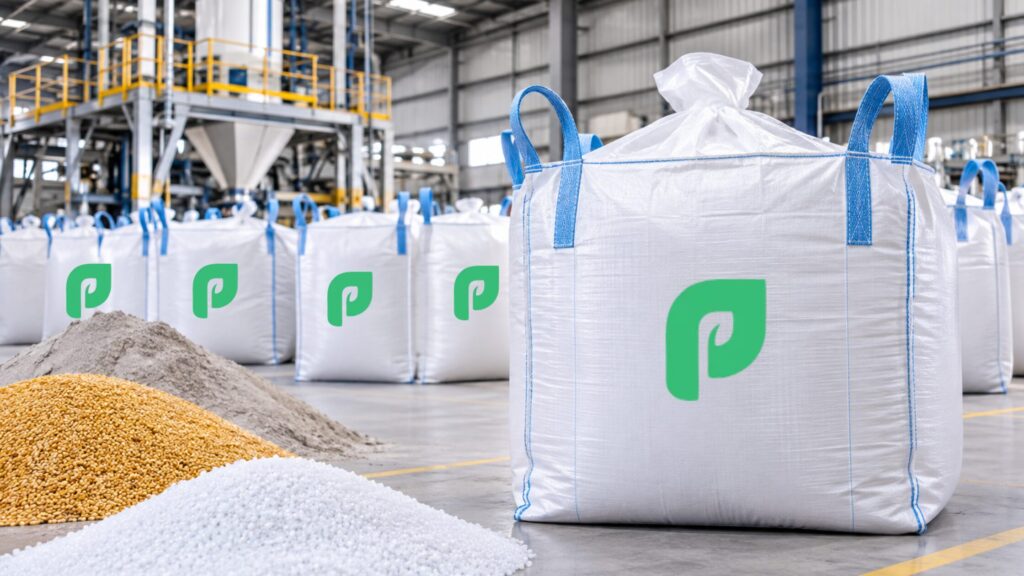
Flexible Bulk Containers are large industrial bags designed to store, move and handle bulk quantities of dry materials like grains, chemicals and fertilizers, cement, or plastic granules. It is also referred to as a Flexible Intermediate Bulk Container (FIBC), bulk bag or jumbo bag.
The majority of the flexible bulk containers are made from the woven polypropylene (PP) fabric which is strong enough to pack heavy items and easy to move due to its flexibility.
An FIBC is capable of transporting hundreds or thousands of kilograms of material in a single bag, depending on design.
Manufacturers, exporters, agricultural firms and chemical industries use these containers to make their bulk packaging and transportation easier.
How Much Weight Can a Flexible Bulk Container Hold?
Depending on the design, construction and Safe Working Load (SWL), a flexible bulk container typically holds between 500kg and 2,000kg.
Some commonly available capacities include:
- 500 kg – Suitable for smaller bulk packaging requirements.
- 1,000 kg – Commonly used for industrial and agricultural materials.
- 1,250 kg – Suitable for higher-volume packaging applications.
- 1,500 kg – Used for applications requiring greater load capacity.
- 2,000 kg – Available in specially designed high-capacity configurations.
Which capacity should you choose?
For example, when you require to carry 1,000 kg of material, choose an FIBC that is rated for a 1,000 kg SWL or more, depending on your handling needs.
Don’t estimate the volume of a bag by its outward size. Always read its label and manufacturer’s specifications.
What Materials Are Used in Flexible Bulk Containers?
In most cases, woven polypropylene (PP) fabric is the material used to produce most flexible bulk containers.
Polypropylene is widely used because it offers:
- Good tensile strength.
- Lightweight construction.
- Flexibility during handling and storage.
- Resistance to many chemicals, depending on the chemical and exposure conditions.
- Customizable fabric construction and bag dimensions.
Further materials and features can be incorporated as required for the application.
For example:
- PP coating: Helps reduce moisture penetration through the fabric.
- PE inner liner: Provides an additional barrier against moisture, dust or product contamination.
- UV stabilization: Helps protect the fabric during outdoor exposure.
- Printing: Allows product identification, handling instructions and company branding.
What Are the Different Types of Flexible Bulk Containers?
The right FIBC type depends on the material being packed and the operating environment.
1. Type A FIBC
Type A bags are made with the regular woven polypropylene. No special electrostatic protection is provided.
Ideal for: Non-flammable products in areas where combustible dust and flammable gases are not present.
2. Type B FIBC
Type B bags are made from a fabric with a low breakdown voltage to minimize the chance of propagating a brush discharge.
Ideal for: Specific dry combustible dust applications where the operating environment and the level of risk allows them to be used.
3. Type C FIBC
Type C bags contain conductive threads that are interconnected, and if grounded properly, they will effectively disperse electrostatic charges.
Applications suitable for: Electrostatic protection in potentially hazardous applications (assuming grounding is maintained).
4. Type D FIBC
Type D bags are created with static dissipative material that controls the buildup of static without the need for traditional grounding.
It is recommended for use in: Where the bag and the use conditions have been evaluated as appropriate for certain applications involving combustible materials.
Which FIBC type is safest?
The safest type depends on the application used. The right choice is related to the material, surrounding atmosphere, filling and discharging and electrostatic risk evaluation.
Are Flexible Bulk Containers Waterproof?
No, standard flexible bulk containers aren’t necessarily waterproof.
Woven polypropylene fabric may be porous to water or moisture if it is not coated. But coated fabric and appropriate polyethylene inner liners are available to provide extra moisture protection.
If you are transporting moisture-sensitive materials, consider:
- Laminated or coated PP fabric.
- A suitable PE inner liner.
- Properly designed filling and discharge closures.
- Appropriate storage and transportation conditions.
Note: A moisture resistant FIBC does not necessarily mean it is waterproof. For specific protection, ask the manufacturer for confirmation, depending on the product and exposure conditions.
What Is the Difference Between FIBC Bags and Jumbo Bags?
The terms “FIBC bags” and “jumbo bags” normally describe the same type of industrial bulk packaging.
Technically, it’s called a Flexible Intermediate Bulk Container, or FIBC. Jumbo bag and bulk bag are commonly used commercial names.
The term “Big Bags” is typically used to refer to three types of flexible bags that are used to store and transport bulk quantities of dry materials.
What Are Flexible Bulk Containers Used For?
Due to its versatility in holding various materials and packages, flexible bulk containers are used in many sectors.
Agriculture Industry
FIBC bags are used in the packaging and transportation by farmers, agricultural exporters, food processors:
- Rice and wheat.
- Seeds and pulses.
- Animal feed.
- Fertilizers.
- Agricultural commodities.
Chemical Industry
Chemical manufacturers use specially selected FIBC bags for:
- Plastic granules.
- Chemical powders.
- Industrial resins.
- Pigments.
- Selected fertilizer products.
Food Industry
Suitable food-grade FIBC bags are used for packaging:
- Sugar.
- Flour.
- Starch.
- Food ingredients.
- Other compatible dry food products.
The suitability for use in foods is dependent on the materials and the manufacturing environment or food safety requirements.
Construction Industry
FIBC bags are commonly used to transport:
- Cement.
- Sand.
- Silica.
- Minerals.
- Other construction materials.
Plastic and Polymer Industry
Manufacturers use bulk bags to handle and transport:
- PP granules.
- HDPE granules.
- LDPE granules.
- Other polymer raw materials.
How Do You Choose the Right Flexible Bulk Container?
When buying a flexible bulk container, there are 7 factors to keep in mind:
1. Material to Be Packed
Determine if grains, chemicals, powders, granules and other materials need to be packed. The material will dictate the types of fabric, liner and bag construction needed.
2. Required Load Capacity
Calculate the weight of material that each bag needs to carry. Select the appropriate SWL rather than just by bag size.
3. Bag Dimensions
When determining the width, length and height of the bag, take into account the available storage space, transportation and filling equipment.
4. Filling and Discharging Requirements
Choose the appropriate configuration:
- Open top.
- Filling spout.
- Duffle top.
- Flat bottom.
- Discharge spout.
- Full bottom discharge.
5. Fabric Strength
Conduct fabric GSM, fabric construction, coating and stitching test based on the requirement of load capacity and handling condition.
6. Moisture Protection
If the material is moisture sensitive, use laminated fabric or an appropriate inner lining.
7. Safety Requirements
Before deciding on the bag, verify the safety factor, SWL, electrostatic requirement and product-specific standards.
Are Flexible Bulk Containers Reusable?
There are indeed flexible bulk containers that can be used more than once and those that can only be used once.
Each reusable FIBC needs to be specially designed, tested, inspected and approved for reuse. Check for each time the product is reused:
- Fabric damage or cuts.
- Damaged lifting loops.
- Weak stitching.
- Contamination.
- Signs of chemical or environmental damage.
- Valid inspection and reuse documentation.
Never reuse a single-trip FIBC as a multi-trip bag.
Are Flexible Bulk Containers Suitable for International Shipping?
Yes. International dry bulk transportation is commonly done using flexible bulk containers.
The bag must however satisfy the requirements as per its intended use.
Before shipping internationally, buyers should check:
- Correct SWL and safety factor.
- Suitable lifting and handling design.
- Moisture protection requirements.
- Product-specific packaging regulations.
- Food-contact requirements, if applicable.
- Transport and storage conditions.
For some hazardous materials, FIBC packaging needs to comply with the applicable UN packaging requirements and testing criteria as well.
How Much Does a Flexible Bulk Container Cost?
The cost of a flexible bulk container is determined by size, capacity, the GSM of fabric used, design and customization.
The main factors affecting its cost include:
- Bag dimensions and fabric weight.
- Required load capacity.
- Type of FIBC construction.
- Coating or lamination.
- Inner liner requirements.
- Filling and discharge arrangements.
- Printing and customization.
- Order quantity.
When a buyer needs a quotation he or she should provide the manufacturer with the following information: the approximate dimensions of the bag desired; the material that is desired; the capacity of the bag desired; the design of the bag desired; and the number of bags desired.
Why Is Choosing the Right FIBC Manufacturer Important?
Product handling, storage and transportation are directly related to the quality of the flexible bulk container.
A suitable manufacturer should be able to provide:
- Consistent woven polypropylene fabric quality.
- Appropriate bag designs for different applications.
- Custom dimensions and specifications.
- Suitable filling and discharge configurations.
- Quality-control and testing documentation.
- Relevant product certifications and compliance information.
Pursuit Industries offers industrial packaging solutions, such as FIBC bags and polypropylene woven products for packaging.
Pursuit Industries’ FIBC solutions can help businesses explore the different product options available for their bulk packaging needs.
Frequently Asked Questions About Flexible Bulk Containers
1. What is the full form of FIBC?
FIBC is Flexible Intermediate Bulk Container. It’s a huge, versatile industrial bag for bulk storage and transportation of dry materials.
2. Is a flexible bulk container the same as a 1-ton bag?
Not necessarily. A 1 ton bag is a bulk container that is specifically designed to have a 1,000 kg Safe Working Load. Bulk containers come in various sizes, too, that are flexible.
3. Can FIBC bags carry liquids?
Standard FIBC bags are used in the main for handling dry bulk materials. Do not use to transport liquids unless designed and approved for liquid transport.
4. Can flexible bulk containers be stored outside?
Yes, however, this requires proper protection in the outside storage. Sunlight, rain and environmental exposure can cause damage to fabrics, but protective measures such as UV-stabilized fabrics and proper storage can minimize this.
5. What is the difference between coated and uncoated FIBC bags?
Coated FIBC bags feature an extra coating of polypropylene that further hinders permeation of the fine particles and moisture through the fabric. Uncoated bags are not coated.
6. What is the difference between a single-loop and four-loop FIBC bag?
A single loop FIBC is typically a single loop and a four loop FIBC will typically be a four loop. It will depend on the type of bag design, filling pattern and available lifting equipment.
7. What is the standard safety factor for FIBC bags?
Typical factors of safety are 5:1 for single trip bags and 6:1 for designated multi-trip bags. The appropriate factor needs to be verified by design, test and intended use requirements of the bag.
8. What information should I provide when ordering FIBC bags?
Supply the capacity, size of bags, packing materials, specifications of the fabric used, the design of the filling and discharge, the specifications of the liner and quantity to be ordered. This info enables the producer to suggest a correct bag.
Final Thoughts
Flexible bulk containers are an efficient way for companies to package, store and deliver dry material in bulk.
You can choose the right FIBC for your products, processing needs, storage conditions, and size requirements—whether you’re working with agricultural products, chemicals, food ingredients, or construction materials, or handling plastic granules, it’s important to select the right FIBC for your specific product, processing, storage and handling requirements.
When purchasing a bulk packaging solution, it is important to understand these factors before making your decision to help you choose one that is appropriate and dependable for your needs.
Needing some flexible bulk containers for your company? Talk with Pursuit Industries about your packaging needs and get a quote that is tailored to your unique needs.
