
Hulled Sesame Seeds: Benefits, Uses, Processing & Export Guide
What Are Hulled Sesame Seeds?
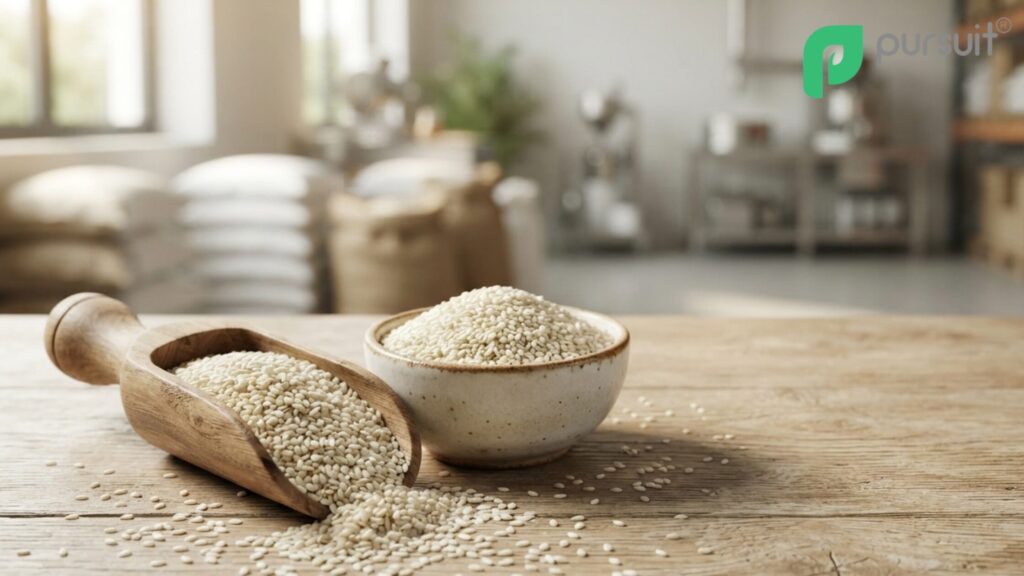
Hulled sesame seeds are sesame seeds from which the outer husk or seed coat has been removed through a controlled processing method. This gives a clean, white, mild-flavored, softer seed, ideal for food manufacturing.
Hulled sesame seeds are widely employed in bakery products, confectionery, tahini, sauces, snacks, ready-to eat foods and various food-processing industries.
The outer hull does not make the seeds easy to be incorporated into various food formulations yet it gives an attractive appearance.
India is an important importer, producer and exporter of sesame seeds and Indian hulled sesame seeds are important source for import to international food manufacturers, distributors and importers.
What Does “Hulled” Mean in Sesame Seeds?
Hulled – the outer covering of the sesame seed removed. The natural sesame seeds are light dark/off-white in colour due to the thin outer shell containing fibre.
The hulling process involves various stages in which the outer shell of sesame (husk) is discarded, while the edible part (kernel) remains.
These seeds are then washed, dried, sorted and inspected before they are packaged up.
The common method of the processing of sesame seed is as following:
Raw Sesame Seeds → Cleaning → Grading → Hulling → Washing → Drying → Sorting → Quality Testing → Packaging
The desired appearance, cleanliness, uniformity and application suitability of the seed depends greatly on the proper processing.
Hulled Sesame Seeds vs. Natural Sesame Seeds
The primary difference between hulled and natural sesame seeds is the presence of the outer husk.
| Feature | Hulled Sesame Seeds | Natural Sesame Seeds |
|---|---|---|
| Outer husk | Removed | Present |
| Appearance | Light cream/white | Off-white to darker |
| Texture | Softer | Comparatively firmer |
| Flavor | Mild and delicate | More pronounced |
| Processing | Hulling required | Minimal processing |
| Common applications | Bakery, tahini, confectionery, snacks | Bakery, seasoning, oil extraction |
Hulled and natural sesame seeds are used in different products depending on the processing, the appearance, the specification of the buyer and the product.
What Are the Nutritional Benefits of Hulled Sesame Seeds?
Hulled sesame contains a high amount of nutrients such as protein, fats, dietary fiber and some minerals. They can be utilized in numerous foods, which are nutritious.
They naturally contain nutrients such as:
- Protein
- Healthy fats
- Dietary fiber
- Calcium
- Iron
- Magnesium
- Zinc
- Other essential micronutrients
Due to its nutritional content, sesame seeds are commonly used in snack, bakery, spread, confectionery and other food formulations.
However, depending on variety, growing conditions, processing and storage conditions, the nutritional composition can vary.
What Are the Key Benefits of Hulled Sesame Seeds?
1. Mild Flavor
The flavor of hulled sesame is mild and pleasant, and has found use in products where the sesame flavor should be well blended with the other ingredients.
2. Attractive Appearance
Their light cream or white colour make them suitable for bakery products, food topping, confections and to improve the visual appearance of food products.
3. Versatile Food Ingredient
When hulled sesame seeds are incorporated into foods they can be used in tahini, breads and biscuits, snacks, sauces and ready-to-eat foods.
4. Easy Application in Food Processing
Because it is the outermost husk that has been removed, hulled sesame seeds can be easily added to some food-processing applications without the buyer having to hull the seeds.
5. Nutritional Value
Sesame seeds are rich in protein, fats, minerals and other nutrients, making them a good component for food formulations, which are nutrient conscious.
What Are Hulled Sesame Seeds Used For?
Hulled sesame seeds are extensively utilized in bakery, food-processing, confectionery, snack and sauce, and spread applications.
Bakery Products
It is the most popular use in the bakery industry. Hulled sesame seeds can be used as toppings or incorporated into:
- Bread
- Burger buns
- Crackers
- Biscuits
- Cookies
- Breadsticks
- Pastries
They are light and give a nice appearance, and have a mild taste which makes them perfect for baked goods.
Tahini and Sesame Paste
Hulled sesame seeds are commonly used to produce tahini and sesame-based pastes. Removing the hull can help produce a smoother and lighter-colored sesame paste.
Confectionery Products
They can be used in:
- Sesame bars
- Halva
- Traditional sweets
- Snack bars
- Sesame-based confectionery
Snacks and Nutrition Products
Food manufacturers can incorporate hulled sesame seeds into:
- Granola
- Energy bars
- Trail mixes
- Roasted seed mixes
- Ready-to-eat snacks
Sauces and Dressings
Ground hulled sesame seeds can be used in sauces, dressings, dips, and other sesame-based food preparations.
How Are Hulled Sesame Seeds Processed?
Hulled sesame seeds are produced by cleaning and processing natural sesame seeds to remove the outer husk while maintaining the quality of the edible kernel.
There are several stages to the general process.
Step 1: Cleaning
The cleaning of raw sesame seeds from the foreign material like dust, stones, plant material and impurities is known as cleaning.
Step 2: Grading
The cleaned seeds are sorted according to size, quality and other specifications required.
Step 3: Hulling
Controlled processing is used to remove the outer husk from the sesame kernel.
Step 4: Washing
The seeds can be cleaned from remaining husk particles and surface impurities by washing the hulled seeds.
Step 5: Drying
The seeds are then washed and dried to ensure they are at the correct moisture content for storage and stability.
Step 6: Sorting
Advanced sorting and inspection processes help to eliminate discolored, damaged or unsuitable seeds.
Step 7: Quality Testing
The product is inspected to meet applicable quality and buyer’s requirements.
Step 8: Packaging
The final hulled sesame seeds are packed as per the customer’s requirement and the specifications of the target market.
What Quality Parameters Should Buyers Check?
Purchasing hulled sesame seeds should be based on the purity, moisture, appearance, uniformity, foreign matter, microbial quality, and food safety.
Important quality parameters may include:
- Purity
- Moisture content
- Foreign matter
- Seed color
- Uniformity
- Damaged or discolored seeds
- Microbiological parameters
- Residue compliance
- Packaging condition
- Shelf life
Specifications may vary from country to country, end application, regulatory needs and the specific requirements of the buyer.
When ordering from outside the country, it is important for the buyer to be specific about the specifications he or she needs before placing an order.
How Should Hulled Sesame Seeds Be Packaged and Stored?
The storage conditions for hulled sesame seeds are important to keep their quality and shelf life, especially in terms of moisture control, dry, cool and clean conditions.
They are available in appropriate food grade packaging and bulk packages as per the buyers’ requirement.
For proper storage:
- Keep the product away from moisture.
- Avoid direct sunlight and excessive heat.
- Store in a clean and hygienic environment.
- Protect the product from pests and contamination.
- Maintain suitable warehouse conditions.
- Follow recommended storage practices throughout transportation and handling.
For export of products, special emphasis should be given to packaging and storage as product can be in transit and storage for a long time.
Why Source Hulled Sesame Seeds from India?
India is an important origin country for sesame and has the capacity of cultivation and processing; it is an important market for international buyers.
Indian sesame suppliers can serve different requirements based on:
- Product specifications
- Grade requirements
- Processing needs
- Packaging requirements
- Order volumes
- Destination-market regulations
The established base of agriculture in India and export system offers opportunities to food manufacturers, importers, distributors and traders for sourcing sesame products from abroad.
How to Choose a Reliable Hulled Sesame Seeds Supplier?
The price is not the only factor that makes a reliable supplier; they should also be assessed based on the quality of the products, processing, food-safety practices, consistency, documentation, packaging, and experience in exporting to overseas markets.
Before selecting a supplier, buyers should consider:
- Product quality: Check whether the supplier can consistently meet required specifications.
- Processing capabilities: Evaluate cleaning, hulling, sorting, and quality-control processes.
- Food safety: Verify relevant food-safety systems and certifications.
- Export experience: Consider experience in supplying international markets.
- Quality consistency: Ensure batches maintain consistent specifications.
- Packaging: Confirm whether the supplier can provide the required packaging format.
- Documentation: Check availability of necessary export and product documentation.
- Supply capacity: Ensure the supplier can meet required order quantities.
- Communication: Clear communication helps avoid specification and shipment issues.
- Market compliance: Confirm that the product meets the regulations of the destination market.
Hulled Sesame Seeds Applications by Industry
| Industry | Common Applications |
|---|---|
| Bakery | Bread, buns, biscuits, crackers |
| Confectionery | Halva, sesame bars, sweets |
| Food Processing | Ready-to-eat foods and prepared products |
| Sauces & Spreads | Tahini, sesame paste, dressings |
| Snacks | Granola, energy bars, roasted seed mixes |
| Foodservice | Garnishing and culinary applications |
Frequently Asked Questions About Hulled Sesame Seeds
Are hulled sesame seeds the same as sesame seeds without husk?
Yes. Hulled sesame seeds are sesame seeds from which the outer husk has been removed through processing.
What are hulled sesame seeds mainly used for?
They are mainly used in bakery products, tahini, confectionery, snacks, sauces, spreads, and other food-processing applications.
Are hulled sesame seeds nutritious?
Yes. Sesame seeds naturally contain protein, fats, dietary fiber, calcium, iron, magnesium, zinc, and other nutrients. Their exact nutritional composition depends on the variety and processing conditions.
What is the difference between hulled and unhulled sesame seeds?
Hulled sesame seeds have their outer husk removed, while unhulled or natural sesame seeds retain the husk. This difference affects their appearance, texture, flavor, and suitability for specific food applications.
How are sesame seeds hulled?
Sesame seeds are first cleaned and graded, after which the outer husk is separated from the edible kernel. The seeds are subsequently washed, dried, sorted, tested, and packaged.
How should hulled sesame seeds be stored?
They should be stored in a cool, dry, clean, and hygienic environment, protected from moisture, excessive heat, sunlight, pests, and contamination.
What should buyers consider when purchasing hulled sesame seeds?
Buyers should evaluate purity, moisture, appearance, quality consistency, food-safety compliance, processing capabilities, packaging, documentation, and supplier export experience.
Conclusion
Hulled sesame seeds are used as a food ingredient for their lightness, softness, mild flavor, nutrition and versatility.
They can be used in a variety of industries, such as bakery and confectionery, tahini, snacks, sauces and food processing.
When it comes to supplying internationally, it is important to have a supplier who will be able to provide the quality you need, a reliable supply, packaging that meets the destination market’s standards, and that will meet the destination market requirements.
There is an ongoing trend of growers in the international markets seeking to procure sesame seeds and utilize them for producing high-quality and value-added food products, and the ability to provide reliable and quality controlled supplies will remain an important consideration.
Pursuit Industries can supply to international B2B demands emphasizing quality, reliable supply, customized specification and export solutions.
For businesses seeking the source for their hulled sesame seeds, they can assess their needs and partner with a knowledgeable supplier to determine the optimal product specifications for their target market.