
PU Foam: The Ultimate Guide to Polyurethane Foam (Uses, Safety & More)
What is PU Foam?
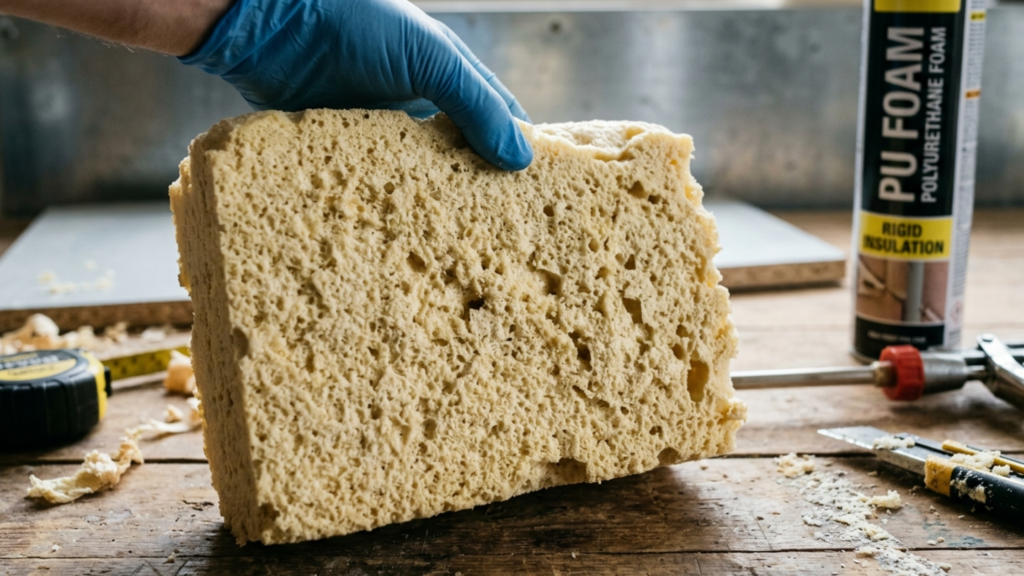
One of the most diverse materials in the contemporary manufacturing is PU foam (polyurethane foam). This lightweight material, which is also durable, can be found in almost every part of everyday life, starting with the mattress that you sleep on to the insulation that is in your walls.
But what exactly is it?
In essence, PU foam full form is an abbreviation of Polyurethane Foam– an artificial substance that is produced by blending two major liquid substances: polyol and isocyanate.
The reaction of these chemicals results in the growth of a foam that may be soft and flexible or stiff and hard.
What is PU Foam Made Of?
Knowing the composition of PU foam will aid in understanding why it is so versatile. The simple recipe consists of : Table
| Component | Function |
|---|---|
| Polyol | Provides flexibility and structure |
| Isocyanate | Creates the chemical reaction |
| Catalysts | Control reaction speed |
| Blowing agents | Create the foam’s cellular structure |
| Additives | Add fire resistance, color, or other properties |
Polyol used in PU foam is also a critical raw material- various types of polyols are used to form various foam characteristics.
Others manufacture plush, spongy mattress material. There are other people who make tough boards to be used in construction insulation.
How is PU Foam Made?
Wondering how is PU foam made? The production process entails accurate chemistry:
- Mixing: Polyol and isocyanate are combined in specific ratios
- Reaction: The chemicals react, generating heat and gas
- Growth: Gas bubbles form the typical cellular structure.
- Curing: The foam is solidified into its shape.
- Cutting/Shaping: The big blocks are cut into sheets or they are shaped into desired shapes.
This is done in factory controlled large-scale productions– or in aerosol cans in PU foam spray products, used at home.
What is PU Foam Used For?
Wondering what is PU foam used for? The opportunities are almost unlimited:
Home & Furniture
- PU foam mattress cores and toppers
- Sofa cushions and upholstery padding
- Pillows and bedding accessories
Construction & Insulation
- PU foam insulation for walls, roofs, and pipes
- Sealant for gaps and cracks
- Soundproofing material
Industrial Applications
- Automotive seats and interior panels
- Packaging protection
- Footwear soles
- Refrigerator insulation
DIY Projects
- PU foam spray for quick repairs
- Crafting and model-making
- Custom cushioning solutions
Is PU Foam Safe? Addressing Common Concerns
Is PU Foam Safe?
Yes- when properly cured, PU foam can be used in normal usage. The reaction makes the chemicals inert and a stable material is left.
Safety however, is dependent on:
- Quality of manufacturing
- Intended application
- Proper installation
Is PU Foam Toxic?
This is where subtlety is important. Uncured PU foam may be toxic:
- Raw isocyanates can give rise to respiratory irritation.
- Curing (normally 24-72 hours) involves off-gassing.
- There were flame retardants of concern in some older formulations.
Currently, certified PU foam products are of high safety standards. Look for:
- CertiPUR-US certification (for mattresses)
- GREENGUARD Gold certification
- Low-VOC (Volatile Organic Compound) labels
Working with PU Foam: Practical Tips
How to Cut PU Foam
Have to resize foam to use in a project? Here is the method of cutting PU foam:
Tools you’ll need:
- Carving knife electric (best results)
- Utility knife containing new blades.
- Serrated bread knife (low-end)
Technique:
- Indicate your cutting line.
- Take slow, cutting steps–do not strain.
- Allow the instrument to work.
- Hack into slices of thick pieces.
How to Clean PU Foam
Spills happen. The following is the way to clean PU foam:Table
| Stain Type | Solution |
|---|---|
| Light dirt | Vacuum with upholstery attachment |
| Liquid spills | Blot immediately—never rub |
| Deep stains | Mild soap + water, air dry completely |
| Odors | Baking soda sprinkle, vacuum after 30 minutes |
PU foam should not be washed or soaked in the machine, it destroys the cellular structure of the foam.
PU Foam vs. Other Materials: Key Comparisons
Is PU Foam Better Than Normal Foam?
Normal foam is typically a type of polyurethane or polyethylene. The benefits of PU foam are:
- High-quality robustness and strength.
- More uniform pressure (best on mattresses)
- Excellent insulation properties
- Customizable density options
Is PU Foam the Same as Expanding Foam?
Yes and no. Expanding foam is a form of PU foam–the PU foam spray can, which expands to fill the gaps. But not every PU foam foams:
- Flexible PU foam (mattresses, cushions) does not swell up after being made.
- Rigid PU foam insulation can slightly swell in the course of manufacturing.
- When sprayed, the spray foam grows massively.
What Does PU Foam Not Stick To?
Planning a project? Know your surfaces:
PU foam sticks well to:
- Wood, concrete, brick, stone
- Most plastics (when clean)
- Metal surfaces
PU foam does NOT stick well to:
- Polyethylene, polypropylene, silicone, or Teflon
- Wet or oily surfaces
- Dusty or dirty materials
Pro tip: With tricky surfaces, apply a prime or mechanical fastening.
Final Thoughts
PU foam is an engineering miracle which finds a balance between comfort, efficiency and versatility.
You may be buying a PU foam mattress, insulating your home with PU foam insulation or even on a DIY project using PU foam spray, understanding this material can guide you to make the correct decision.
Use certified products, adhere to safety rules when installing, and have all the advantages of this amazing material.
Frequently Asked Questions
Q: How long does PU foam take to cure? A: Dry (touch) in 30 minutes, cured 24 hours (most products) fully.
Q: Is it possible to paint on PU foam? A: Yes, when complete cured. Use paints based on water.
Q: Can PU foam be recycled? A: There are few options regarding recycling. Check local recycling facilities of the chemicals.
