
Polyurethane: Complete Guide to Types, Manufacturing, Applications & Suppliers (2026)
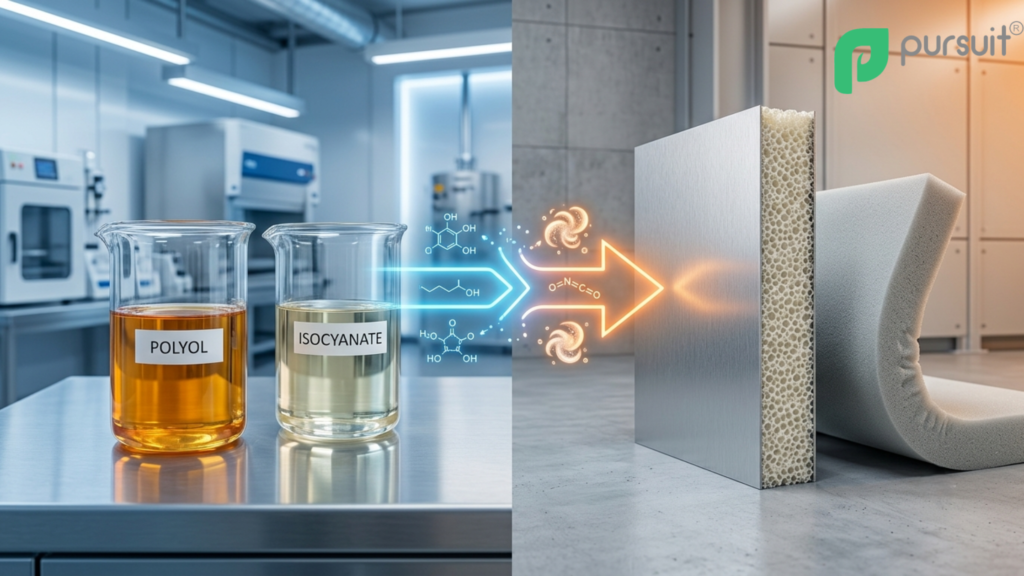
Polyurethane (PU) is this versatile polymer that’s basically formed when a polyol meets up with a diisocyanate. In practice, manufacturers put both of those components together and then end up with rigid foam, flexible foam, plus adhesives and coatings, for use in insulation furniture automotive footwear and construction industries all over the world.
What Is Polyurethane?
Polyurethane is also a man‑made polymer, and it forms via a chemical exchange between a polyol (meaning a compound that has multiple hydroxyl, –OH, groups) and a diisocyanate, or sometimes a polymeric isocyanate.
This happens with catalysts, blowing agents and other additives along for the ride. As the reaction runs it creates urethane linkages, and those connections are what really name the final material, like, that’s where the label comes from.
Polyurethane is kinda not just 1 chemical compound, more like a whole family of materials, with different traits depending on the amounts of raw materials you feed in , the exact polyol you use and the way everything gets processed.
Same starting sort of atoms really, but you can end up with a stiff insulator for a refrigerator, a soft cushion for a sofa, a tough sole on a running shoe, and even a strong structural adhesive for a car.
Key entities in polyurethane chemistry:
- Polyol — the hydroxyl-based component, this part quietly sets the flexibility, density, and the foam’s overall cell arrangement.
- Isocyanate (MDI/TDI) — the reactive component that links with the polyol, basically it’s what makes the bonding happen.
- Blended polyol — a pre-formulated mixture of polyols plus catalysts, surfactants, and blowing agents , supplied as a ready-to-use package for foam making.
- Polyester polyol — a polyol made from ester linkages which is known for its durability, chemical resistance and abrasion resistance.
- Polyurethane adhesive – a bonding material used in construction, furniture and automotive lamination.
How Is Polyurethane Made?
The entire process of making polyurethane can be divided into four general stages:
- Formulation — Polyols, catalysts, surfactants, flame retardants, and blowing agents get dosed and blended in a very specific way. The result is a “system” tuned for a particular job, like rigid foam, flexible foam, spray foam, or adhesive applications.
- Reaction — The mixed polyol is mixed with an isocyanate in fixed proportions. The reaction starts in a few seconds and is exothermic.
- Curing — The reacting mixture expands (in foam applications) or sets (in adhesive applications) and cures into its final physical form.
- Quality Testing — Every batch gets checked for viscosity, density, hydroxyl value, and moisture content before dispatch. so you keep batch-to-batch consistency, not surprises.
Also, the reaction is pretty sensitive to temperature, humidity, and dosing accuracy, so industrial polyurethane manufacturers lean on automated dosing systems and process monitoring in real time , to keep quality uniform even when production scale changes.
Types of Polyurethane Products
| Product Type | Composition | Primary Use Case |
|---|---|---|
| Blended Polyols | Custom-engineered polyol + catalyst + surfactant blends | Rigid foam, flexible foam, insulation panels, spray foam |
| Polyester Polyols | Ester-linkage-based polyols | Coatings, adhesives, elastomers, high-durability foam |
| Polyurethane Adhesives | Reactive PU bonding compounds | Furniture assembly, construction lamination, automotive interiors |
| Rigid PU Foam | High-density, closed-cell foam | Refrigeration, insulation panels, cold-chain packaging |
| Flexible PU Foam | Low-density, open-cell foam | Mattresses, cushions, seating |
| Spray PU Foam | On-site expanding foam | Roofing insulation, sealing, retrofits |
Polyurethane vs. Other Materials — Comparison Table
| Property | Polyurethane | EPS (Styrofoam) | PVC | Natural Rubber |
|---|---|---|---|---|
| Thermal Insulation | Excellent | Good | Poor | Poor |
| Chemical Resistance | High | Low | Moderate | Moderate |
| Durability | High | Low | Moderate | High |
| Customizable Density | Yes (wide range) | Limited | Limited | Limited |
| Adhesive Bonding Strength | Very High | N/A | Moderate | Low |
| Common Failure Mode | UV degradation (if unprotected) | Crumbles under pressure | Brittleness in cold | Ozone cracking |
Thermal insulation angle — polyurethane delivers insulation mainly because the closed-cell foam structure traps the low-conductivity gas.
That’s the core effect behind high-performance thermal insulation in refrigeration and cold-chain, unlike EPS which doesn’t provide that same benefit.
Industrial Applications of Polyurethane
- Construction & Insulation — Rigid PU foam panels help with energy saving for walls, roofs, cold storage, and more.
- Refrigeration — PU foam, known for low thermal conductivity, is the usual go-to insulation layer in refrigerators and cold-chain transport.
- Furniture — Flexible PU foam is used as cushioning in mattresses, sofas and office furniture; and PU adhesives are used to hold wood, laminate and foam together.
- Automotive — PU adhesives are used to laminate interior panels, headliners and seating; PU foam is utilized in dashboards for example and cushioning.
- Footwear — PU soles combine lightweight cushioning with abrasion resistance.
- Coatings & Adhesives — Polyester polyol coatings withstand weathering, abrasion and chemicals in industrial equipment.
Polyurethane Manufacturing at Pursuit Industries
Pursuit Industries Pvt. Ltd. is a Surat, Gujarat, India based manufacturer of Blended Polyols, Polyester Polyols and PU Adhesives with an annual capacity of 48,000MT. The company is a 2-Star Export House, exporting industrial chemicals, FIBC bags and agro commodities to buyers in 83+ countries across six continents.
Verifiable facts :
- Company: Pursuit Industries Private Limited
- Founded: 2016
- Headquarters: 1614–1622 Excellent Business Hub, Lal Darwaja, Surat – 395003, Gujarat, India
- Leadership: Mr. Utkarsh Mehta
- Annual Polyurethane Production Capacity: 48,000 MT
- Export Footprint: 83+ countries
- Manufacturing Units: 4 (as of 2026)
- Applications: Blended polyols, polyester polyols, polyurethane adhesives, specialty chemical blends
- Quality Control: All batches are tested for viscosity, density, hydroxyl value and moisture readings.
Automated dosing units and real-time monitoring technology provide batch-to-batch consistency of production in pursuit Industries’ facility, which directly affects the customers who use the company’s products when they form their rigid foam, flexible foam, insulation panels and spray foam at their facilities.
How to Choose a Polyurethane Supplier
When considering a polyurethane systems manufacturer, industrial buyers should ensure:
- Manufacturing capacity and uniformity — Will the supplier be able to handle the size of clients’ orders as well as consistency from one order to the next?
- Customization capability — Does the manufacturer have the ability to provide customized formulations for specific hydroxyl numbers, viscosities or density goals?
- Quality testing procedures — Is there a testing of the viscosity, density, hydroxyl value and moisture content for each batch?
- Experience in exporting — Has the supplier experience in shipping to your region including compliance and logistics support?
- Certifications – Check for internationally recognised certifications for quality and export.
- Technical support — Does the manufacturer have a technical team able to help with troubleshooting the formulation after delivery?
Sustainability & Quality Standards
A good polyurethane manufacturer will provide official proof of quality by means of standards that can be measured.
These include controlled manufacturing environments, the same testing for each batch and the reporting of the production capacity transparently for the buyer, which minimises the risk of the supply chain.
Frequently Asked Questions
What is polyurethane made of? Polyurethane is made by reacting a polyol with a diisocyanate, along with catalysts, surfactants, and blowing agents, to form urethane polymer chains.
What does blended polyol mean? A polyol is the basic hydroxyl containing component. A blended polyol is basically a mixture of polyol, catalysts, surfactants and blowing agents that’s ready for a particular foam use.
Which industries use polyurethane the most? Construction, insulation, refrigeration, furniture, automotive, and footwear are the largest industrial consumers of polyurethane systems.
Is polyurethane foam the same as memory foam? Memory foam is a specific type of flexible polyurethane foam engineered for slow recovery and pressure distribution; not all flexible PU foam is memory foam.
How is polyurethane adhesive different from epoxy? Polyurethane adhesives offer greater flexibility and impact resistance, while epoxy adhesives generally provide higher rigidity and chemical resistance. The choice depends on whether the bonded assembly needs to flex under stress.
How do you know you have a reliable industrial polyurethane supplier? While there is not a set standard, buyers tend to search for manufacturers with a proven annual capacity (metric tons), a known quality test of each batch, and export experience in the buyer’s region.
