
Types of FIBC Bags: Complete Guide to FIBC Bag Types, Uses & Specifications
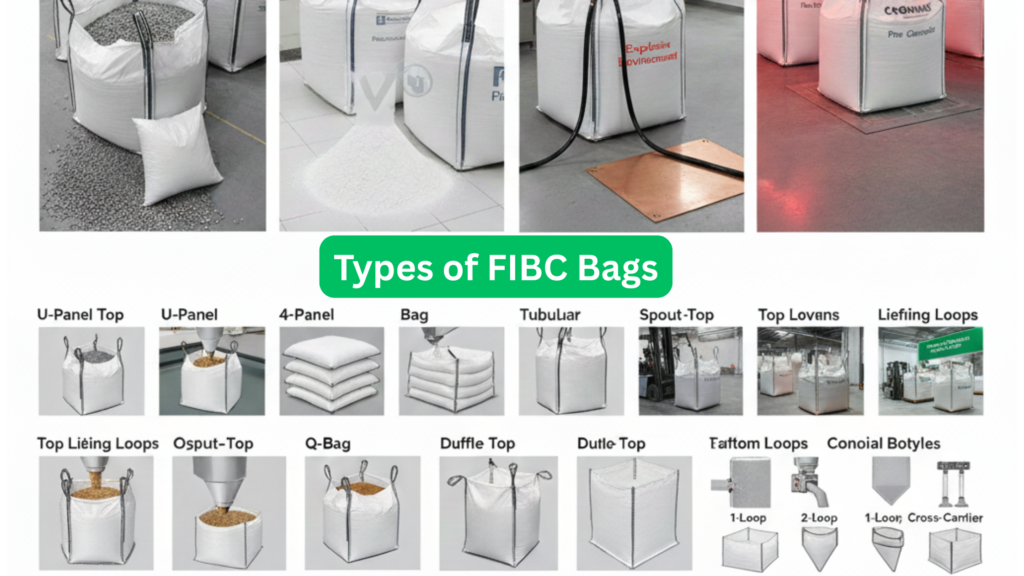
In case you are looking into the variety of FIBC bags, there are four main types of bags: Type A, Type B, Type C, and Type D, which are to provide the different degrees of the electrostatic protection and even the specific industrial use.
These jumbo bags (also referred to as big bags, super sacks and jumbo bags) are applied in agriculture, chemicals, food, pharmaceutical, construction, and mining to handle bulk material safely.
What Are FIBC Bags? (Flexible Intermediate Bulk Containers)
Definition
Flexible Intermediate Bulk Containers Bags (FIBC) The bags are very large woven polypropylene bags that are used to store, transport and manipulate bulk material in the form of powders to granules to aggregates.
What They Are Made Of
They are produced in woven polypropylene (PP), which makes them lightweight, strong, waterproof as well as adjustable to suit different industrial needs.
Common Names
- Bulk Bags
- Jumbo Bags
- Big Bags
- Tote Bags
- Super Sacks
Where They Are Used
FIBC bags are widely used in:
- Agriculture
- Chemical & Petrochemical industries
- Construction
- Food & Pharma
- Mining & Minerals
- Plastic granules & resin industries
FIBC Full Form
FIBC means Flexible Intermediate Bulk Container
How Many Types of FIBC Bags Are There?
There are four major types of FIBC bags based on electrostatic safety classification:
- Type A – Standard, non-conductive
- Type B – Low breakdown voltage
- Type C – Conductive, grounding required
- Type D – Anti-static, no grounding required
Why This Classification Matters
This category guarantees the safety in the process of working with flammable materials, powdery substances, and the environment where the person may become a source of a current.
When to Choose Which Type
- For general materials → Type A
- For dry powders with surface discharge risk → Type B
- For flammable environments → Type C
- For industries needing safety without grounding → Type D
Types of FIBC Bags (Electrostatic Classification)
Type A FIBC Bags (Standard, Non-Conductive)
Construction
Made from plain woven polypropylene without special electrostatic properties.
Safe Uses
The product is appropriate in non-flammable goods like:
- Sand
- Gravel
- Plastic granules
- Cement
Not Suitable For
- Handling flammable powders
- Areas of exposures to explosive vapors.
Industries
Construction, mining, agriculture, general industrial use.
Type B FIBC Bags (Low Breakdown Voltage)
Difference vs Type A
Type B bags look similar to Type A but have low breakdown voltage (<6kV) to prevent energetic propagating brush discharges.
Limitations
Still not safe for environments having flammable gases/vapors.
Best Applications
- Dry powders
- Fertilizer
- Starch
- Pharmaceuticals
- Fine chemicals
Type C FIBC Bags (Conductive, Groundable Bags)
When Grounding Is Required
These bags must be grounded during filling and discharge to eliminate static charges.
Industries Using Type C
- Petrochemical
- Pharmaceuticals
- Chemical powders
- Explosive environments
Safety Requirements
- Always connect to grounding system
- Regular resistance testing
- Only used in controlled industrial setups
Type D FIBC Bags (Anti-Static, No Grounding Required)
CROHMIQ / Dissipative Fabric Explanation
Made from antistatic fabrics such as CROHMIQ, which safely dissipates static charges without grounding.
Ideal Conditions
Best suited for industries where grounding is difficult or impossible.
Benefits Over Type C
- No grounding needed
- Safer for operators
- Higher efficiency in fast-paced environments
FIBC Bag Construction Styles (Shape & Build Types)
U-Panel Bags
Made from three panels: one U-shaped panel + two sides.
- Strong structure
- Economical
- Widely used
4-Panel Bags
Four panels stitched together.
- Better shape retention
- Ideal for stacking
Circular (Tubular) Bags
Woven in a circular loom; minimal seams.
- Stronger
- No side seams
- Used for fine powders
Baffle (Q Bags / Form-Stable Bags)
Internal baffles maintain cube shape.
- Maximum space efficiency
- Best for container loading
- Reduces bulging
Top Styles of Flexible Intermediate Bulk Containers
Loop Varieties
1-Loop FIBC
Used mainly for fertilizer & cement.
2-Loop FIBC
Suitable for crane or hook lifting.
4-Loop FIBC
Most common; used with forklifts.
Cross-Corner Loops
Easy lifting when bag is full.
Corner Loops
Standard lifting option for most industries.
Top Closures
Open Top
For easy filling of materials like sand, stones, grains.
Spout Top
For precise filling of powders.
Duffle Top
Offers full opening and closure flexibility.
Conical Top
Ideal for sticky or flow-challenged materials.
Bottom Discharge Types
Plain Bottom
For single-use bags with no discharge needs.
Discharge Spout
Controls material release.
Duffle Bottom
Quick and wide unloading.
Conical Discharge
For sticky powders & fine materials.
FIBC Bag Specification Options
- GSM (fabric weight)
- Coated vs Uncoated
- SWL (Safe Working Load: 500 kg–2000+ kg)
- SF (Safety Factor: 5:1, 6:1, etc.)
- Inner Liners (PE liners for moisture protection)
- Fabric Types (uncoated, laminated)
- Printing & Branding (logo, instructions, barcode)
Applications & Industries Using Different Types of FIBC Bags
- Agriculture & seeds
- Fertilizers
- Chemicals
- Food ingredients
- Pharma powders
- Cement, sand & aggregates
- Mining & minerals
- Plastic granules
- Recycled materials
- UN-certified hazardous products
How to Choose the Right Type of FIBC Bag
1. Consider Material Type
Powders, grains, granules, or hazardous material.
2. Load Capacity & SWL Requirements
Choose bags based on your required safe working load.
3. Flammability & Static Needs
Select between Type A, B, C, or D.
4. Storage & Handling Conditions
Stacking, humidity, method of transportation.
5. Environmental Factors
UV protection, exposure to moisture, exposure to dust.
Advantages of FIBC Bags (Why Businesses like Bulk Bags)
- Cost-effective
- High safety & strength
- Reusable & recyclable
- Space-saving
- Easy transportation & handling
- Reduced packaging waste
Frequently Asked Questions (FAQ)
What does FIBC stand for?
Flexible Intermediate Bulk Container.
Which type of FIBC is safest for flammable materials?
Type C (with grounding) and Type D (without grounding).
Do Type C bags always require grounding?
Yes, grounding is mandatory.
Can Type D bags be used outdoors?
Yes, if UV-stabilized.
What is the most common FIBC bag type?
4-loop standard Type A bulk bag.
Conclusion: Which Type of FIBC Bag Is Right for You?
The selection of the appropriate type of FIBC bag is based on the type of product, the risk at rest, the loading method, and the level of safety in the industry.
Type A is applicable in most general products. With powders and chemicals Type B, C or D may be required based on flammability and non-flammability conditions.
Why Choose Pursuit for FIBC Bags?
- Custom sizes, GSM & print options
- High-strength PP fabric
- Custom manufacturing
- Global supply capacity
- Food-grade & pharma-grade production
- ISO & UN-certified options