

Polyurethane Foam Guide
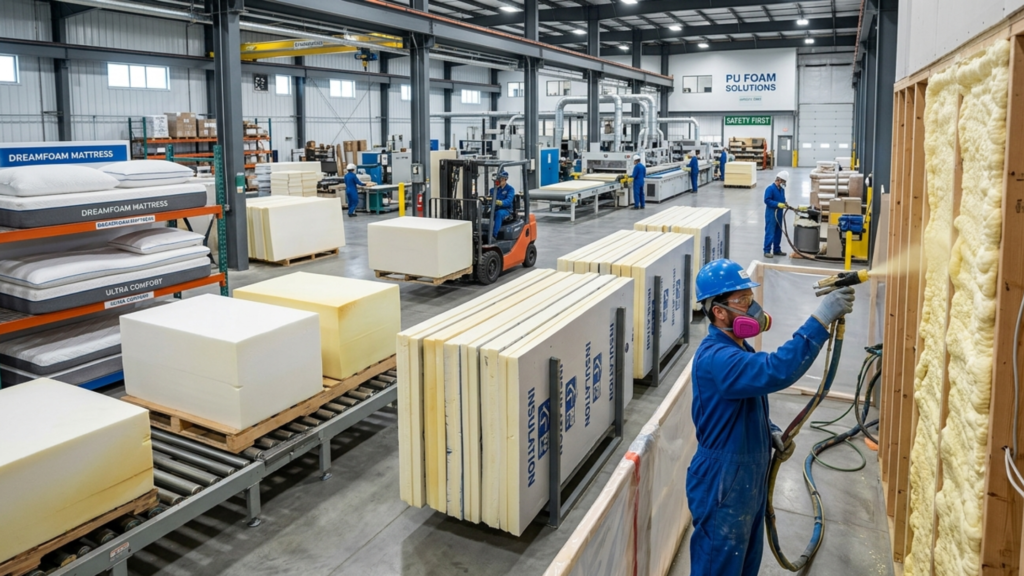
Polyurethane foam is a very popular polymer based material that has been used in various industries today.
PU foam can be used in packaging and construction, but also in insulation panels and automotive seats, among others, which makes it very essential in the modern manufacturing process.
Since it is a B2B manufacturer and supplier approach (this is the case particularly with companies that export globally based in India), buyers, engineers, and procurement departments need to know types, manufacturing process, and industrial application.
If you want to understand the complete base material, you can read our detailed guide on What Is PU? Complete Guide to PU Material (Polyurethane).
What is Polyurethane Foam
Polyurethane foam is a cellular polymer substance that is created by chemically combining polyols and the diisocyanates in the presence of catalysts, blowing agents and additives.
The reaction forms a foam structure which is capable of being:
- Soft and flexible
- Hard and rigid
- Spray-applied and expanding
Density, resilience, thermal conductivity and compressive strength can also be tailored to its performance; thus, it can serve a variety of industries.
Largely, as an industrial chemistry, polyurethane foam falls under the larger category of polyurethane systems that Otto Bayer invented in 1937 at IG Farben.
Types of PU Foam
Polyurethane foam is widely divided into three large groups:
- Flexible Foam
- Rigid Foam
- Spray Foam
There are various mechanical and thermal needs of each of the types.
Flexible Foam
Polyurethane foam is soft, resilient and cushioning in nature and flexible. It is open cell structure with comfort and flow of air.
Key Properties:
- High elasticity and rebound
- Lightweight
- Breathable structure
- Good vibration absorption
Common Applications:
- Furniture cushions
- Automotive seats
- Mattresses
- Packaging inserts
- Sound insulation panels
The level of flexible foam density may be low-density comfort grade to high-resilience industrial grade based on formulation.
You can also explore the complete polyurethane system and industrial production process in our guide Polyurethane: Properties, Production Process, and Industrial Applications.
Rigid Foam
Rigid polyurethane foam is a closed structure material that is used as a thermal insulator.
Key Properties:
- High compressive strength
- Low thermal conductivity
- Moisture resistance
- Structural stability
Common Applications:
- Cold storage panels
- Refrigeration systems
- Insulated sandwich panels
- Roofing insulation
- Pipeline insulation
Rigid PU foam finds extensive application in the construction and infrastructure fabrication as it has better insulation properties than most conventional materials.
Spray Foam
Spray polyurethane foam (SPF) occurs in liquid state and swells on-site as an insulating factor and layer of sealing.
Types of Spray Foam:
- Open-cell spray foam
- Closed-cell spray foam
Key Benefits:
- Seamless insulation layer
- Air sealing capability
- Energy efficiency
- Fast application
Spray foam is used in commercial properties and industrial insulation applications where air leakage is very important.
Manufacturing Process
Polyurethane foam production is a controlled reaction engineering and chemical formulation.
1. Raw Materials
- Polyols
- Isocyanates (MDI / TDI based)
- Catalysts
- Blowing agents
- Surfactants
These materials are also used in several other polyurethane-based products such as Polyurethane Adhesives: Uses in Construction and Manufacturing.
2. Mixing & Reaction
The raw materials are measured and mixed accurately. The exothermic reaction produces a polymer network and gives off gas to form the foam structure.
3. Foaming & Expansion
Blowing agents form cells in the compound. Formulation is used to regulate density and cell structure.
4. Curing
The foam is left to dry and level off.
If you want to understand how long polyurethane takes to cure in different applications, read our guide How Long for Polyurethane to Cure? Complete Drying & Curing Guide.
5. Cutting & Fabrication
Blocks or panels after curing are cut into sizes and shape demanded by industries.
The industrial level production must be strictly regulated in terms of:
- Temperature
- Reaction time
- Density consistency
- Quality testing standards
Fire-retardant, VOC, and environmental requirements are also mandatory to manufacturers who export their products to the entire world.
Industrial Applications
It is used in different industries throughout the world by polyurethane foam:
Construction & Infrastructure
- Wall insulation
- Roof insulation
- Structural panels
- Expansion joint fillers
Automotive Industry
- Seating systems
- Interior cushioning
- Acoustic insulation
Cold Chain & Refrigeration
- Insulated containers
- Cold rooms
- Refrigerators
Furniture & Bedding
- Mattresses
- Sofa cushions
- Office chairs
Packaging
- Shock-absorbing protective inserts
It is flexible and therefore suitable to the OEM manufacturers and industrial customers who require performance-driven materials.
For comparison with other industrial polymers, you can also explore Polypropylene Uses: Properties, Applications, and Everyday Products.
Advantages of PU Foam
Polyurethane foam has a number of competitive advantages:
1. Excellent Thermal Insulation
The amount of heat transfer reduction is high in rigid foam and this leads to increase in energy efficiency.
2. Lightweight but Strong
Large strength-to-weight ratio.
3. Customizable Formulations
It can be designed in terms of density, hardness, flexibility, and fireproofing according to the needs of the industry.
4. Cost-Effective
High repair and maintenance.
5. Versatile Processing
Moldable, sprayable, pourable or lamenable.
Safety Considerations
While polyurethane materials are widely used in industrial applications, safety during manufacturing and processing is important.
You can read more about potential health and environmental considerations in our article Is Polyurethane Toxic? Safety, Health Risks, and Everything You Should Know.
Why Polyurethane Foam is Important for Global B2B Buyers
The demand of a lightweight solution and energy efficiency of materials with the increasing global demand has seen polyurethane foam grow in the construction, automotive, refrigeration, and packaging sectors.
In the case of companies that are manufacturing in India and exporting to the global market, emphasis should be put on:
- Stable capacity of production.
- Strict quality control
- Custom formulations
- Adherence to international standards.
is essential in the creation of the long-term industrial relationships.
Final Thoughts
Polyurethane foam is not a mere cushioning or insulation product, it is an engineered polymer system that is performance-oriented, durable and efficient.
The knowledge of its types, production process, and industrial use will enable the buyers to make better choices based on the density, thermal performance, mechanical strength, and the project demands.