
Polypropylene Grain Bags: Everything You Need to Know Before Buying
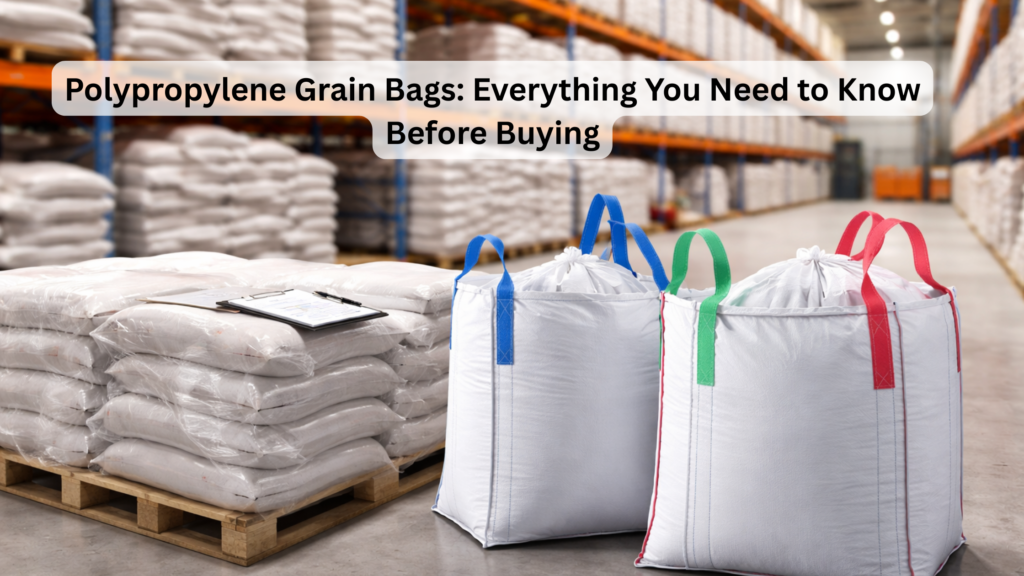
Need a bag to store your grain that won’t burst when filled with heavy loads, is moisture-resistant, and can be branded with your company’s logo? If you’re a farmer, trader, or exporter in India or beyond, you know the drill: every season you’re looking for the best type of grain storage bag – and that’s a PP (polypropylene) grain bag.
From wheat to rice, maize to pulses, animal feed to flour, this article explains all you need to know about the varieties, sizes, how to buy and what to look for in a good-quality PP grain bag.
What Are Polypropylene Grain Bags?
Polypropylene grain bags are woven sacks that are made from extruded PP (polypropylene) polymer tapes that are woven on circular looms, cut and stitched, and optionally laminated or printed.
They are the world’s most popular form of grain packaging to replace traditional jute bags due to greater strength, moisture barrier, weight reduction and superior printability for branding.
PP woven grain bags can be customised specifically for your type of grain, desired weight, and storage conditions – and they are used in nearly all agricultural, commercial, and export storage situations.
Types of PP Grain Bags — Which One Do You Need?
Not all PP grain bags are the same. Here’s a breakdown of the main types:
1. Laminated PP Grain Bags
A thin BOPP (Biaxially Oriented Polypropylene) film is heat-bonded over the woven fabric. This gives a smooth and printable surface and a good moisture barrier.
Best for: Export shipments, branded retail packaging, premium grain products, seeds Used in: More than 50% of export grain shipments worldwide
2. Non-Laminated (Plain Woven) PP Grain Bags
These are porous bags – air is able to flow through them. It’s a good thing, actually.
Best for: Localised farm-to-market grain supply, temporary storage, ventilation-requiring grains (to prevent condensation) Used in: Domestic markets in India, Bangladesh, Southeast Asia
3. FIBC / Jumbo Bulk Bags
Also known as “Bulk Bags” or “Big Bags” – these are large woven PP bags that hold 500 to 2000 kg of grain.
Best for: Commercial grain traders, large-scale processors, export loading operations Common configurations: 4-panel, U-panel, circular; with discharge spouts
4. UV-Stabilized PP Grain Bags
Standard PP degrades under prolonged sunlight exposure. UV-stabilized bags contain additives in the resin that extend outdoor life significantly.
Ideal for: Outdoors, storage of grain, farmyards, open warehouse areas
5. Valve-Mouth & Gusseted Bags
Valve bags allow automated filling machines to fill at high speeds. Gusseted bags expand at the sides for a better fit and stacking.
Best for: Industrial grain packaging operations with automated fill lines
Key Specifications to Check Before Ordering
When you’re buying PP grain bags — especially in bulk — these are the specifications that actually matter:
| Specification | What to Look For |
|---|---|
| GSM (Grams per Square Meter) | 55–90 GSM for standard grain bags; higher GSM = more strength |
| Weight Capacity | 25 kg, 50 kg (most common); FIBC up to 2000 kg |
| Denier | Thickness of individual PP tapes; higher denier = stronger weave |
| Bag Dimensions | Depends on grain density; standard 50 kg rice bag ~60×105 cm |
| Mouth Type | Open mouth (hand stitched), valve mouth (machine filled), heat sealed |
| Liner | LDPE inner liner for moisture-sensitive grains like paddy, maize |
| Print Colors | 1–6 color rotogravure or flexo printing available |
| UV Stabilization | Required if bags will be stored or transported outdoors |
Quick Rule: For wheat and rice in 50 kg packs, a minimum 65 GSM laminated bag is the standard. For seed packaging, go 70–80 GSM with food-grade certification.
How PP Grain Bags Are Made — The Manufacturing Process
Knowing how it’s made helps assess quality when you’re buying:
- PP Resin Selection — Virgin or recycled PP resin is selected according to food grade and desired strength
- Tape Extrusion — Resin is extruded to form tapes of a consistent width and thickness
- Circular Weaving — Tapes are woven together using circular looms
- Lamination (for laminated bags) — BOPP film is heat-bonded to one or both sides
- Printing — Rotogravure or flexo for branding and labelling
- Cutting & Stitching — Fabric is cut to size, bottom is sewn, liner optional insert
- Quality Check — Weight, strength and print quality check
Quality manufacturers maintain ISO-certified production lines and comply with food-grade standards (FDA, BIS in India) at every step.
Key Features & Benefits of PP Grain Bags
Here’s why PP woven bags have become the default choice for grain packaging:
High Tensile Strength & Tear Resistance Woven PP structure distributes load across thousands of interlocked tapes — making it resistant to tearing even when dragged, dropped, or stacked.
Moisture & Humidity Resistance PP is inherently hydrophobic. Laminated variants add a second layer of protection — critical for paddy, maize, and any grain susceptible to fungal growth from humidity.
Lightweight Yet Durable A 50 kg PP bag weighs around 100–150 grams compared to a jute bag that weighs 500+ grams. This directly reduces transport cost.
Smooth Canvas for Better Printing Laminated bags have a smooth surface that allows high-quality multi-color printing, your branding, product details, barcode and quality labels.
Air Permeability for Local Storage Air-permeable bags (non-laminated) help control the condensation and heat inside the bag, ensuring proper storage of fresh crops.
Reusable & Recyclable Quality PP bags are reusable 2-3 times before they are disposed, and 100% recyclable into PP products.
Where Are PP Grain Bags Used?
PP grain bags are used in many different ways in the agri supply chain:
Primary Storage for Farmers Non-laminated bags are used at farm level for post-harvest primary storage of grain – breathable, economical, easy to handle.
Grain Trade Warehousing Mandis, FCI godowns and private grain depots typically use 50 kg printed, laminated bags.
Export Grain Bags High-quality laminated bags with BOPP printing are used for grain exports – wheat, rice, pulses – adhering to the importing country’s food safety and labelling regulations.
Seed Packaging Certified seed bags must use food-grade high-GSM, printed PP bags – sometimes with tamper evidence stitching or seals.
Animal Feed Packaging A massive parallel market – the same PP woven bag construction is used for compound feed, bran and concentrates.
Global Market: Where Does the PP Grain Bag Industry Stand?
The PP grain bag industry is substantial and growing:
The grain packaging segment was valued at USD 511.47 million in 2025, holding around 16% of the total PP woven bags market globally, and is expected to grow at a 3.93% CAGR through 2034.
The broader PP woven bags market was valued at USD 2,832.2 million in 2024 and is projected to reach USD 3,483.25 million by 2033, growing at a steady 3% CAGR.
The Asia-Pacific region accounts for more than 40% of share – huge food production in India, China, Bangladesh, Vietnam and Thailand.
Laminated bags are used for more than 50% of export grain shipments, while non-laminated bags still dominate at farm gate level.
Regional Demand at a Glance
| Region | 2025 Market Size | Key Drivers |
|---|---|---|
| USA | USD 76.71 million | Bulk wheat & maize export |
| Brazil | USD 61.37 million | Soybean & maize export supply chains |
| Russia | USD 51.15 million | Rising grain exports to Asia & Africa |
| India & China | Largest producers | Domestic and export grain volume |
| Middle East & Africa | Growing | Import-dependent food supply |
India – particularly Gujarat and Rajasthan – is the largest PP woven bag manufacturing region, with hundreds of manufacturers ranging in size from global exporters to local mills.
Buying Guide: How to Choose the Right PP Grain Bag
Here’s a procurement guide:
Step 1 — Identify Your Grain & Use Case
- On-farm storage bags → Non-laminated, low GSM, open mouth
- Export or branded retail → Laminated, higher GSM, printed
- Bulk industrial → FIBC / jumbo bags
Step 2 — Select the Right GSM
- 55-65 GSM: Local distribution bags
- 65-75 GSM: Regular commercial 50 kg grain bags
- 75-90 GSM: Export, seed, special packaging
- FIBC: Fabric weight depends on SWL (Safe Working Load)
Step 3 — Decide on Liner Requirement
If you’re storing moisture-sensitive grains (paddy, maize, groundnuts), request bags with LDPE inner liner — it adds a second moisture barrier inside the woven shell.
Step 4 — Check Certifications
Look for: Food-grade compliance (FDA / FSSAI), BIS certification (India), ISO 9001 for the manufacturing facility.
Step 5 — Clarify MOQ & Lead Time
Standard MOQs for printed PP grain bags range from 5,000 to 50,000 bags depending on the supplier. Unprinted bags can be obtained in smaller volumes.
Step 6 — Evaluate Print & Branding Options
Rotogravure printing (6 colours maximum) on laminated bags is standard. Flexo printing will be more cost-effective for small orders.
Price Factors to Know:
PP resin costs (market-driven), size, GSM, lamination, print colors and liner all influence the cost of the bag.
Sustainability & Environmental Considerations
PP grain bags aren’t environmentally clean. PP is a plastic derived from oil, and there are concerns about microplastics being released and how to handle disposal.
What the industry is doing:
- Recyclable PP programs – collecting PP bags for reuse as industrial PP powder
- Reusable bag programs – standardising bags for 2-3 cycles in the domestic grain market
- Biodegradable PP formulations – still in its infancy but showing promise in high-end markets
- Regulatory compliance – India’s Plastic Waste Management Rules, and EU regulations, are driving the shift to EPR (extended producer responsibility)
If you are procuring based on sustainability, ask your supplier for their bag return program, and request virgin food-grade PP over recycled for grain-contact applications.
Challenges Facing the PP Grain Bag Industry
Raw Material Price Volatility PP resin prices are linked to crude oil markets — price swings of 15–25% in a year are common, making long-term procurement contracts tricky.
Competition from Alternatives Jute bags (for premium/export markets focused on eco-credentials), HDPE woven bags, and paper-laminate composites compete in specific segments.
Regulatory Pressure on Plastics Several countries are tightening rules on single-use plastic packaging. PP grain bags, being reusable and recyclable, are generally exempt, but manufacturers must stay compliant.
Opportunities on the Horizon
- New lamination technology for stronger seals and high-quality printing
- Non-slip treatments for export warehouse pallet stacking
- Growing export markets for grain in Africa and Southeast Asia create new opportunities
- Market for customised branding as grain traders and agri-businesses build brands
Frequently Asked Questions
Are PP grain bags food-safe? Yes — when manufactured with virgin food-grade polypropylene resin and compliant with FDA, FSSAI, or BIS standards. Be sure to request a food-grade certificate from the vendor.
What is the shelf life of a PP grain bag? A quality PP grain bag stored indoors (away from UV light) can last 3–5 years without degradation. UV bags have a longer life outdoors.
Can PP grain bags be reused? Generally 2-3 times for each grain. Don’t reuse bags for food grain that have contained chemically-treated seed, and check for holes.
What are the standard sizes for grain packaging?
- 25 kg: ~45×75 cm
- 50 kg: ~60×100–110 cm
- FIBC: Customized, typically 90×90×120 cm or as per SWL specification
What is the difference between laminated and non-laminated grain bags? Laminated bags have a BOPP film bonded to the woven surface — they are moisture-proof, printable, and preferred for export and branded retail.
Non-laminated bags are non-moisture resistant, cheaper and lightweight – ideal for farm storage and short transportation.
Which GSM is suitable for 50 kg rice? 65-75 GSM laminated bags are commonly used for 50 kg rice bags in commercial and export.
Why Pursuit Industries for PP Grain Bags?
At Pursuit Industries (pursuitind.com), we manufacture high-quality polypropylene woven grain bags from our facility — serving domestic buyers, traders, and exporters across India and international markets.
Our range includes:
- Laminated & non-laminated grain sacks (25 kg, 50 kg)
- Multi-color printed PP bags with food-grade compliance
- FIBC / jumbo bags for bulk grain handling
- UV-stabilized bags for outdoor storage
- Custom sizes, GSM, liner, and print as per requirement
We work directly with grain traders, agri-businesses, FCI contractors, seed companies, and exporters — with competitive pricing, reliable lead times, and quality that meets BIS and food-grade standards.
Ready to place an order or need samples? Contact us at pursuitind.com to request a quote, check availability, or discuss your custom requirements. Our team will get back to you within 24 hours.
PP grain bags remain the most practical, cost-effective, and scalable packaging solution for grain storage and transport — at every scale, from the farm to the export container.
Choose the right type, the right GSM, and the right supplier — and your grain stays safe from harvest to the end consumer.
