Uncategorized
FIBC Bag Manufacturers: A Complete People‑First Guide for Buyers & Businesses
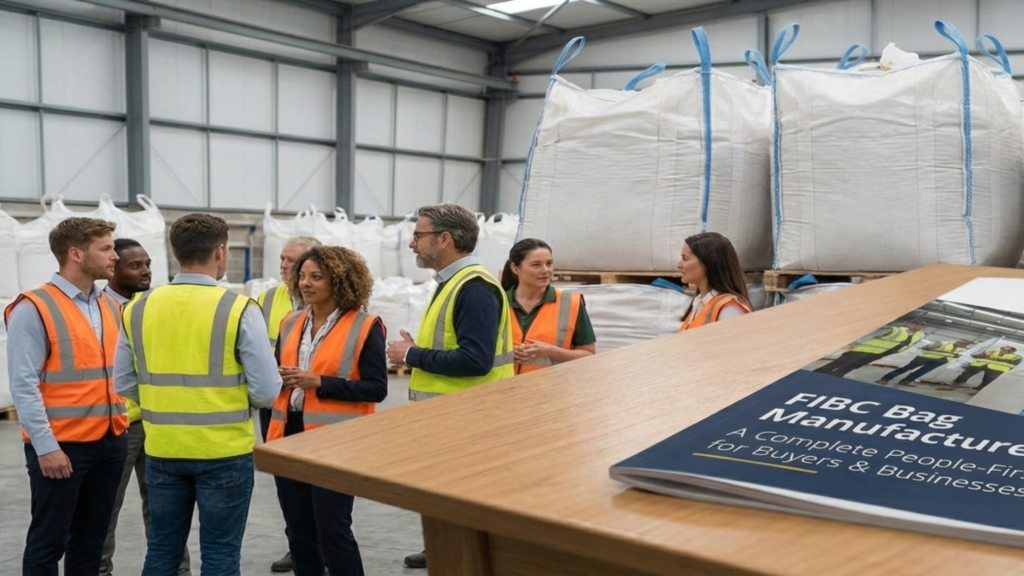
In case you are in search of manufacturers of FIBC bags, then there are high chances that you have been in need of bulk packaging services that are safe, durable, and cost effective in terms of your products.
It could be agriculture, chemicals, construction materials or food grains, and the selection of the manufacturer results in direct influence on the product safety, the efficiency of logistics, and the final costs.
This is a guide written to real buyers, the procurement managers, exporters, the head of the plants, and business owners, and hence you can make a sound decision in a non technical manner.
What Are FIBC Bags?

FIBC (Flexible Intermediate Bulk Container) bags also referred to as jumbo bags or bulk bags are industrial packaging containers that are used to transport dry flowable materials in large volumes-typically between 500 kg and 2000 kg.
Their use is extensive as they are:
- Portable but highly powerful.
- Easy to store and transport
- Less expensive than flexible packaging.
- Different industries customizable.
Why Choosing the Right FIBC Bag Manufacturer Matters
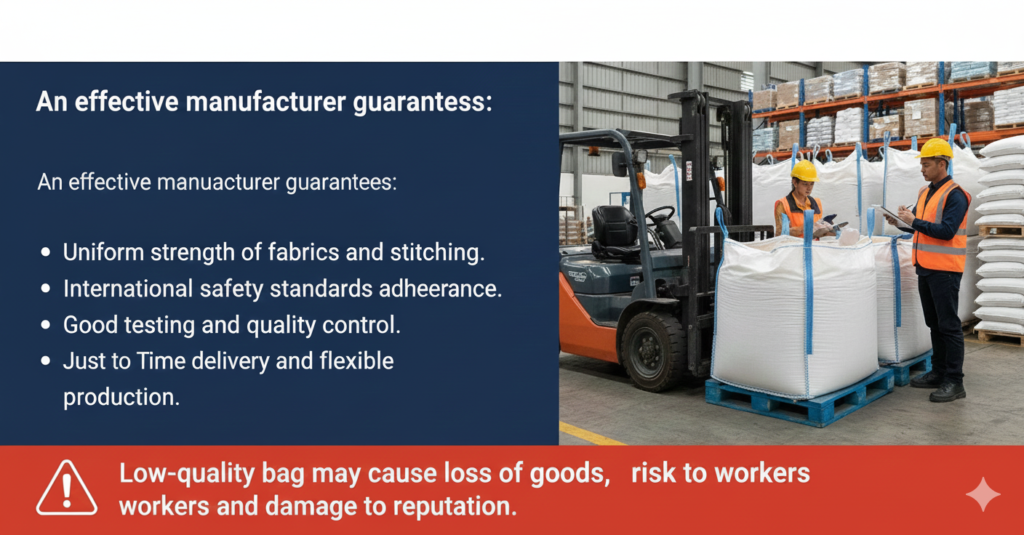
Not every manufacturer of the FIBC bag is of similar quality. An effective manufacturer guarantees:
- Uniform strength of fabrics and stitching.
- International safety standards adherence.
- Good testing and quality control.
- Just in Time delivery and flexible production.
Low-quality bag may cause loss of goods, risk to the lives of customers and loss of reputation- particularly in the foreign markets.
Types of FIBC Bags Offered by Manufacturers

The manufacturers of the highest quality of the FIBC bags normally provide a broad variety of selections to accommodate various uses:
1. Standard FIBC Bags
Applications Because of general industrial products like sand, fertilizers and minerals.
2. U‑Panel FIBC Bags
Constructed of a u-shaped piece of fabric to improve the distribution of loads and shape retention.
3. Circular / Tubular FIBC Bags
Floating sides offer greater leakage and moisture proofing.
4. Baffle (Q‑Bag) FIBC Bags
They were made square and aimed at enhancing the use of containers in the course of transport.
5. Food‑Grade FIBC Bags
Produced in sanitary conditions of food grains, sugar, flour and starch.
6. UN‑Certified FIBC Bags
Necessary so as to transport hazardous chemicals and materials safely.
Not sure which FIBC type suits your product? Talk to our packaging expert
Also Read: Types Of FIBC Bags
Industries That Depend on FIBC Bag Manufacturers
Clients to which the trusted manufacturers of FIBC bags cater to are numerous and may include:
- Agriculture: rice, wheat, maize, seeds
- Chemicals: resins, powders, pigments
- Construction: cement, sand, aggregates
- Processing Food: sugar, flour, salt.
- Mining & Minerals: concentrates, ores.
- Pharmaceuticals: regulated bulk materials.
In every industry, there are bag specifications that are required and therefore, the expertise of manufacturers is important.
Key Factors to Consider When Selecting FIBC Bag Manufacturers
When settling on a supplier, consider the vendor on the following critical parameters:
1. Quality Certifications
Search manufacturers qualified with:
- ISO standards
- Compliance with food-grade (where applicable)
- Hazardous goods certification by the UN.
2. Customization Capability
An excellent manufacturer must provide:
- Custom sizes and capacities
- Printing and branding options
- Special liners or coatings
3. Raw Material Quality
Polypropylene fabric of high-grade renders it strong, UV resistant, and durable.
4. Manufacturing Capacity
Mass producers are able to make bulk purchases without jeopardizing their delivery schedules.
5. Export Experience
When exporting internationally, select suppliers that have dealt with international logistics and documentation.
Sustainability & Eco‑Friendly Manufacturing
Some of the sustainable practices that modern manufacturers of FIBC bags are taking include:
- Recyclable polypropylene materials
- Reduced fabric wastage
- Emission less energy-consuming production.
- Reusable FIBC bag designs
The identification of a sustainability-oriented supplier facilitates the minimization of the adverse impact on the environment and is consistent with international compliance standards.
Benefits of Working With Reliable FIBC Bag Manufacturers
Collaborating with a reliable manufacturer is long-term benefits:
- Lower packaging failures and losses
- Improved supply chain efficiency
- Consistent product quality
- Better brand reputation in global markets
It is not only about purchasing bags but also about establishing a reliable packaging alliance.
Frequently Asked Questions (FAQs)
Q1. What is the average load capacity of FIBC bags?
Most FIBC bags carry between 500 kg to 2000 kg, depending on design and fabric strength.
Q2. Are FIBC bags safe for food products?
Yes, the food-grade FIBC bags produced in hygienic conditions are safe in storage and transportation of food.
Q3. Can FIBC bags be reused?
Most of the FIBC bags can be re-used when they are used on numerous trips and they are used properly.
Q4. Do FIBC bag manufacturers offer export‑ready packaging?
Reputed manufacturers provide export‑compliant packaging with proper labeling and certifications.
Final Thoughts
The correct selection of the manufacturers of the FIBC bags is a strategic move which influences product safety, efficiency in logistics and business expansion.
You can be confident with quality, certifications, customization and sustainability of bulk packaging solutions to your industry.
When sourcing on a long term basis, you should always deal with suppliers whose values are people, performance and product integrity and not price.
Seeking reliable manufacturing alternatives of FIBC bags? The step to take is an established manufacturer who knows what you require in your industry and can provide it at scale.
List of Suppliers Offering Food-Grade FIBC Bag Manufacturers in India

In terms of keeping bulk food products and ensuring their safety throughout storage and transportation, the solution to the problem lies in the adoption of FIBC bags (Flexible Intermediate Bulk Containers) by industries throughout India.
By selecting the appropriate fibc bag manufacturers, the food is safe and protected as well as compliant with the regulations.
Our guide will give you the names of the best suppliers and will give an insight into what they offer to assist you in making a good choice.
What Are Food-Grade FIBC Bags?
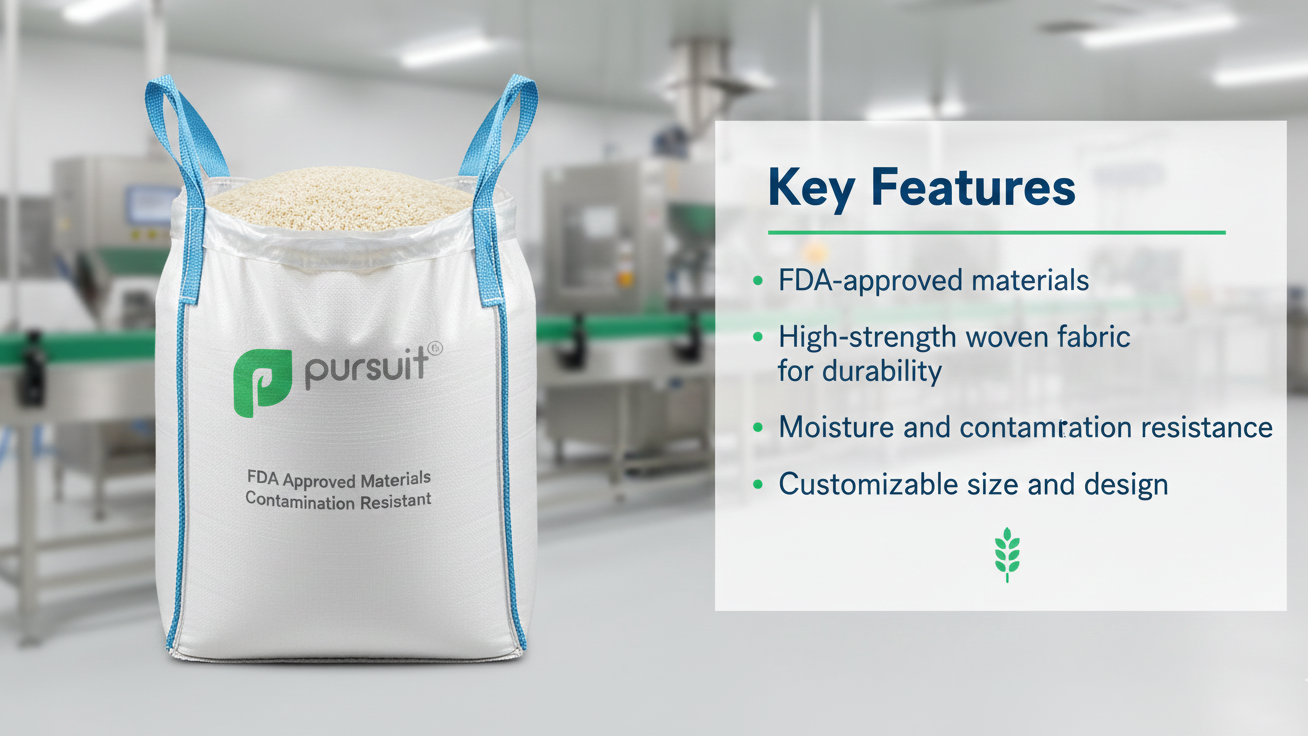
Food-grade FIBC bags are specially manufactured containers, which are in compliance with food safety standards, and the products stored in the containers would not be contaminated.
Such bags are produced of high-quality polypropylene and usually have coating and linings to avoid contamination.
Key features include:
- FDA-approved materials
- High-strength woven fabric for durability
- Moisture and contamination resistance
- Customizable size and design
Why Choosing the Right FIBC Bag Manufacturer Matters

Selecting the correct fibc bag manufacturers is crucial for:
- Regulation of food safety- The assurance of your storage systems of compliance with the law.
- Quality and reliability of the product – Prevent losses in the form of losing the bag during storage or transit.
- Customization features – Depending on the type of product that you are dealing with, you can require certain coating, liners, or size.
Top Food-Grade FIBC Bag Manufacturers in India
The following is a list of quality reliable manufacturers of FIBC bags serving the food industry:
1. Pursuit Industries Pvt. Ltd.
In Pursuit Industries Pvt. Ltd. we are not merely a manufacturing and trading firm but a partner with the world behind us making excellence to work in various industries.
Our reputation is based on innovation, reliability, sustainability, and uncompromising quality which is backed by a powerful heritage that has been passed across generations.
As the global presence increases, Pursuit Industries still maintains its global empowerment of industries through providing world-class solutions in chemicals, plasticizers, packaging materials and food (agro) products.
We are proud to have milestones that place emphasis on our commitment to international supply standards, ethical business and long-term customer relationships.
Why Choose Pursuit Industries
Our Key Strengths
Cost Benefit
Price guarantee agreements serve to provide a control over costs even in the conditions of fluctuating market.
On-Time Delivery
Specialized logistics and time-limited dispatch systems guarantee that your production does not come to a halt.
Focus on Quality & Service
The inspection procedures in accordance with the international standards guarantee purity, performance and reliability – since the procurement to the final delivery.
Certifications & Compliance
We are qualified and aligned with accepted international standards, which adds strength to our credo in quality, safety, and regulatory excellence in chemicals, packaging and food products.
Location: Gujarat, India
2. Rishi FIBC Solutions Pvt. Ltd.
Location: India
Specialty:
Manufacturer of food grade FIB jumbo bags used in bulk packaging of agricultural and food products.
Why choose them:
- Focus on hygienic and food-safe manufacturing
- Custom sizes and liner options available
- Reliable quality for grains, pulses, and sugar packaging
3. Shankar Packaging Ltd.
Location: India
Specialty:
Producer of food grade FIBC bags that are used in the safe storage and transportation of dry food items.
Why choose them:
- Durable fabric with strong stitching
- Consistent quality control standards
- Suitable for large-volume food packaging applications
4. Sudarshan Addpack
Location: India
Specialty:
Food and agro industry Supplier of FIBC bags with coating and liner-fitted bulk bags.
Why choose them:
- Customizable food-grade packaging solutions
- Emphasis on safe handling and contamination control
- Trusted supplier for bulk food storage needs
5. Alpine FIBC Pvt. Ltd.
Location: India
Specialty:
Manufacturer of FIBC bags in India that produces food grade jumbo bags in both the local and export market.
Why choose them:
- Food-grade compliant manufacturing process
- Options for anti-static and moisture-resistant bags
- Timely delivery and flexible order quantities
How to Choose the Best FIBC Jumbo Bags Manufacturer in India

When selecting a fibc jumbo bags manufacturer in India, consider:
- Certifications: Look for ISO, FDA, or BIS-certified manufacturers.
- Material Quality: Ensure bags are made from virgin polypropylene to avoid contamination.
- Customization: Check if the manufacturer offers size, weight, and liner options.
- Customer Reviews: The loyalty and credibility are expressed through the feedback of the current customers.
- After Sales Services: Companies that offer instructions on how to store and handle it are added value.
Benefits of Working with Trusted FIBC Bag Manufacturers

By collaborating with a fibc bag manufacturers that is reputable, it is ensured that:
- Long-lasting and durable bags
- Compliance with international food safety standards
- Reduced risk of product contamination or damage
- Cost-effective bulk packaging solutions
Final Thoughts
Companies that deal with bulk food products must make the right choice when selecting an Indian manufacturer of the FIBC bag.
With the help of the cooperation with trusted suppliers, who have specialized in fibc jumbo bags manufacturers in Gujarat and in the whole of India, the companies will be able to have safe, efficient, and regulatory-compliant storage and transportation.
FAQs
Q1: What is the difference between FIBC bags and jumbo bags?
A: The jumbo bags and the FIBC bags are basically the same. Jumbo bag is also commonly referred to as large-capacity FIBC bags in India.
Q2: Are food-grade FIBC bags reusable?
A: Yes, but only if they are handled carefully and meet hygiene standards after each use.
Q3: How can I ensure the FIBC bags I buy are food-grade?
A: Change to certifications such as FDA, BIS or ISO and ensure that the materials are Virgin polypropylene.
FIBC Bag Manufacturers in India – Leading Jumbo & Bulk Bag Suppliers
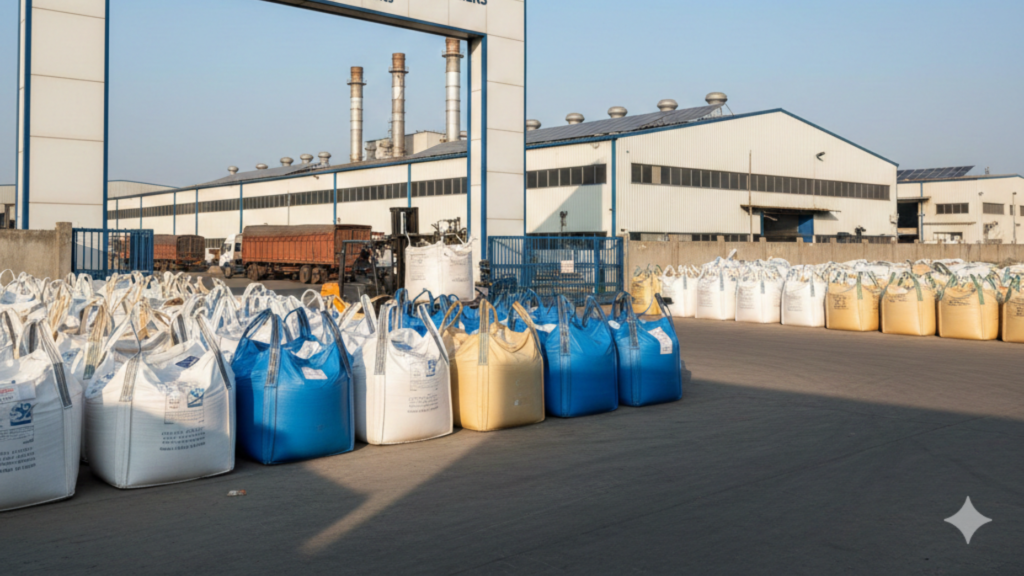
India is also among the largest manufacturers of the FIBC bags in the world and it provides quality bulk packaging solutions to the world industries.
The producers of the Fibc bag in India are characterized by the high-level production, the high quality of the goods, the low prices, and effective exporting web.
These are the bags that are commonly utilized in storage and transportation of the dry bulk materials in a safe and efficient manner.
As industries like agriculture, chemicals, food processing, construction and pharmaceuticals among others have increased demand, the manufacturers in India have established themselves as reliable suppliers of the FIBC bags, jumbo bags and bulk bags globally.
What Are FIBC Bags?
FIBC stands for Flexible Intermediate Bulk Containers. These are large, flexible bags made from woven polypropylene (PP) fabric, designed for storing and transporting bulk materials.
The bags made in the form of FIBC are lightweight, can be used again and again, save space and can be loaded up to 250 kg or up to 2000 kg, depending on the design and safety factor (5:1 or 6:1).
Key Benefits of FIBC Bags
- High load-bearing capacity
- Bulk packaging solution that is cost effective.
- Portable and convenient handling and transportation.
- Adjustable designs and sizes.
- Eco-friendly and recyclable
Why Choose FIBC Bag Manufacturers in India?
The decision to select the manufactures of FIBC bags in India has several benefits both to the local and foreign customers:
- Incident costs of manufacturing competition.
- Currently designed and developed production facilities.
- Adherence to global quality guidelines.
- Accessibility of application-specific and tailored bags.
- Well established exporter network to the world markets.
The Indian manufacturers integrate quality, innovation and scalability hence India is a source of bulk bags preferred due to its ability to offer in bulk.
Types of FIBC Bags Manufactured in India
The major Indian manufacturers of bulk bags made of the FIBC have a variety of bulk bags available to meet the needs of various industries:
Standard FIBC Bags
Ordinary purpose of bulk handling material used with easy design and with high efficiency.
Jumbo Bags / Bulk Bags
Bags with large capacity which are used in storing and transportation of grains, fertilizers, minerals and construction materials.
Baffle FIBC Bags
Built with internal baffles to keep the shape square and ensure that the maximum amount of space is used in the container.
UN Certified FIBC Bags
Produced of dangerous substances and meet UN packaging standards.
Food Grade FIBC Bags
Manufactured in clean conditions with virgin raw material, which is appropriate in food and pharmaceutical industries.
Ventilated FIBC Bags
Applied on agricultural, such as potatoes, onions, and firewood, where there is need of air movement.
Conductive FIBC Bags (Type C & Type D)
Supposed to be used in industries that deal with flammable powders and chemicals to avoid the risk of electric shocks.
Manufacturing Process of FIBC Bags
The manufacturing process pursued by the manufacturers of the FIBC bags in India guarantees durability of the product, safety, and performance:
- Pure polypropylene extrusion tapes of PP.
- Textile production on round mules.
- Moisture protection lamination or coating.
- Shearing and fine sewing.
- Attachment of lifting loops
- Final inspection and quality test.
Quality checks are ensured at every step to keep the standards the same.
Quality Standards Followed by Leading FIBC Manufacturers
Top FIBC bag manufacturers in India strictly adhere to international quality and safety norms:
- ISO 9001: Quality Management System
- BRCGS certification of food grade packaging.
- UN certification of baggage of dangerous material.
- SWL, SF, UV resistance and fabric strength testing in house.
These are standards that guarantee quality, reliable and safe bulk packaging solutions.
Applications of FIBC Bags
FIBC bags are widely used across various industries due to their versatility:
- Agriculture (grains, seeds, fertilizers)
- Chemicals and minerals
- Food and pharmaceutical products
- Building materials (cement, sand)
- Polymers and petrochemicals.
How to Choose the Best FIBC Bag Manufacturer in India
In choosing a manufacturer, the following things may be put into consideration:
- Production capability and equipment.
- Product differentiation and customization.
- Laboratory and certification of quality.
- Domestic and export market experience.
- Delivery and customer services.
By purchasing a reliable manufacturer, you are guaranteed of long-term value and regular supply.
FIBC Bag Manufacturers in India: Manufacturer vs Supplier vs Exporter
In response, a manufacturer makes FIBC bags internally, and this guarantees the quality and personalization.
A supplier is where bags are taken by manufacturers and an exporter is one who deals with global deliveries.
It is more economical and they can be customized and inspected better in case they are working directly with an exporter of the manufacturer of the FIBC bags in India.
Why We Are a Trusted FIBC Bag Manufacturer in India
As being one of the trusted manufacturers of the FIBC bags in India, we are providing:
- Extended variety of FIBC jumbo bags and bulk bags.
- Tailor-made packaging systems.
- Quality certifications internationally.
- High levels of exports in the international markets.
- Customer support and delivery in good time.
Quality, innovation, and customer satisfaction are the drivers behind our choice of business partners in terms of bulk packaging.
Frequently Asked Questions (FAQs)
Q1. Who are the best FIBC bag manufacturers in India?
India boasts of a couple of well-established companies that provide quality FIBC bags that are internationally certified and have the ability to be exported.Q2. What is the price of FIBC bags in India?
The prices will be relative to the type of bag, size, design, raw material and quantity of order.Q3. What is the full form of FIBC bags?
FIBC stands for Flexible Intermediate Bulk Containers.Q4. Are FIBC bags suitable for food-grade materials?
Yes, food grade FIBC bags are produced in virgin material of PP under hygienic conditions.Q5. Do Indian manufacturers export FIBC jumbo bags?
Yes, India is one of the largest manufactures of FIBC jumbo bags to the international markets.Conclusion
India has become a major provider of solutions in bulk packaging in the world. When deciding on your choice of the manufacturing companies of the best FIBC bag in India, you would be guaranteed of quality, reasonably priced yet reliable and quality packaging of your business.
I have to tell you that Indian manufacturers can offer you the solutions to the problems in terms of both standard bulk bags and customized jumbo bags in terms of both demand of international standard and industry.
To get the highest quality of the FIBC bags and custom-designed bulk packaging services, contact a reliable supplier now.
Big Bag: A Complete Guide to Flexible Intermediate Bulk Containers (FIBC)
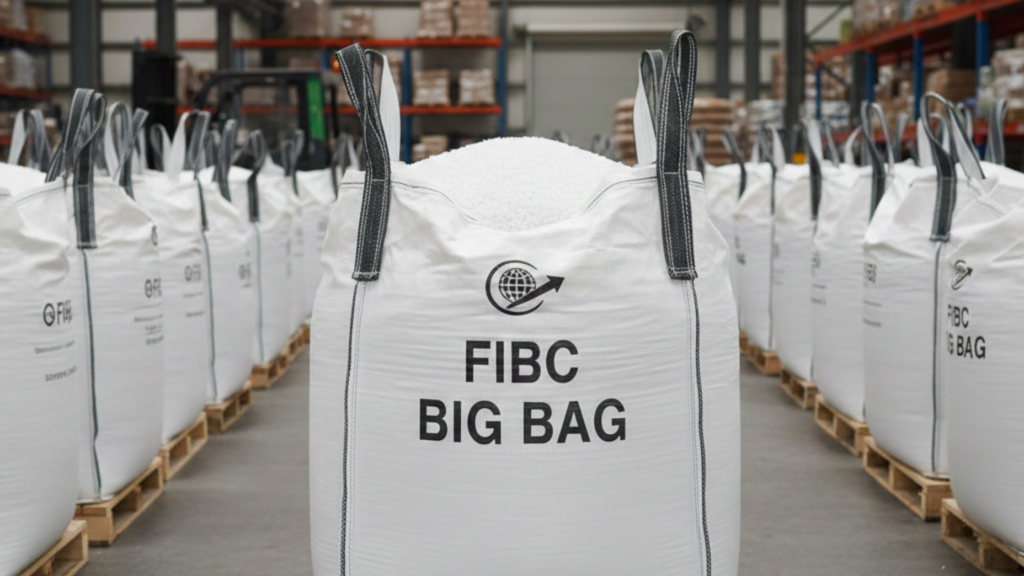
Big Bags (also called Flexible Intermediate Bulk Containers (FIBC), jumbo bags, bulk bags, dumpy bags, or super sacks) are common industrial packaging material solutions that are used in the transportation and storage of dry, flowing substances.
Big Bags are made using the fabric of woven polypropylene; they are lightweight, very durable, and can carry a load of between 500 kg and 2000kg and above.
This detailed manual defines what Big Bags are, their varieties, usage, history, size criteria and the entire manufacturing process.
What Is a Big Bag?
A Big Bag is a stretchy industrial bag made of woven polypropylene (PP) material. It specifically is made to carry bulk material like:
- Sand & aggregates
- Fertilizer
- Plastic granules
- Cement
- Food grains
- Chemicals & minerals
- Construction materials
The reason behind using Big Bags is that it is a combination of strength, lightweight, cost-effective and easy handling.
They can be used with forklifts, cranes, and pallet systems, which accelerate and secure bulk handling.
Standard Size, Volume & Capacity of Big Bags
Though the sizes may be custom made, the common specifications are:
Dimensions
- Width / Diameter: 45–48 inches (114–122 cm)
- Height: 39–79 inches (100–200 cm)
Volume
- 1 m³ to 3 m³
Weight Capacity
- Safe Working Load (SWL): 500 kg – 2000 kg
- Heavy-duty variants may exceed 2+ tons
Bag Weight
- A typical 1-ton Big Bag weighs only:
2.3–3.2 kg
This makes them have an extremely large ratio of strength to weight.
Common Uses of Big Bags
Big Bags apply to a large variety of industries, such as:
Construction & Infrastructure
- Cement
- Sand
- Gravel
- Gypsum
Agriculture
- Seeds
- Potatoes & onions
- Fertilizer
- Animal feed
Chemical & Plastic Industry
- Resin granules
- Powders
- Additives
Food & Pharma
- Sugar
- Salt
- Starch
- Pharmaceutical powders (via food-grade FIBC)
Mining & Minerals
- Metal powders
- Ores
- Limestone
- Silica
Because of their versatility, Big Bags have become a global standard for bulk packaging.
History of Big Bags (FIBC)
1940s: Early Versions
The first concepts emerged during the 1940s using PVC rubberized fabric.
These early containers were mainly used in the rubber industry to transport carbon black.
1960s: Polypropylene Revolution
With the invention of woven polypropylene (PP) and advancements in fabric weaving, the modern Big Bag was born.
1970s Oil Crisis: Massive Growth
During the oil boom, FIBC demand skyrocketed. Over 50,000 metric tons of cement was transported weekly to the Middle East using Big Bags. This boosted global usage.
2020s–Present
Today, Big Bags help transport over 250 million metric tons of products annually. They now include:
- Antistatic (Type B, C, D) bags
- UN-certified bags
- Food-grade bags
- Recyclable and environmental friendly versions.
The Big Bag keeps up with the contemporary industrial demands.
The Complete Manufacturing Process of Big Bags
Production of a Big Bag is an elaborate and multi-stage process in the industry that requires raw materials, extrusion, weaving, testing, and assembling.
Below is a full breakdown:
1. Raw Material Preparation – Polypropylene Resin
Big Bags are primarily made using polypropylene (PP) granules due to their:
- Strength
- Durability
- Lightweight
- Cost efficiency
During compounding, several additives may be mixed:
- UV stabilizers: protect from sunlight
- Color masterbatch: adds branding
- Antistatic additives: for explosive environments
- Food-grade additives: for hygiene
2. Tape Extrusion
This is one of the most critical steps.
- PP resin is melted and extruded through a die to form a thin sheet.
- The sheet is slit into narrow strips (tapes).
- These tapes are elongated to stretch polymer molecules, and the tensile strength is enhanced.
- And lastly the tapes are reeled onto the weaving bobbins.
Result: High-tensile PP tape yarn ready for fabric creation.
3. Fabric Weaving
The PP tapes are woven on:
- Circular looms → Produce tube-shaped fabric (no side seams)
- Flat looms → Produce fabric sheets
The weave pattern is typically plain weave, giving excellent load distribution and durability.
Fabric types:
- Uncoated woven fabric
- Coated woven fabric (with lamination)
4. Lamination (Optional)
For moisture-sensitive products, the woven fabric is laminated with:
- Polypropylene film or
- Polyethylene film
Benefits:
- Prevents moisture penetration
- Controls dust leakage
- Enhances print quality
5. Cutting & Printing
The woven or laminated fabric rolls are cut into:
- Body panels
- Bottom panels
- Top panels
- Spouts (top/bottom)
Flexographic printing is used to print:
- Brand logo
- Handling instructions
- Safety information
- Batch details
6. Sewing & Final Assembly
A Big Bag is assembled using heavy-duty industrial sewing machines.
Components attached include:
- Lifting loops: 1-loop, 2-loop, 4-loop
- Top options: open top, filling spout, duffle top
- Bottom options: flat bottom, discharge spout, full open bottom
Strengthening load areas is by means of double and triple stitching.
7. Quality Control & Testing
Every Big Bag undergoes strict testing based on FIBCA and ISO standards.
Major Quality Tests:
Top Lift Test
Bag is filled to SWL and lifted to evaluate loop strength.
Drop Test
Bag is dropped from a specific height to check body and seam durability.
Stacking Test
Simulates storage conditions for long-duration stacking.
Safety Factor (SF) Test
Checks the bag in 5:1 (single-use) or 6:1 / 8:1 (Multi-use).
Only bags passing tests are shipped to customers.
Advantages of Big Bags
✔ Lightweight yet extremely strong
✔ Can carry 1–2 tons
✔ Recyclable polypropylene material
✔ Cost-effective versus rigid containers
✔ Saves storage space (foldable)
✔ Easy handling via loops or pallets
✔ Multiple designs for various industries
✔ Environmentally friendly alternatives to plastic drums
Types of Big Bags
1. Regular Big Bags (Standard FIBC)
For cement, sand, gravel, grains.
2. Food-Grade Big Bags
Manufactured in clean rooms (BRC/FSSC certified).
3. Conductive / Antistatic Big Bags
Used in industries with explosive powders.
- Type B – anti-static
- Type C – conductive (grounding required)
- Type D – dissipative (no grounding)
4. UN-Certified Big Bags
Used for hazardous chemicals.
5. Ventilated Big Bags
Used for vegetables like potatoes and onions.
6. Single-Loop & Two-Loop Bags
Used for fertilizers and agricultural products.
7. Container Liner Bags
Fit inside shipping containers.
Applications of Big Bags
Big Bags serve numerous industrial applications:
Construction
- Cement
- Mortar
- Gypsum
- Aggregates
Agriculture
- Seeds
- Fertilizer
- Animal feed
- Harvest crops
Chemical Industry
- Powders
- Resins
- Masterbatch
- Calcium carbonate
Food Industry
- Sugar
- Salt
- Flour
- Pulses
Mining
- Iron ore
- Copper concentrate
- Minerals
Their versatility makes Big Bags essential in global supply chains.
Environment & Sustainability
Big Bags support sustainability:
- Reusable versions reduce waste
- 100% recyclable polypropylene
- Lower carbon footprint compared to rigid packaging
- Reduced transportation energy due to lightweight design
They are considered one of the most eco-friendly bulk packaging options.
Conclusion
A Big Bag (FIGB) is a necessary bulk holding container that is utilized in industries to safely, effectively and economically transport materials.
The fact that it is strong to weight ratio, flexible in its design and can make its goods precisely in manufacturing makes it ideal in transporting different dry flowable goods.
Starting with construction and then agriculture right up to the use of the Big Bags in food-grade applications, Big Bags have remained a stable ally in the workings of the world industry.
With the changing technology, Big Bags are safer, more durable, and becoming more environmental friendly.
Flexible Intermediate Bulk Container Bags (FIBC Bags): Complete Guide for 2026
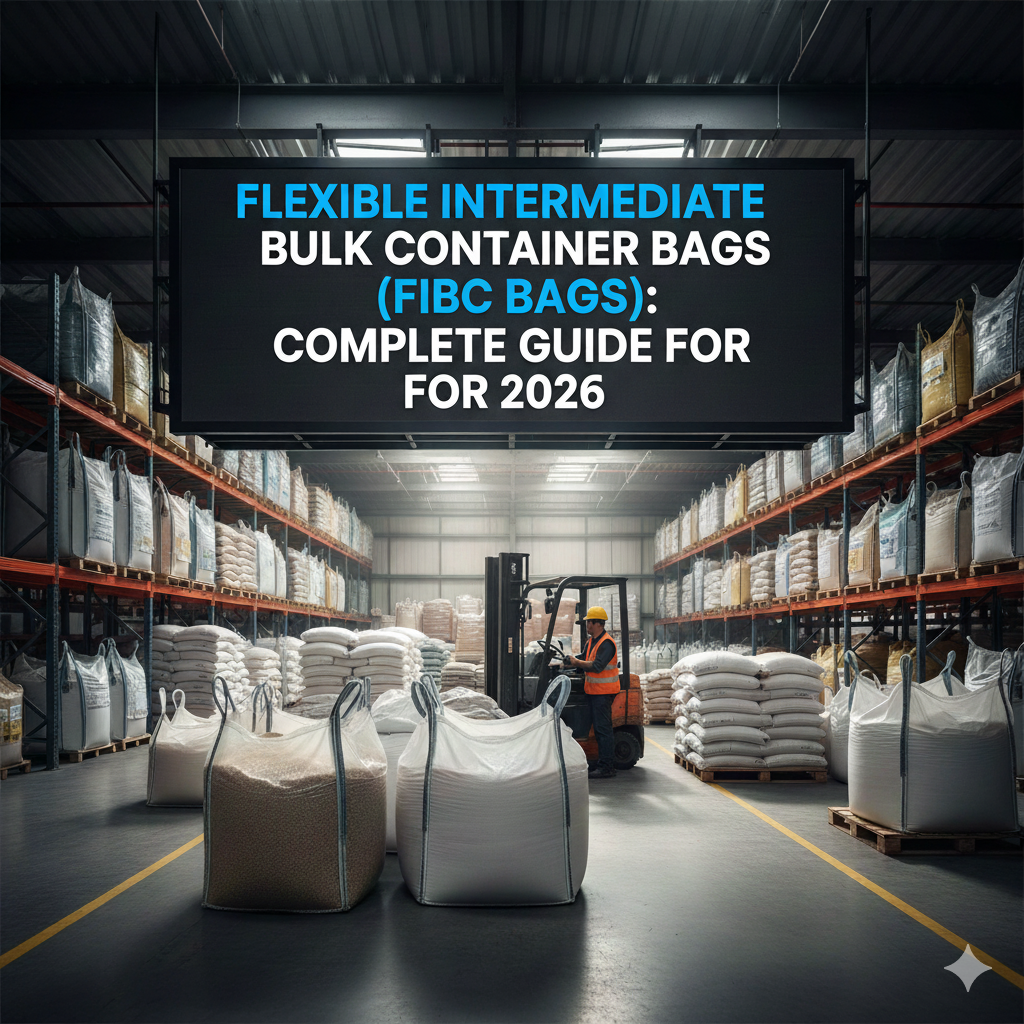
Flexible Intermediate Bulk Container bags (FIBCs) are woven polypropylene bags designed to safely transport 500–4,000 lb (225–1,800 kg) of dry bulk material.
These bags are not generic plastic sacks, they are custom-crafted to carry a lot of weight, discharge without any movement, UV and long term storage.
A 28-year plant manager tells you the updated specifications as at 2025-2026, UN-certified load tests, cost-saving tips, and the buying tips of an expert so that you can save freight costs up to 32 percent without loss in products.
What Are Flexible Intermediate Bulk Container Bags (FIBCs)?
FIBCs are bulk containers that are constructed of woven polypropylene, constructed to:
- Bulk solid, powder, and granule transportation that is safe.
- Easy handling with forklifts or hoists
- Reusable and stackable storage
They find application in such industries as agriculture, food, chemicals, mining, pharmaceuticals.
| Term | Industry Meaning | Floor-Level Translation |
|---|---|---|
| Flexible | Fabric folds flat | Save 80% storage vs. rigid IBCs |
| Intermediate | 500–4,000 lb (225–1,800 kg) | One bag ≈ 10 × 25 kg sacks |
| Bulk Container | Holds free-flowing solids | Cocoa nibs, frac sand, fishmeal |
Common Look-Alikes That Are NOT FIBCs:
25 kg paper valve sacks – burst at ~80 kg
PE-lined landscape "jumbo bags” – SWL only 300 kg
Anti-static types A, B, C, D – straight from the guy who wrote the standard
| A | plain PP | none | sand, gravel |
| B | thin dielectric film | none | flour, sugar (prevents brush) |
| C | conductive tapes | mandatory <10⁷ Ω | solvents, resins |
| D | dissipative yarns | not needed | pharma, fine chem |
Pro Tip: If relative humidity drops below 50%, switch to Type C or D, even for “safe” products like sugar.
11 Critical Numbers We Certify on Every Lot
Every lot is tested and certified to ensure safety and compliance.
| Specification | Value | Notes |
|---|---|---|
| Safe Working Load (SWL) | 1,500 kg | 5:1 safety factor → 7,500 kg rupture |
| UV Life | 1,600 h @ 150 kLy | ≈ 12 months Florida sun |
| Fabric Weight | 180 g/m² ±5 % | Ensures tensile strength |
| Seam Tensile | ≥ 1,050 N | ASTM D4884 |
| Static Decay (Type C) | <0.5 s | IEC 61340-4-4 |
| Food Contact | EU 10/2011 & FDA 177.1520 | Safe for food-grade bulk |
| Top Spout Diameter | 35 cm ±2 mm | Ensures consistent filling |
| Loop Tensile | ≥ 2,900 N each | Handles heavy lifting |
| Dust-Proof Stitching | 7 stitches/inch, 1,200 D thread | Minimizes contamination |
| Pallet Pack Height | 120 cm | 1,000 bags per pallet |
| Net Tare Weight | 2.1 kg | Liner adds 0.25 kg |
Rupture Test Proof: 1 bag per 500 is destroyed on a 50 kN Lloyd tester. A 1,500 kg SWL bag ruptured at 7,620 kg, proving overbuild.
Buying Guide: How to Choose the Right FIBC
1. Match Bag Type to Material
- Powders: Type B or C for anti-static protection
- Granules: Type A for non-static materials
- Chemicals & Pharma: Type D for fine or hazardous powders
2. Consider SWL vs. Safety Factor
A 5:1 safety factor ensures that bags are overbuilt for unexpected loads.
3. Verify Certification
- UN-certified for transport of hazardous goods
- ISO-compliant manufacturing processes
4. Check UV and Weather Resistance
- If stored outdoors: UV life ≥ 1,500 h
- Covers or liners for rain, sunlight, and dust
5. Inspect Stitching and Fabric Weight
- Minimum 7 stitches per inch with high-denier threads
- Fabric weight ≥ 180 g/m²
6. Evaluate Cost-Per-Trip
- Over multiple trips → savings from reusable FIBCs
- Heavier bags → more expensive upfront
FIBC Advantages at a Glance
| Feature | Benefit | Example |
|---|---|---|
| Foldable & Flexible | Space-efficient storage | 5,000 empty bags per pallet |
| Heavy Load Capacity | Safe transport of 500–4,000 lb | 1,500 kg SWL bags tested to 7,620 kg |
| Reusable | Reduced operational cost | Multiple trips per bag |
| Customizable | UV-resistant, food-grade, printed logos | Pharma, chemicals, grains |
Maintaining FIBC Quality
- Store off the ground to avoid moisture damage
- Inspect loops and stitching before each trip
- Clean bags before reuse, especially for food-grade applications
- Replace UV-exposed bags after 12–18 months
Frequently Asked Questions About FIBCs
What is the Safe Working Load (SWL) of an FIBC?
Most standard FIBCs are designed with a Safe Working Load (SWL) of 1,500 kg, using a 5:1 safety factor.
This means that while the bag can safely handle 1,500 kg of material, the fabric itself only ruptures at approximately 7,500 kg, ensuring a significant safety margin.
Can FIBCs be reused?
Yes. When well maintained, FIBGs can be re-used several times. Before reusing, it is important to check any holes in the stitching, loops, and the fabric to see whether or not it is worn or destroyed.
The life of the bag can be prolonged through proper handling and storage which will reduce the overall costs of operation.
Which FIBC type is suitable for powders prone to static?
Type C FIBCs with conductive tapes are required in the case of powders that produce a static electricity.
Fine chemicals and pharmaceutical powders can also be packed in type D bags with dissipative yarns and this is particularly effective when the relative humidity is less than 50%.
Are FIBCs safe for food products?
Absolutely. FIBCs that meet the EU 10/2011 and FDA 177.1520 are safe to food grade products, including sugar, grains, and cocoa nibs.
To ensure further hygiene, liners are possible to avoid contamination and assure products quality.
How long can FIBCs last outdoors?
Every project can last between 12 to 18 months in direct sunlight in UV-resistant FIBCs. Its durability is determined by the weight of the fabric and the intensity of the UV.
Bags kept inside in an environment without access to UV radiations, moisture as well as harsh temperatures will have a much longer life.
How should FIBCs be stored?
Store FIBCs off the floor, not in direct sunlight, rain or excess moisture to maximize lifespan and ensure the safety of the product.
Do not over-stack bags above recommended heights of pallets because the bags can be deformed and lessen the performance.
Can FIBCs be used for hazardous chemicals?
Yes. The UN-certified FIBCs are actually meant to carry hazardous materials.
Under the conditions of shipping hazardous goods, it is always necessary to make sure that the type of bag, the grounding, and the certifications correspond to the type of material that is being delivered.
What materials can be shipped in FIBCs?
FIBCs are suitable with free flowing solids, granules, powders and flakes.
Typical ones are sugar, flour, cocoa nibs, frac sand, fishmeal, among other large volumes of agricultural, chemical, or construction products.
How do I choose the right FIBC supplier?
In choosing a supplier, seek transparency, certification (ISO, UN, FDA/EU compliance), technical advice and readiness to supply sample bags.
A small test before a bulk order will make sure that the bag fits your needs and operational quality.
Conclusion
FIBCs are much more than just large plastic bags. They are very designed, strong and efficient ways of carrying bulk goods safely.
By knowing the types, certifications and specifications of the FIBCs, buyers can save a lot of money as a result of freight, prevent the products against contamination or harm, as well as assure adherence to the safety and food grade requirements.
The reuse of FIBCs, the correct type of the collection and proper storage guarantees the maximum life and cost-saving.
The type of FIBC to use, combined with the best practice, is a sure way of receiving safe (and reliable) bulk shipping, regardless of what you are transporting agricultural products, chemicals, pharmaceuticals, or construction materials.
Pro Tip: When buying in large quantities, never neglect to ask to have certified load tests, technical data sheets and confirmation of manufacturer specification.
An effectively selected FIBC is a cost-effective investment, which is rewarded by saving costs, expediency, and product security.
Bitumen
Premium Bitumen Solutions for Modern Infrastructure – Pursuit Industries
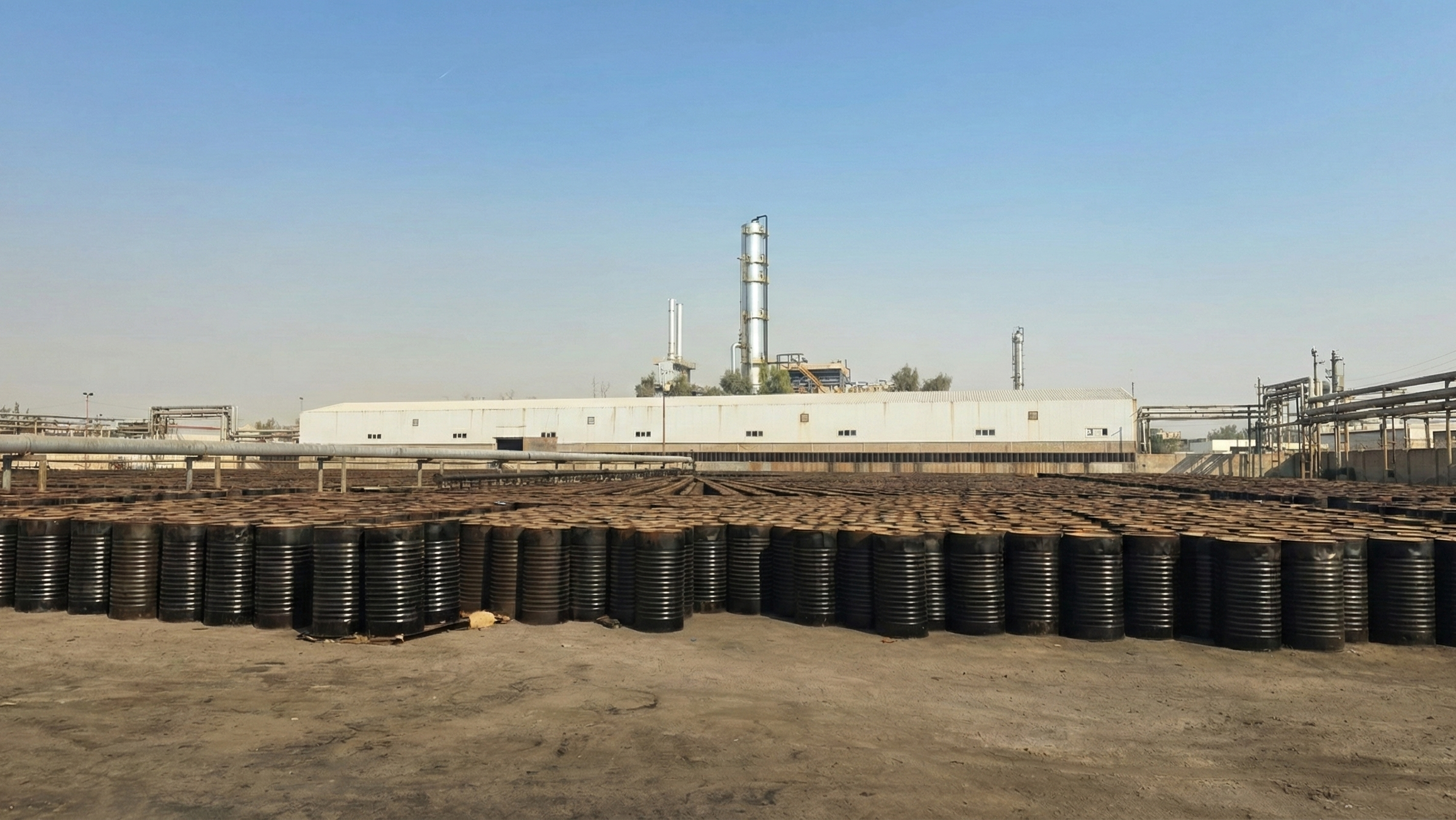
Pursuit Industries proudly participated in the 5th Edition of the Global Road Construction Conference 2025, showcasing our complete range of high-performance Penetration Grade Bitumen and Viscosity Grade Bitumen designed for modern infrastructure and heavy-duty road applications.
Our bitumen solutions are engineered to deliver exceptional stability, durability, and performance under varying climatic and traffic conditions. With consistent quality and international certifications, Pursuit Industries supports large-scale construction companies, road contractors, and government infrastructure projects worldwide.
Penetration Grade Bitumen
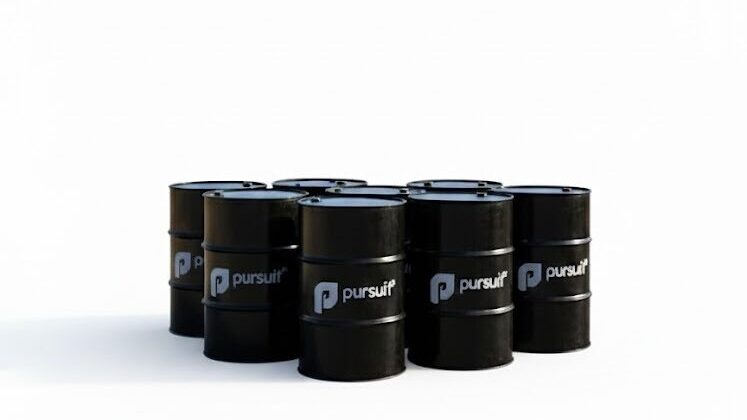
Our Penetration Grade Bitumen is formulated to meet international standards, offering excellent binding strength, temperature resistance, and long-lasting pavement performance.
Available Grades:
- 40/50
- 50/70
- 60/70
- 70/100
- 85/100
- 160/220
➤ Bitumen 40/50
Characteristics:
- Hard grade
- Best for extremely hot climates
- Highly resistant to rutting
Applications:
- Heavy-duty pavements
- National highways
- Sea-port roads
- Industrial zones
➤ Bitumen 50/70
Characteristics:
- Balanced hardness
- Good resistance to traffic stress
- Suitable for hot to moderate climates
Applications:
- Standard highways
- Asphalt concrete
- Base & binder courses
➤ Bitumen 60/70
Characteristics:
- Most widely used penetration grade
- High durability
- Excellent adhesion
Applications:
- Flexible pavements
- Expressways
- Airport runways
- General road construction
➤ Bitumen 70/100
Characteristics:
- Softer than 60/70
- Suitable for cold regions
- Prevents cracking
Applications:
- Cold-climate roads
- Asphalt surface dressing
- Rural roads with low–medium traffic
➤ Bitumen 85/100
Characteristics:
- Soft and flexible
- Better low-temperature performance
- Reduces brittleness
Applications:
- Northern/cold regions
- Cracking-resistant pavements
- Maintenance works
➤ Bitumen 160/220
Characteristics:
- Softest grade
- Very high penetration
- Used where flexibility is needed
Applications:
- Freeze-prone areas
- Surface treatments
- Premix carpets and light-traffic roads
Applications:
- Wearing courses & surface dressing
- Asphalt pavements
- National highways
- Airport runways
- Dense bitumen macadam (DBM)
- Wearing courses & surface dressing
Viscosity Grade Bitumen (VG Bitumen)
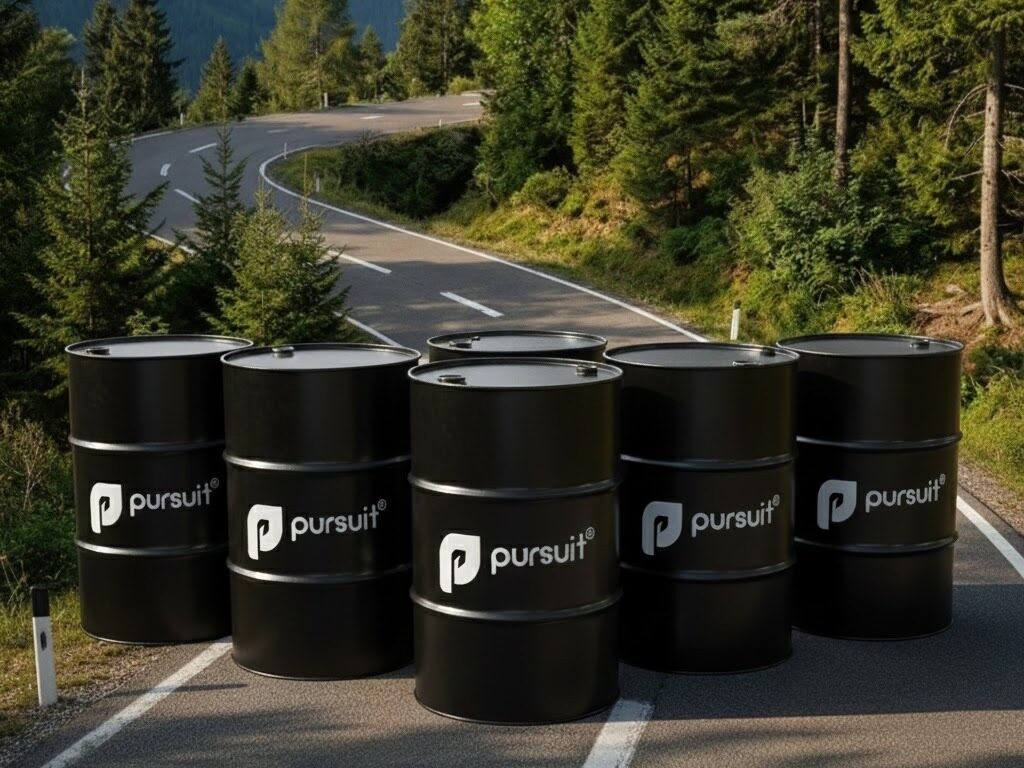
Viscosity Grade Bitumen is widely used across India and the Middle East due to its consistent quality and reliable performance in hot climates and heavy traffic conditions.
Available Grades:
- VG-10
- VG-20
- VG-30
- VG-40
➤ VG-10 Bitumen
Characteristics:
- Low viscosity
- Best for cold and rainy regions
- Easy to spray and mix
Applications:
- Surface dressing
- Cold-climate roads
- Bitumen emulsions manufacturing
➤ VG-20 Bitumen
Characteristics:
- Medium viscosity grade
- Suitable for moderate climate conditions
- Good resistance to rutting
Applications:
- Semi-dense bituminous concrete
- State highways
- Base & binder courses
➤ VG-30 Bitumen
Characteristics:
- Most commonly used viscosity grade
- High viscosity & strength
- Suitable for heavy traffic
Applications:
- National highways
- Airport runways
- Hot mix asphalt (HMA)
- Heavy-load roads
➤ VG-40 Bitumen
Characteristics:
- Highest viscosity
- Extremely strong & durable
- Ideal for industrial and high-load zones
Applications:
- Industrial roads
- Container yard roads
- Toll expressways
- High-temperature regions
Applications:
- Flexible pavements
- High-traffic highways
- Industrial and commercial paving
- Hot Mix Asphalt (HMA) manufacturing
Why Choose Pursuit Industries?
- Premium & consistent quality bitumen
- Global supply capability
- Bulk packaging options: drums, tankers, bitutainers
- Technical assistance for grade selection
- Export-ready documentation & logistics support
Contact Us for Bulk Orders & Export Pricing
For technical datasheets, bulk supply, or country-specific export requirements — contact Pursuit Industries today.
Types of FIBC Bags: Complete Guide to FIBC Bag Types, Uses & Specifications
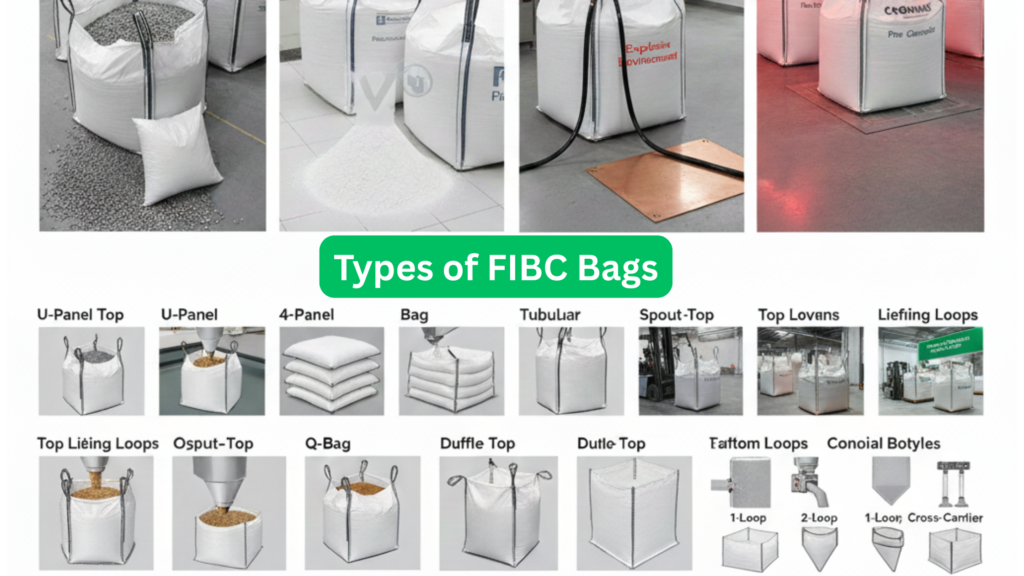
In case you are looking into the variety of FIBC bags, there are four main types of bags: Type A, Type B, Type C, and Type D, which are to provide the different degrees of the electrostatic protection and even the specific industrial use.
These jumbo bags (also referred to as big bags, super sacks and jumbo bags) are applied in agriculture, chemicals, food, pharmaceutical, construction, and mining to handle bulk material safely.
What Are FIBC Bags? (Flexible Intermediate Bulk Containers)
Definition
Flexible Intermediate Bulk Containers Bags (FIBC) The bags are very large woven polypropylene bags that are used to store, transport and manipulate bulk material in the form of powders to granules to aggregates.
What They Are Made Of
They are produced in woven polypropylene (PP), which makes them lightweight, strong, waterproof as well as adjustable to suit different industrial needs.
Common Names
- Bulk Bags
- Jumbo Bags
- Big Bags
- Tote Bags
- Super Sacks
Where They Are Used
FIBC bags are widely used in:
- Agriculture
- Chemical & Petrochemical industries
- Construction
- Food & Pharma
- Mining & Minerals
- Plastic granules & resin industries
FIBC Full Form
FIBC means Flexible Intermediate Bulk Container
How Many Types of FIBC Bags Are There?
There are four major types of FIBC bags based on electrostatic safety classification:
- Type A – Standard, non-conductive
- Type B – Low breakdown voltage
- Type C – Conductive, grounding required
- Type D – Anti-static, no grounding required
Why This Classification Matters
This category guarantees the safety in the process of working with flammable materials, powdery substances, and the environment where the person may become a source of a current.
When to Choose Which Type
- For general materials → Type A
- For dry powders with surface discharge risk → Type B
- For flammable environments → Type C
- For industries needing safety without grounding → Type D
Types of FIBC Bags (Electrostatic Classification)
Type A FIBC Bags (Standard, Non-Conductive)
Construction
Made from plain woven polypropylene without special electrostatic properties.
Safe Uses
The product is appropriate in non-flammable goods like:
- Sand
- Gravel
- Plastic granules
- Cement
Not Suitable For
- Handling flammable powders
- Areas of exposures to explosive vapors.
Industries
Construction, mining, agriculture, general industrial use.
Type B FIBC Bags (Low Breakdown Voltage)
Difference vs Type A
Type B bags look similar to Type A but have low breakdown voltage (<6kV) to prevent energetic propagating brush discharges.
Limitations
Still not safe for environments having flammable gases/vapors.
Best Applications
- Dry powders
- Fertilizer
- Starch
- Pharmaceuticals
- Fine chemicals
Type C FIBC Bags (Conductive, Groundable Bags)
When Grounding Is Required
These bags must be grounded during filling and discharge to eliminate static charges.
Industries Using Type C
- Petrochemical
- Pharmaceuticals
- Chemical powders
- Explosive environments
Safety Requirements
- Always connect to grounding system
- Regular resistance testing
- Only used in controlled industrial setups
Type D FIBC Bags (Anti-Static, No Grounding Required)
CROHMIQ / Dissipative Fabric Explanation
Made from antistatic fabrics such as CROHMIQ, which safely dissipates static charges without grounding.
Ideal Conditions
Best suited for industries where grounding is difficult or impossible.
Benefits Over Type C
- No grounding needed
- Safer for operators
- Higher efficiency in fast-paced environments
FIBC Bag Construction Styles (Shape & Build Types)
U-Panel Bags
Made from three panels: one U-shaped panel + two sides.
- Strong structure
- Economical
- Widely used
4-Panel Bags
Four panels stitched together.
- Better shape retention
- Ideal for stacking
Circular (Tubular) Bags
Woven in a circular loom; minimal seams.
- Stronger
- No side seams
- Used for fine powders
Baffle (Q Bags / Form-Stable Bags)
Internal baffles maintain cube shape.
- Maximum space efficiency
- Best for container loading
- Reduces bulging
Top Styles of Flexible Intermediate Bulk Containers
Loop Varieties
1-Loop FIBC
Used mainly for fertilizer & cement.
2-Loop FIBC
Suitable for crane or hook lifting.
4-Loop FIBC
Most common; used with forklifts.
Cross-Corner Loops
Easy lifting when bag is full.
Corner Loops
Standard lifting option for most industries.
Top Closures
Open Top
For easy filling of materials like sand, stones, grains.
Spout Top
For precise filling of powders.
Duffle Top
Offers full opening and closure flexibility.
Conical Top
Ideal for sticky or flow-challenged materials.
Bottom Discharge Types
Plain Bottom
For single-use bags with no discharge needs.
Discharge Spout
Controls material release.
Duffle Bottom
Quick and wide unloading.
Conical Discharge
For sticky powders & fine materials.
FIBC Bag Specification Options
- GSM (fabric weight)
- Coated vs Uncoated
- SWL (Safe Working Load: 500 kg–2000+ kg)
- SF (Safety Factor: 5:1, 6:1, etc.)
- Inner Liners (PE liners for moisture protection)
- Fabric Types (uncoated, laminated)
- Printing & Branding (logo, instructions, barcode)
Applications & Industries Using Different Types of FIBC Bags
- Agriculture & seeds
- Fertilizers
- Chemicals
- Food ingredients
- Pharma powders
- Cement, sand & aggregates
- Mining & minerals
- Plastic granules
- Recycled materials
- UN-certified hazardous products
How to Choose the Right Type of FIBC Bag
1. Consider Material Type
Powders, grains, granules, or hazardous material.
2. Load Capacity & SWL Requirements
Choose bags based on your required safe working load.
3. Flammability & Static Needs
Select between Type A, B, C, or D.
4. Storage & Handling Conditions
Stacking, humidity, method of transportation.
5. Environmental Factors
UV protection, exposure to moisture, exposure to dust.
Advantages of FIBC Bags (Why Businesses like Bulk Bags)
- Cost-effective
- High safety & strength
- Reusable & recyclable
- Space-saving
- Easy transportation & handling
- Reduced packaging waste
Frequently Asked Questions (FAQ)
What does FIBC stand for?
Flexible Intermediate Bulk Container.
Which type of FIBC is safest for flammable materials?
Type C (with grounding) and Type D (without grounding).
Do Type C bags always require grounding?
Yes, grounding is mandatory.
Can Type D bags be used outdoors?
Yes, if UV-stabilized.
What is the most common FIBC bag type?
4-loop standard Type A bulk bag.
Conclusion: Which Type of FIBC Bag Is Right for You?
The selection of the appropriate type of FIBC bag is based on the type of product, the risk at rest, the loading method, and the level of safety in the industry.
Type A is applicable in most general products. With powders and chemicals Type B, C or D may be required based on flammability and non-flammability conditions.
Why Choose Pursuit for FIBC Bags?
- Custom sizes, GSM & print options
- High-strength PP fabric
- Custom manufacturing
- Global supply capacity
- Food-grade & pharma-grade production
- ISO & UN-certified options
Food-Grade FIBC Manufacturers in India — Complete Guide
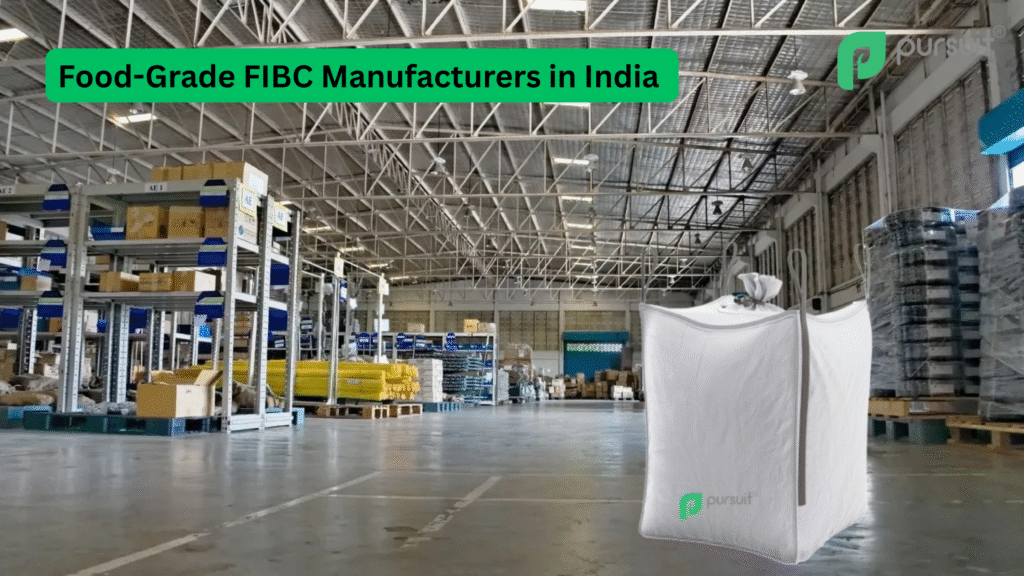
The world food supply chain is supported by safe packaging.
Whether exporting and/ or storing food ingredients (grains, sugar, salt, flour, starch, pulses, spices and edible powders) you will need to make sure your packaging requires zero contamination, zero exposure to moisture and one hundred percent hygiene.
This is where Food-Grade FIBC Bags become the No.1 choice globally.
India is a most reputable and largest food-grade FIBC manufacturer that supplies industries in USA, UAE, Europe, Australia and Africa with quality jumbo bags that are certified and meet the safety requirements ensuring export.
What Are Food-Grade FIBC Bags?
Food-grade FIBC bags are bulk packaging bags manufactured specifically for safe handling, transport, and storage of edible and food-related materials.
They are produced in clean, controlled environments to prevent:
- Contamination
- Dust & dirt exposure
- Microbial risks
- Foreign particles
- Odors or chemical contact
Companies that export food items require these bags for product safety and compliance with global regulations.
Why Food-Grade FIBC Bags Are Essential for Edible Products
Food products are extremely sensitive to:
- Humidity
- Bacteria
- Cross-contamination
- Packaging residue
- Insects
- Temperature
- Dust
A slight drop in hygiene can cause:
- Spoilage
- Infections
- Customer complaints
- Legal issues
- Shipment rejection
Jumbo bags with food grade are a barrier, keeping your product clean and exportable.
Key Features of High-Quality Food-Grade FIBC Bags
1. Manufactured in Hygienic Clean-Room Facilities
Quality manufacturers use:
- HEPA-filtered air control
- Pest-free controlled rooms
- Metal detection systems
- Cleaning & de-dusting stations
- Sanitized sewing zones
👉 To see examples of standard FIBC bags, visit: https://pursuitind.com/fibc-bags/
2. Compliant With Global Food Safety Standards
Reliable manufacturers follow:
- BRCGS (Food Safety Standard)
- ISO 22000 / HACCP
- GMP (Good Manufacturing Practices)
- FDA-compliant production processes
These certifications guarantee safe handling of edible goods.
3. Safe-contact fabric & components
The fabric, stitching, printing, loops, liners, and every component are selected to ensure:
- No chemical interference
- No odor transfer
- No contamination risk
4. Customization for Any Food Product
Foods have different handling requirements.
Manufacturers provide:
- Custom sizes
- Top & bottom options (spout, duffle, flap)
- Loops (side-seam, cross-corner, single loop)
- Liners for moisture-sensitive items
- Printing options
- Baffles for space optimization
Explore customizable bag options at: https://pursuitind.com/fibc-bags/
5. Strong for export handling
Food-grade bulk bags go through:
- Strength testing
- UV testing
- Lift test
- Drop test
- Seam inspection
This ensures safe transport across long distances.
Why India Is a Global Leader in Food-Grade FIBC Manufacturing
1. High-Quality Standards
Modern machines are used in Indian FIBC factories and they observe strict quality checks.
2. Competitive Pricing
India has cost-effective manufacturing which does not compromise on quality compared to USA and Europe.
3. Massive Export Network
Indian manufacturers export to:
- USA
- UK & Europe
- UAE
- Africa
- Australia
- South America
- Southeast Asia
4. Large Manufacturing Capacity
India has the world’s largest FIBC production zones, capable of supporting bulk and urgent orders.
5. Skilled Workforce
Manufacturing teams are trained in:
- Food hygiene
- Clean-room operation
- Quality inspections
- Packaging standards
Industries That Use Food-Grade FIBC Bags
Food-grade jumbo bags are used by:
- Rice mills & grain exporters
- Sugar manufacturing units
- Spices processors
- Salt manufacturers
- Flour mills
- Pulses exporters
- Coffee & cocoa industries
- Starch & powder businesses
- Animal feed suppliers
- Dairy powder companies
For industry-specific solutions, visit: https://pursuitind.com/industries-we-serve/
Types of Food-Grade FIBC Bag
1. Standard Food-Grade Bags
For grains, pulses, sugar, spices.
2. Baffle Bags
Ideal when you need shape stability and container optimization.
3. Bags With Liners
Appropriate to items that are sensitive to moisture such as starch or milk powder.
4. Conductive Type C Bags
Prevents static charge during handling.
5. Anti-static Type D Bags
Best for explosive and dust-prone environments.
Step-by-Step Manufacturing Process of Food-Grade FIBC Bags
A top-quality manufacturer follows this complete process:
Step 1: Material Preparation
To prevent contamination of the fabric, it is made according to food-safe guidelines.
Step 2: Yarn Extrusion & Weaving
Yarns are prepared and woven into fabric rolls used for bag body.
Step 3: Cutting & Printing
The cloth is cut to desired dimensions. Food-compliant safe inks are used in printing.
Step 4: Clean-Room Sewing Process
This includes:
- Air cleaning
- Dust removal
- Sanitized sewing machines
- Skilled workers wearing protective gear
This is the most important step in producing food-safe FIBC bags.
Step 5: Liner Fabrication (If Required)
Salt, starch, dairy powders and moisture sensitive food products are optional liners.
Step 6: Metal Detection & Quality Checks
Bags undergo:
- Metal detection
- Load test
- UV test
- Cleanliness check
- Visual inspection
Step 7: Final Packing
The bags are packed in uncontaminated containers that are well sealed to ensure that they are not contaminated in the process of transportation.
How to Choose the Best Food-Grade FIBC Manufacturer in India
1. Check Certifications
Prefer manufacturers with:
- BRCGS
- ISO 22000
- HACCP
- GMP
2. Inspect Manufacturing Environment
Ensure they have:
- Clean-room sewing
- Air filtration
- Pest control
- Metal detection systems
- Traceability records
3. Ask About Customization Options
Your manufacturer should offer:
- Custom dimensions
- Printing
- Loops
- Liners
- Baffles
- Safe working load options
4. Check Global Export Experience
A good manufacturer must understand export documentation & compliance.
5. Evaluate Communication & Support
Companies like Pursuit Industries offer excellent customer support and quick response times.
Know more: https://pursuitind.com/about-us/
Benefits of Food-Grade FIBC Bags
1. Ideal for Food Safety
Protects from impurities, microbial exposure, and dust.
2. Reduces Handling Costs
One bag can carry large volumes.
3. Easy to Transport
Forklift-friendly loops make stacking and movement simple.
4. Space-Saving & Efficient
Baffle bags help load more material in containers.
5. Eco-Friendly & Recyclable
Made from recyclable materials.
Applications of Food-Grade FIBC Bags
These bags are perfect for storing and exporting:
- Rice
- Wheat
- Sugar
- Salt
- Pulses
- Spices
- Coffee beans
- Cocoa powder
- Dry fruits
- Food-grade starch
- Dairy powders
- Additives & food ingredients
Why Importers Prefer Indian Manufacturers
- High-quality standards
- Better hygiene compliance
- Export-friendly documentation
- Competitive pricing
- Timely deliveries
- Advanced machinery
- Expertise in bulk manufacturing
FAQs
1. Are food-grade FIBC bags safe for direct food contact?
Yes, when produced under certified food-safe environments.
2. Can I request customized sizes and printing?
Yes, customization is available for all food-grade bags.
3. Which industries are the biggest users?
Rice, spices, grains, sugar, flour, salt, and powders.
4. Do Indian manufacturers export worldwide?
Yes, India exports to more than 30+ countries.
5. Are liners compulsory?
They are optional but recommended for moisture-sensitive items.
Conclusion
The production methods, clean room, world safety standards and competitive pricing have made India one of the most desired destinations of food grade FIBC bags in the world.
In need of a good supplier, Pursuit Industries is one of the reputable manufacturers in the provision of:
- High-quality FIBC bags
- Food-safe production
- Clean-room facility
- Custom packaging solutions
- Global export support
Pursuit Industries: A Complete Guide to India’s Leading Packaging, Chemical & Agro Export Company
Pursuit industries is a fast growing and diversified export company in India with high growth rate. The company boasts of a global presence, a good reputation in terms of quality, commitment, and reliability, having had business verticals that are packaging solutions, chemical and pharmaceutical raw materials, and agro and food commodities.
What started as a small agro-trading company in 1940 has been transformed into a contemporary, multi-division export house with its clientele in 80+ countries. Pursuit Industries Pvt Ltd is a company that is on the brink of innovation, international trade, and manufacturing perfection today.
What is Pursuit Industries Known For?
Pursuit Industries have three large business areas:
- FIBC & Packaging manufacture.
- Industrial Pharma Raw Materials & Chemicals.
- Exporting of Agro Products and Food Commodities.
All the segments are well-developed with their own product proposal, clientele, and distribution channel.
1. Packaging Division — FIBC & PP Woven Bags
One of the best pillars of Pursuit Industries is the packaging industry.
The company produces and exports:
- FIBC Jumbo Bags
- PP & HDPE Woven Bags
- BOPP Laminated Bags
- U-Panel Bags
- Circular Bags
- Ventilated Bags
- Conductive & UN-Certified FIBC Bags
- Tarpaulins
- Woven Fabrics
Industries Served
- Agriculture
- Fertilizers & Minerals
- Food Grains & Seeds
- Petrochemicals
- Cement & Construction
- Plastics & Polymers
These products are known for durability, strength, and compliance with global safety standards — making Pursuit Industries a reliable packaging manufacturer for international cargo and bulk-handling needs.
2. Chemicals & Pharmaceutical Raw Materials
The chemical division of Pursuit Industries supplies high-quality industrial chemicals and raw materials used in:
- Pharmaceuticals
- Water treatment
- Home-care & detergents
- Plastics & rubber
- Paints, inks & coatings
- Mining & drilling
- Food processing
Key Highlights
- Multi-industry chemical portfolio
- Strict quality checks
- Bulk availability
- Safe packaging
- Internationally acceptable purity levels
This diversified chemical offering gives Pursuit Industries a strong foothold in global B2B chemical supply markets.
3. Agro & Food Products Export
Even after diversification, agro-business remains the heritage foundation of Pursuit Industries.
The company exports:
- Spices
- Pulses
- Cereals
- Oil-seeds
- Raisins
- Fruit Pulp (especially Mango)
- Peanut Butter
- Jams, Sauces, and Pastes
As the demand of Indian food products grows globally, Pursuit Industries accepts the global standards of quality and hygiene as a reliable exporter of the same.
Mission, Vision & Core Values of Pursuit Industries
Mission
To empower the world trade through the provision of high-quality products supported by a superior service, ethical business, and innovations.
Vision
To reach the position of the internationally-known leader in the packaging, chemicals, and agro commodities with the emphasis put on quality, sustainability, and customer satisfaction.
Core Values
- Integrity
- Quality Excellence
- Customer-First Approach
- Diversity & Inclusion
- Sustainability
- Continuous Innovation
These values would assist Pursuit industries in developing long-run relations with international customers.
What Makes Pursuit Industries Stand Out?
⭐ 1. Eight-Decades Legacy
Pursuit industries is a company that dates its existence back to 1940 and still enjoys the benefit of both traditional business strength and the contemporary global trade.
⭐ 2. Multi-Industry Presence
The firm has reduced risk on the basis of various operations – packaging, chemicals, and agro food products.
⭐ 3. Export Excellence
Having customers in 80 + countries, Pursuit industries is known to be a powerful international supplier.
⭐ 4. Strong Manufacturing Capabilities
They have modern technology and quality control in their Gujarat-based manufacturing units in their FIBC and PP woven.
⭐ 5. Competitive Pricing + High Quality
The company is compromised in terms of cost and quality, and it provides them with a competitive edge in the global market.
⭐ 6. Customer Commitment
Regular supply and open communication are also the key strengths on time delivery.
Company Structure & Leadership
Pursuit industries Pvt Ltd is a company that has several manufacturing plants and export channels in Surat, Gujarat.
The management is concentrating on growth, technological advancements and better global presence- that will keep the organization abreast of the competitive trends in the international markets.
Challenges Ahead (Market-Based)
Even dominating firms have problems. In the case of Pursuit Industries, the possible obstacles are:
- International price volatility of raw materials of chemicals and plastics.
- Sustainability requires high demands.
- Global regulatory standards.
- Quality management of a product-diversified range.
Nevertheless, the flexibility of the company and diversified structure can make them overcome these obstacles.
Future Outlook: What’s Next for Pursuit Industries?
The objective of Pursuit Industries targets:
- Entering new continents.
- Moving towards eco-friendly packaging technology.
- Expansion of production capacity.
- Bringing new value added chemical, food products.
- Enhancing the brand presence internationally.
The company has a large growth agenda that is placing it on the path of being among the leading diversified exporters in India.
FAQ
1. What is Pursuit Industries?
Pursuit industries are an Indian based company which deals with packing of agro/food commodities, manufacturing of industrial chemicals and production of FIBC packaging.
2. Where does Pursuit industries reside?
The company is headquartered in Surat, Gujarat, with manufacturing units across the state.
3. What products does Pursuit Industries manufacture?
It manufactures FIBC bags, PP woven bags, chemicals, pharma raw materials, spices, pulse, oils seeds and food products.
4. Is Pursuit industries an exporter?
Yes, Pursuit industries is exporting to over 80 countries across the world.
5. What industries use Pursuit’s packaging products?
Agriculture, minerals, fertilizers, petrochemicals, cement, plastics, and food industries.
6. Does Pursuit industries distribute chemicals?
Yes, the chemical division supplies water-treatment chemicals, pharma raw materials, detergent chemicals, coatings chemicals, and more.
7. Is Pursuit industries a product that is customizable?
The elegance of the customers can be fully satisfied with the customization of the FIB Bags, woven fabrics, and sizes of the chemical packs.
8. Is Pursuit industries an ISO certified organisation?
The company has upheld the international quality and compliance standards in different lines of products.
9. Does Pursuit sell food grade products?
Yes, including spices, cereals, pulses, fruit pulp, peanut butter, and processed food products.
10. What makes Pursuit Industries different from other manufacturers?
Their diversification, experience in exporting, quality management and devotion to their customers.
Conclusion
Pursuit industries is not just a packaging company or a chemical distributor, it is a diversified global business house with decades of experience, good values and vision of the future.
The company provides end to end export solutions, including industrial chemicals and agro commodities, among other things, under a single roof, which are in the form of PIBC jumbo bags.
As the world grows more and more demanding and Pursuit Industries is determined to focus on quality, it is going to become even stronger as an international brand that the world can rely on.
Polypropylene Woven Bags: Complete Guide, Types, Manufacturing & Uses
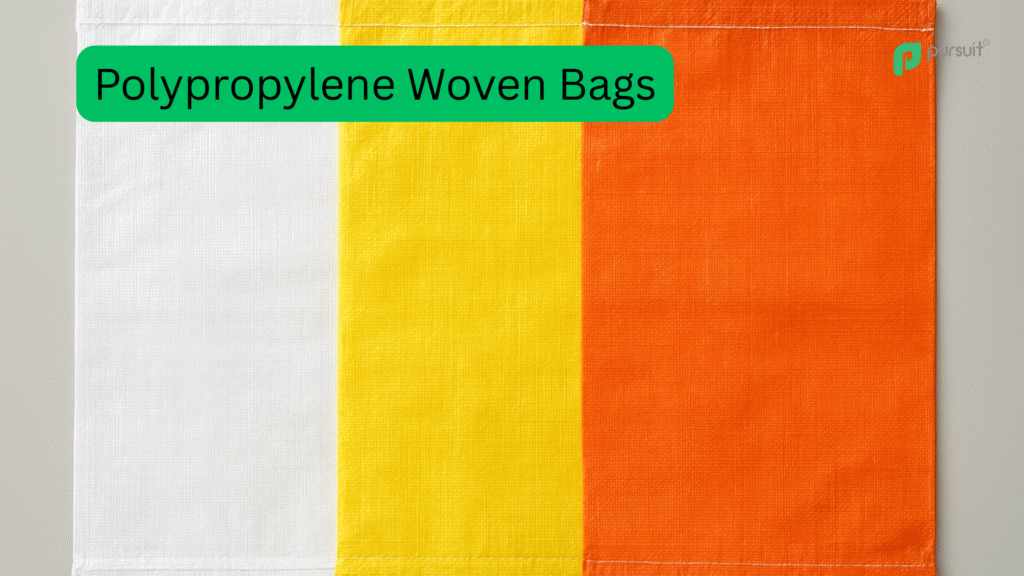
One of the most common and the most reliable packaging options that have been adopted in various industries such as food, agriculture, chemical, construction and retail packaging is the polypropylene woven bags.
These PP woven bags are produced with high-quality PP (polypropylene) fabric that is also very strong, tear resistant and economical.
We, Pursuit Industries, produce premium-grade polypropylene woven bags of which products, rice, flour, sugar, fertilizers, seeds, and others are in high demand in terms of transportation and storing their goods.
What Are Polypropylene Woven Bags Made Of?
Polypropylene woven bags are made using the PP (polypropylene) plastic which is a light weight but a strong thermoplastic polymer.
- The PP material is melted and is pulled into thin tapes.
- These tapes are woven like in the warp and weft fashion to produce a strong fabric.
- The woven provides high tensile strength and load carrying.
The use of woven PP bags is contrasted with non-woven polypropylene bags, which are produced by bonding but not by weaving.
Types of Polypropylene Woven Bags
Standard PP Woven Bags
It is usually used in packing grains, sugar, fertilizers, and industrial materials.
Laminated PP Woven Bags
These bags are water-resistant and will be perfect in printing, with the exception of being laminated to shield them against water.
HDPE Bags vs PP Bags
HDPE bags offer flexibility, but PP woven bags are stronger, more durable, and preferred for heavyweight packaging.
Non-Woven Polypropylene Bags
Used widely in retail shopping and branding.
Printed Polypropylene Bags / Custom Bags
High-quality printing (up to 8 colors) for brand visibility.
Woven Polypropylene Sacks (PP Sacks)
Used for 25kg–50kg packaging: grains, feed, cement, sand, chemicals.
Key Features & Benefits of Polypropylene Woven Bags
It is desired that polypropylene woven bags should be used since they provide:
- Good strength and durability.
- Resistance to tears and punctures.
- Portable and economical.
- Waterproof, recyclable and friendly to the environment.
- Outdoor products — UV-stabilized.
- Food safe and hygienic packaging.
- Portable storage and transportation.
These characteristics render PP woven bags one of the strongest packaging options, which are present nowadays.
Applications of PP Woven Bags
Food & Grain Packaging
It is suitable to rice, wheat flour, dal, sugar, salt, and pulses.
Fertilizer & Chemical Industry
Used in the storage of fertilizers, minerals, chemicals and powders.
Animal Feed, Seeds & Agro Products
Agricultural products are safeguarded against moisture using strong woven polypropylene sacks.
Construction Materials
Ideal in carrying sand, cement, stones and resin.
Retail & Shopping (Non-Woven PP Bags)
Green non-woven polypropylene shopping and branding bags.
Polypropylene Woven Bag Manufacturing Process
At Pursuit Industries, the manufacturing of PP woven bags is done on high automated machinery.
Extrusion
The granules of Pp are melted into tapes.
Weaving Fabric
The tapes are also knitted into cloths using circular machines.
Printing
Good printing ensures brand recognition.
Lamination / Liner Addition
Water protection is provided by lamination and additional protection is offered by liners.
Cutting & Stitching
The fabric is stitched with high strength threads and cut depending on the size of the bag required.
Difference Between Woven and Non-Woven Polypropylene Bags
Woven PP Bags
- Made by weaving threads
- Strong and durable
- Suitable for industrial packaging
Non-Woven PP Bags
- Made by bonding fibers
- Used for shopping bags
- Lightweight and customizable
How to Choose the Right Polypropylene Woven Bag
Consider the following:
- Bag capacity (5kg, 10kg, 25kg, 50kg)
- GSM (fabric thickness)
- Coated vs uncoated
- With or without liner
- UV stabilization
- Custom printing requirements
Pursuit Industries helps customers choose the best type based on their industry needs.
Polypropylene Woven Bags Price Factors
Price depends on:
- Bag size and GSM
- Printing (single/dual color)
- Lamination
- Liner thickness
- Order quantity
- Material quality (PP or HDPE)
Top Polypropylene Woven Bag Manufacturers & Suppliers
India has many manufacturers, but Pursuit Industries (pursuitind.com) stands out due to:
- High production capacity
- Custom printing options
- UV-stabilized PP woven bags
- Durable and export-quality products
- Affordable wholesale pricing
Why Choose Polypropylene Woven Bags for Packaging?
Polypropylene woven bags offer:
- Excellent durability
- High load capacity
- Long life
- Moisture resistance
- Low cost
- Eco-friendly design
- Reusability
They are ideal for industries looking for strong, cost-effective, and reliable packaging.
Conclusion
Polypropylene woven bags are the strongest and multifunctional among the packaging solutions in the world.
PP woven bags are superior in their durability and cost efficiency whether you require a bag to keep your grains, fertilizers or chemicals, construction materials or even retail bags.
In case you need high-quality PP woven bags, Pursuit industries are a reliable manufacturer of high quality to offer durable and customizable and affordable packaging across India (pursuitind.com).