Big Bag: A Complete Guide to Flexible Intermediate Bulk Containers (FIBC)
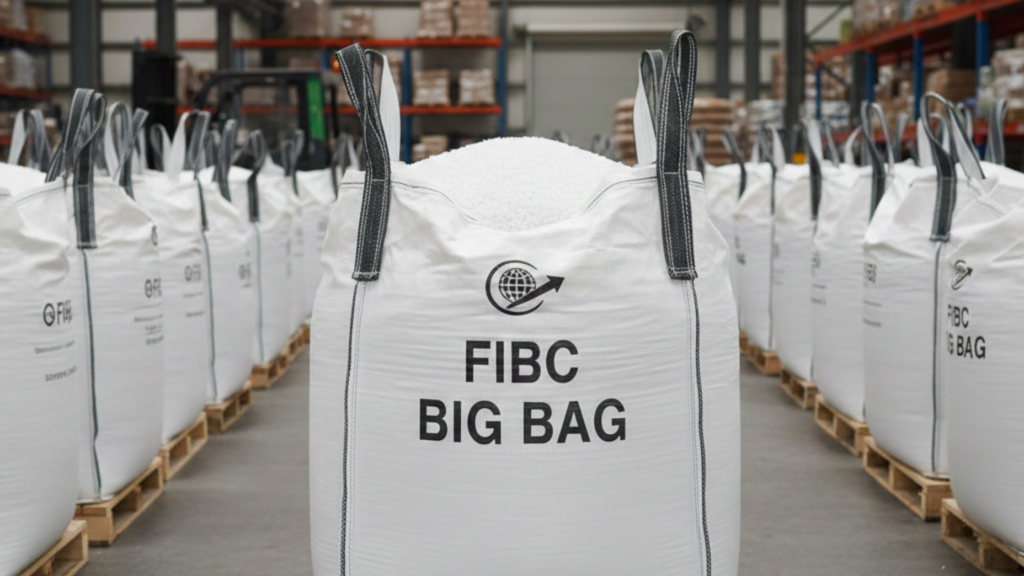
Big Bags (also called Flexible Intermediate Bulk Containers (FIBC), jumbo bags, bulk bags, dumpy bags, or super sacks) are common industrial packaging material solutions that are used in the transportation and storage of dry, flowing substances.
Big Bags are made using the fabric of woven polypropylene; they are lightweight, very durable, and can carry a load of between 500 kg and 2000kg and above.
This detailed manual defines what Big Bags are, their varieties, usage, history, size criteria and the entire manufacturing process.
What Is a Big Bag?
A Big Bag is a stretchy industrial bag made of woven polypropylene (PP) material. It specifically is made to carry bulk material like:
- Sand & aggregates
- Fertilizer
- Plastic granules
- Cement
- Food grains
- Chemicals & minerals
- Construction materials
The reason behind using Big Bags is that it is a combination of strength, lightweight, cost-effective and easy handling.
They can be used with forklifts, cranes, and pallet systems, which accelerate and secure bulk handling.
Standard Size, Volume & Capacity of Big Bags
Though the sizes may be custom made, the common specifications are:
Dimensions
- Width / Diameter: 45–48 inches (114–122 cm)
- Height: 39–79 inches (100–200 cm)
Volume
- 1 m³ to 3 m³
Weight Capacity
- Safe Working Load (SWL): 500 kg – 2000 kg
- Heavy-duty variants may exceed 2+ tons
Bag Weight
- A typical 1-ton Big Bag weighs only:
2.3–3.2 kg
This makes them have an extremely large ratio of strength to weight.
Common Uses of Big Bags
Big Bags apply to a large variety of industries, such as:
Construction & Infrastructure
- Cement
- Sand
- Gravel
- Gypsum
Agriculture
- Seeds
- Potatoes & onions
- Fertilizer
- Animal feed
Chemical & Plastic Industry
- Resin granules
- Powders
- Additives
Food & Pharma
- Sugar
- Salt
- Starch
- Pharmaceutical powders (via food-grade FIBC)
Mining & Minerals
- Metal powders
- Ores
- Limestone
- Silica
Because of their versatility, Big Bags have become a global standard for bulk packaging.
History of Big Bags (FIBC)
1940s: Early Versions
The first concepts emerged during the 1940s using PVC rubberized fabric.
These early containers were mainly used in the rubber industry to transport carbon black.
1960s: Polypropylene Revolution
With the invention of woven polypropylene (PP) and advancements in fabric weaving, the modern Big Bag was born.
1970s Oil Crisis: Massive Growth
During the oil boom, FIBC demand skyrocketed. Over 50,000 metric tons of cement was transported weekly to the Middle East using Big Bags. This boosted global usage.
2020s–Present
Today, Big Bags help transport over 250 million metric tons of products annually. They now include:
- Antistatic (Type B, C, D) bags
- UN-certified bags
- Food-grade bags
- Recyclable and environmental friendly versions.
The Big Bag keeps up with the contemporary industrial demands.
The Complete Manufacturing Process of Big Bags
Production of a Big Bag is an elaborate and multi-stage process in the industry that requires raw materials, extrusion, weaving, testing, and assembling.
Below is a full breakdown:
1. Raw Material Preparation – Polypropylene Resin
Big Bags are primarily made using polypropylene (PP) granules due to their:
- Strength
- Durability
- Lightweight
- Cost efficiency
During compounding, several additives may be mixed:
- UV stabilizers: protect from sunlight
- Color masterbatch: adds branding
- Antistatic additives: for explosive environments
- Food-grade additives: for hygiene
2. Tape Extrusion
This is one of the most critical steps.
- PP resin is melted and extruded through a die to form a thin sheet.
- The sheet is slit into narrow strips (tapes).
- These tapes are elongated to stretch polymer molecules, and the tensile strength is enhanced.
- And lastly the tapes are reeled onto the weaving bobbins.
Result: High-tensile PP tape yarn ready for fabric creation.
3. Fabric Weaving
The PP tapes are woven on:
- Circular looms → Produce tube-shaped fabric (no side seams)
- Flat looms → Produce fabric sheets
The weave pattern is typically plain weave, giving excellent load distribution and durability.
Fabric types:
- Uncoated woven fabric
- Coated woven fabric (with lamination)
4. Lamination (Optional)
For moisture-sensitive products, the woven fabric is laminated with:
- Polypropylene film or
- Polyethylene film
Benefits:
- Prevents moisture penetration
- Controls dust leakage
- Enhances print quality
5. Cutting & Printing
The woven or laminated fabric rolls are cut into:
- Body panels
- Bottom panels
- Top panels
- Spouts (top/bottom)
Flexographic printing is used to print:
- Brand logo
- Handling instructions
- Safety information
- Batch details
6. Sewing & Final Assembly
A Big Bag is assembled using heavy-duty industrial sewing machines.
Components attached include:
- Lifting loops: 1-loop, 2-loop, 4-loop
- Top options: open top, filling spout, duffle top
- Bottom options: flat bottom, discharge spout, full open bottom
Strengthening load areas is by means of double and triple stitching.
7. Quality Control & Testing
Every Big Bag undergoes strict testing based on FIBCA and ISO standards.
Major Quality Tests:
Top Lift Test
Bag is filled to SWL and lifted to evaluate loop strength.
Drop Test
Bag is dropped from a specific height to check body and seam durability.
Stacking Test
Simulates storage conditions for long-duration stacking.
Safety Factor (SF) Test
Checks the bag in 5:1 (single-use) or 6:1 / 8:1 (Multi-use).
Only bags passing tests are shipped to customers.
Advantages of Big Bags
✔ Lightweight yet extremely strong
✔ Can carry 1–2 tons
✔ Recyclable polypropylene material
✔ Cost-effective versus rigid containers
✔ Saves storage space (foldable)
✔ Easy handling via loops or pallets
✔ Multiple designs for various industries
✔ Environmentally friendly alternatives to plastic drums
Types of Big Bags
1. Regular Big Bags (Standard FIBC)
For cement, sand, gravel, grains.
2. Food-Grade Big Bags
Manufactured in clean rooms (BRC/FSSC certified).
3. Conductive / Antistatic Big Bags
Used in industries with explosive powders.
- Type B – anti-static
- Type C – conductive (grounding required)
- Type D – dissipative (no grounding)
4. UN-Certified Big Bags
Used for hazardous chemicals.
5. Ventilated Big Bags
Used for vegetables like potatoes and onions.
6. Single-Loop & Two-Loop Bags
Used for fertilizers and agricultural products.
7. Container Liner Bags
Fit inside shipping containers.
Applications of Big Bags
Big Bags serve numerous industrial applications:
Construction
- Cement
- Mortar
- Gypsum
- Aggregates
Agriculture
- Seeds
- Fertilizer
- Animal feed
- Harvest crops
Chemical Industry
- Powders
- Resins
- Masterbatch
- Calcium carbonate
Food Industry
- Sugar
- Salt
- Flour
- Pulses
Mining
- Iron ore
- Copper concentrate
- Minerals
Their versatility makes Big Bags essential in global supply chains.
Environment & Sustainability
Big Bags support sustainability:
- Reusable versions reduce waste
- 100% recyclable polypropylene
- Lower carbon footprint compared to rigid packaging
- Reduced transportation energy due to lightweight design
They are considered one of the most eco-friendly bulk packaging options.
Conclusion
A Big Bag (FIGB) is a necessary bulk holding container that is utilized in industries to safely, effectively and economically transport materials.
The fact that it is strong to weight ratio, flexible in its design and can make its goods precisely in manufacturing makes it ideal in transporting different dry flowable goods.
Starting with construction and then agriculture right up to the use of the Big Bags in food-grade applications, Big Bags have remained a stable ally in the workings of the world industry.
With the changing technology, Big Bags are safer, more durable, and becoming more environmental friendly.