
Ferric Chloride Anhydrous / Liquid
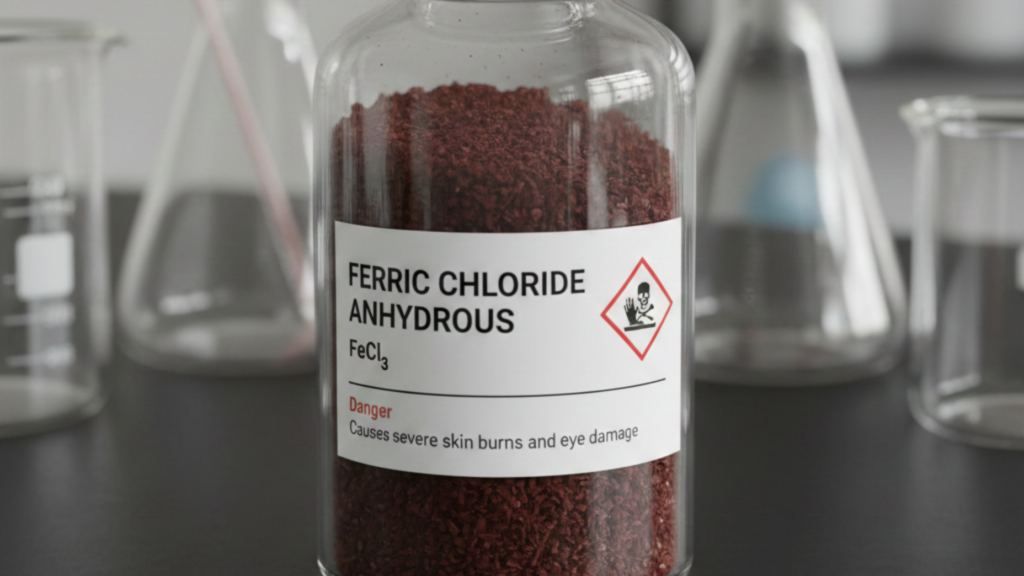
- Chemical Formula: FeCl₃
- CAS No.: 7705-08-0
- Appearance: Dark brown / black crystalline solid
- Odor: Slight acidic smell
- Solubility: Highly soluble in water
Ferric Chloride (FeCl₃) is a widely used industrial chemical mainly applied in water treatment, PCB etching, pigment production, and wastewater management.
It is available in two major forms: Anhydrous (solid) and Liquid (solution form).
Key Features:
- Strong coagulating agent
- Moisture sensitive (absorbs water quickly)
- Highly reactive with water
Applications:
- Manufacturing of liquid ferric chloride solution
- Chemical intermediate
- Catalyst in organic synthesis
- PCB etching industry
- Pigment production
Ferric Chloride Liquid (Solution)
Basic Details:
- Available Concentration: 30%-42% (commonly 40%)
- Appearance: Dark reddish-brown liquid
- pH: Strongly acidic
- Water Soluble: Completely miscible
Major Uses:
- Municipal water treatment plants
- Industrial wastewater treatment
- Effluent treatment plants (ETP)
- Sewage treatment plants (STP)
- Sludge dewatering
- Phosphate removal
Ferric chloride works as a coagulant that removes suspended solids, heavy metals, phosphorus, and impurities from water.
How It Works in Water Treatment
When added to water:
- It reacts with water to form iron hydroxide flocs
- These flocs trap dirt, oil, metals, and particles
- The impurities settle down and are removed
This makes it one of the most effective solutions used by water treatment chemicals suppliers and commercial water treatment companies.
Safety & Handling
- Corrosive chemical
- Use protective gloves & goggles
- Store in HDPE tanks (for liquid)
- Keep anhydrous form moisture-free
Why It Is Important for Water Treatment Industry
Ferric chloride is:
- Cost-effective
- Highly efficient for turbidity removal
- Suitable for large-scale municipal plants
- Better phosphorus removal compared to alum
